For an equilibrium at zero, the local stable manifold consists of nearby points whose forward trajectories remain nearby and tend to zero; the local unstable manifold is defined by backward trajectories with the analogous property. For a smooth system with , and no zero-real-part eigenvalues, the stable-manifold theorem gives manifolds tangent to the negative- and positive-real-part eigenspaces. Their dimensions are the corresponding eigenvalue counts. Real distinct eigenvalues alone are insufficient if one is zero; then a centre equilibrium direction requires additional analysis. In the saddle case each manifold is a curve, found by imposing invariance on a power-series graph through the relevant eigenvector.
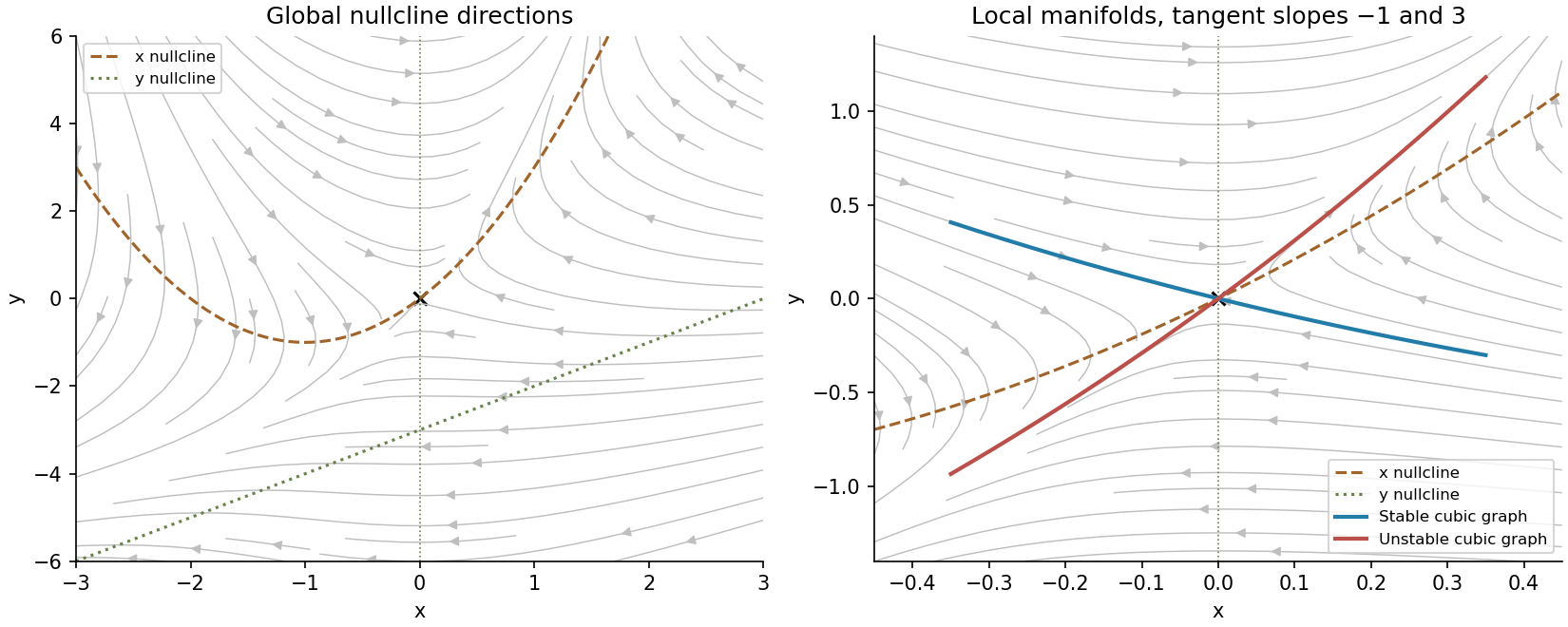
In this system, the nullcline is and the nullclines are and . Substituting the first into the second gives . Since the quadratic has discriminant , the origin is the only real equilibrium. Its Jacobian matrix has eigenvalues , with eigenvectors and . It is therefore a hyperbolic saddle.
Set for either manifold. Invariance requiresFor , matching the linear coefficient gives or . The quadratic and cubic coefficients respectively satisfyFor the stable slope , this yields , ; for the unstable slope , it gives , . ThusSubstituting back into gives the reduced dynamicsThe signs of the linear terms confirm attraction and repulsion along the respective curves.
In the phase portrait, is positive above its parabolic nullcline and negative below it; has sign . The stable branches approach the saddle and the unstable branches leave it in opposite directions. There can be no periodic orbit, since such an orbit would require total enclosed equilibrium index , while the only equilibrium has index . There is no homoclinic excursion either: eliminating gives , so a positive turning point is a strict local minimum and a negative one a strict local maximum. A loop returning to zero would require the opposite extremum somewhere. Hence bounded forward trajectories lie on the stable manifold and approach zero; other trajectories eventually leave compact regions, without a claimed universal rate or infinite-time existence at infinity. The figure shows the global nullclines and the local cubic manifold approximations; the latter are used only near zero.

Articles by others on the same topic
There are currently no matching articles.