A steady population is a root . To linearize one needs differentiable near that root, an extra local regularity assumption beyond the source's continuity. Setting gives , hence at linear order.
Thus gives linear asymptotic stability and gives instability. If , linearization is inconclusive. In a one-dimensional phase line, the more general nonlinear test is whether the vector field points towards the root from both sides. At the physical boundary , only the right-hand side matters. Continuity alone does not guarantee uniqueness of trajectories, so a standard well-defined flow also presumes a local uniqueness condition, such as local Lipschitz continuity.
The four nonnegative equilibria are . Since all factors are positive below , the sign of on consecutive intervals isThe phase line therefore points away from zero, towards , away from , and towards . Equivalently , and at each simple positive root , . Their signs alternate negative, positive, negative.
Hence extinction and are unstable, while and are asymptotically stable. Initial positive populations below tend to ; those above tend to ; an initial population exactly at remains there. This is bistability with a threshold separating the two basins.
Put . The harvested vector field is . Define the extinction threshold , and let be the positive local maximum of , with . Writing , givesPositive equilibria are intersections of with the horizontal line . A lower stable branch in exists exactly for . A pair in exists exactly for : its smaller member has and is unstable; its larger member has and is stable. At a positive root the linear eigenvalue is , which proves these claims. Extinction has eigenvalue , becoming stable for .
The harvested bistable population thresholds determine the behaviour. If , the upper stable population and its unstable separator first disappear in a saddle-node bifurcation. Populations then tend to the remaining lower stable state until that branch reaches extinction at ; beyond it extinction attracts every positive initial state. If , the lower stable branch reaches extinction first. For , extinction and the upper positive state are both stable, separated by the middle unstable root. Increasing effort through then destroys the remaining positive attractor, causing a sudden collapse to extinction. If , both events occur at the same effort at different populations.
At , near zero the leading term is , so extinction attracts from the physical right side algebraically, despite its zero linear eigenvalue. At , the double positive root is semistable: locally , attracting from above and repelling from below. These critical cases matter for exact initial data. The figure shows examples of both strict threshold orderings.
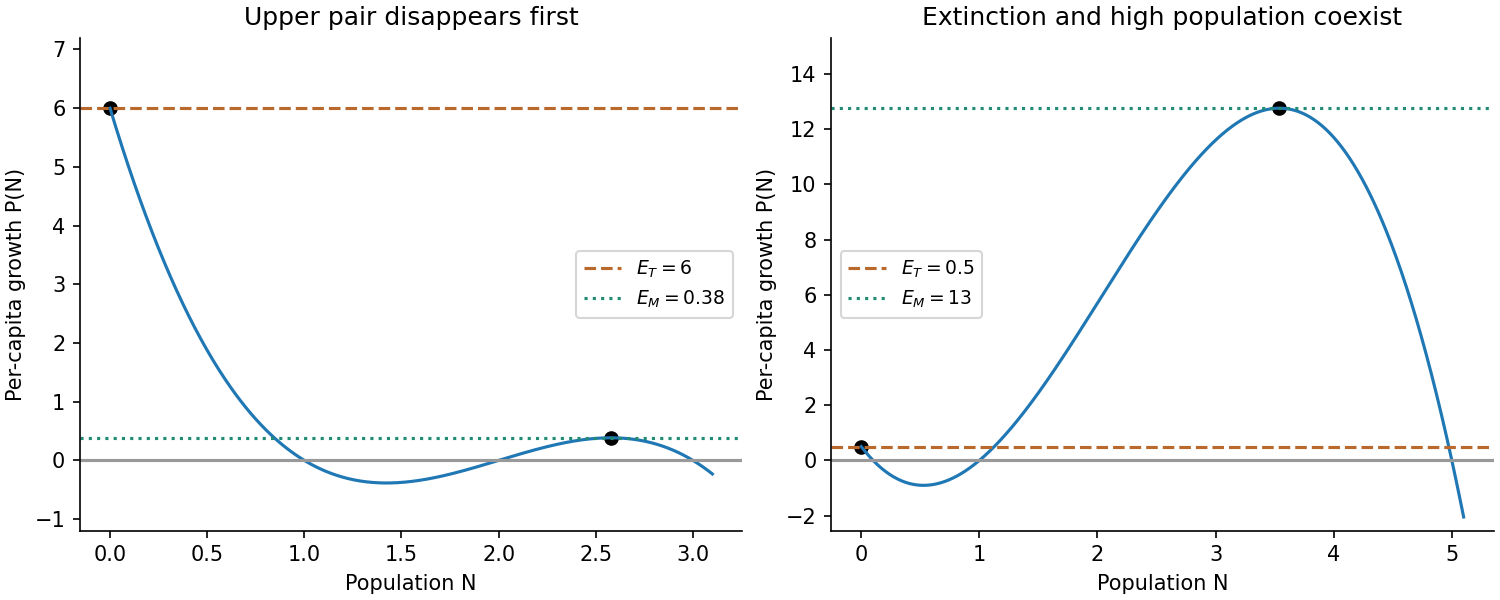
Two possible orderings of the extinction and saddle-node harvesting thresholds
. Details. 
Articles by others on the same topic
There are currently no matching articles.