Write . Its nonnegative fixed points are and, when ,Indeed a positive fixed point satisfies . The linear stability multiplier isAt a positive fixed point, , henceFor strict discriminant positivity, is attracting and repelling; the extinction state is superstable. At equality the positive point has multiplier one. Sinceit attracts from above and repels from below at equality. This is a semistable fixed point, whose one-sided behavior requires the nonlinear calculation.
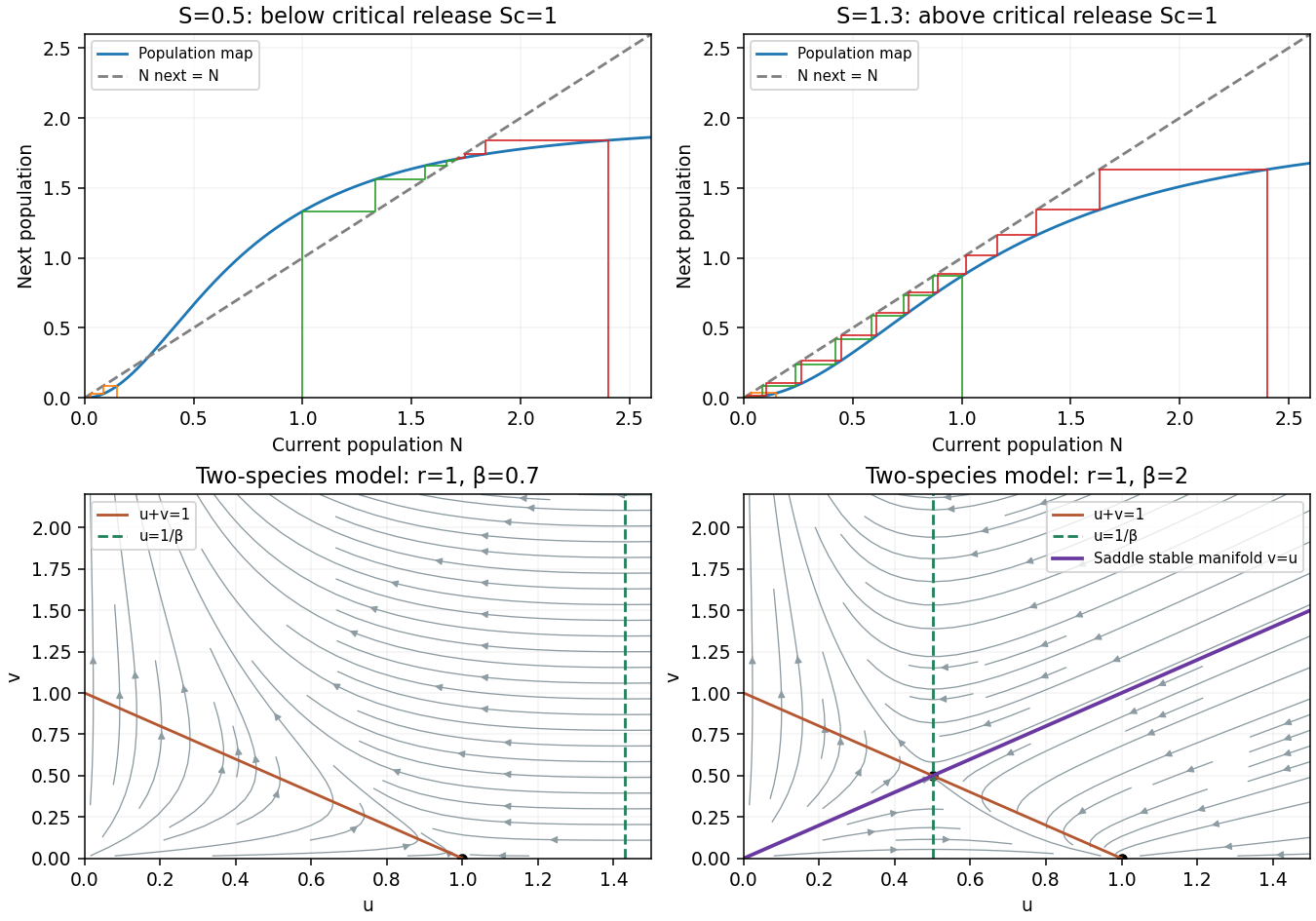
The two positive fixed points merge whenHere , , and increasing decreases , so this is a saddle-node bifurcation of the map. For , the cobweb descends to zero below , rises towards between the positive fixed points, and descends towards above it. Monotonicity of prevents a trajectory from overshooting across the attracting fixed point. Thus is an extinction threshold.
For , for every . The iterates decrease to a nonnegative fixed point, necessarily zero. At , initial states below tend to zero and those above tend to . The sterile-release population threshold therefore combines bistability below the critical release with extinction above it.

The term is unrestricted growth of species , and represents its density-dependent self-limitation, with scaled carrying capacity one. The interaction suppresses in the presence of species .
Species has intrinsic growth and suppression by . Thus both interspecific effects are harmful: this is a competition model, with no self-limitation term for . Its unbounded growth when disappears is a consequence of that modeling choice. The parameter is the growth-time ratio, while measures the effect of on .
The equilibrium points areThe third is biologically interior only for , and coincides with at . The Jacobian matrix isAt the eigenvalues are , so it is a repelling node. At they are , giving a stable node for and a saddle for .
At the interior equilibrium,so coexistence is a saddle. The formal equilibrium with negative for is not a population state; there its trace is negative and determinant positive.
At the boundary equilibrium is nonhyperbolic. To determine its behavior into the positive quadrant, put . A local center manifold has , so for small positive . Thus it is unstable to introduction of species , though attracting along the axis. The boundary/interior branches undergo a transcritical bifurcation at this parameter.
The positive quadrant is invariant. The non-axis nullclines are and . Below , increases; above it, decreases. To the left of , increases; to the right, it decreases.
For , the stable manifold of the interior saddle separates trajectories tending to from those for which and . Exactly on that manifold, the trajectory tends to the saddle. For the illustrated , the separating manifold is exactly , since the vector field preserves that diagonal.
For , every strictly positive initial state ultimately has and . Indeed implies , so eventually is bounded below by a positive constant. Then grows exponentially, forcing down. At , a positive eventually drives below one; thereafter increases. A finite positive limit for would force , inconsistent with , so the same exclusion outcome holds.
There are no interior periodic orbits: the Bendixson-Dulac criterion with multiplier givesThe phase portraits in the preceding figure show the threshold geometry and the absence of a bounded attracting coexistence state. Initial states on the axes retain the corresponding one-species dynamics.
Articles by others on the same topic
There are currently no matching articles.