Repeated use of the product rule and chain rule givesThe denominators are strictly positive on the whole real line, making the signs in the next parts easy to read.
The critical points of occur where , namely . Its sign on the four intervals separated by these points is, in order, positive, negative, positive, negative. Thus has local maxima at and a local minimum at zero. Their values areSince at both ends of the real line, these are also the global maximum and the global minimum . The sign analysis establishes extremality; merely solving would not.
The printed inequality has its sign reversed: for . This is present in the original scan, rather than arising in transcription. For , Taylor's theorem with Lagrange remainder givesPart (a) has , so the remainder is strictly negative. As an independent check, direct algebra gives the quadratic Taylor majorant of a reciprocal quadratic:For example, is already a counterexample to the requested direction. The exact identity also shows that this polynomial majorizes on the entire real line, with equality only at one.
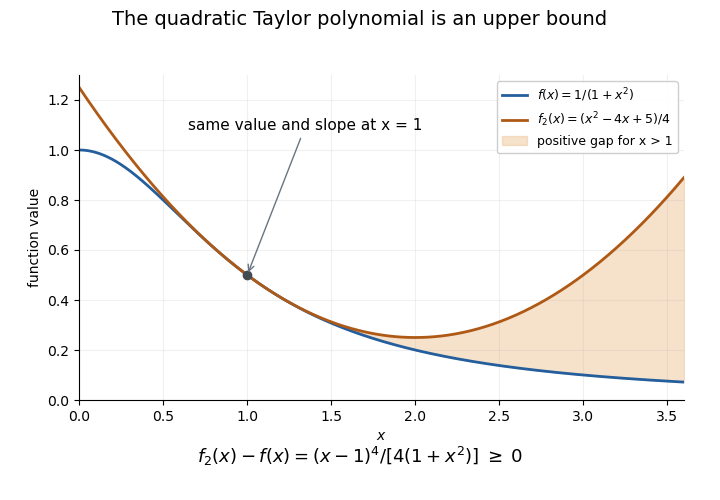
The quadratic Taylor polynomial lies above the reciprocal quadratic, correcting the printed inequality
. The shaded gap for is positive and equals . Details.
With unit strip width, the composite trapezoidal rule givesFor Simpson's rule, the even integer arguments are the odd-numbered interior grid positions. ThereforeThe requested two-decimal answers are and . The supplied component sums are individually rounded; they should not be treated as exact simultaneous identities. Computing from the original function gives approximately and , respectively, with the same two-decimal results.
For equal strips and a uniform bound on , the composite trapezoidal error bound isOn , part (b) gives : is positive and decreases from after . HenceTo certify error at most , choose ; equality gives exactly in this bound. This is a sufficient certificate, not a claim that every smaller fails in actual numerical error.
Strictly, the maximum specified over the open interval is not attained; its supremum is . Using the maximum on the closed interval, or simply the uniform bound , gives the valid error estimate above.
Articles by others on the same topic
There are currently no matching articles.