The fault dips are approximately . The mapped senses of fault slip are predominantly strike-slip faulting. In an Andersonian faulting regime, the intermediate principal stress is vertical and the maximum and minimum principal stresses are horizontal, so the preferred fault planes are vertical. Local bends can introduce oblique-slip faulting without changing this first-order interpretation.
Treat the two strands as newly formed conjugate faults obeying the same Mohr-Coulomb failure criterion, rather than merely inherited faults reactivated in a later stress field. A fault strike is an unoriented line, so is equivalent to . The acute angle between the fault strikes is therefore . The formal compressive acute bisector puts at azimuth and at . This orientation must also be checked against the mapped senses of strike-slip faulting, as discussed below.
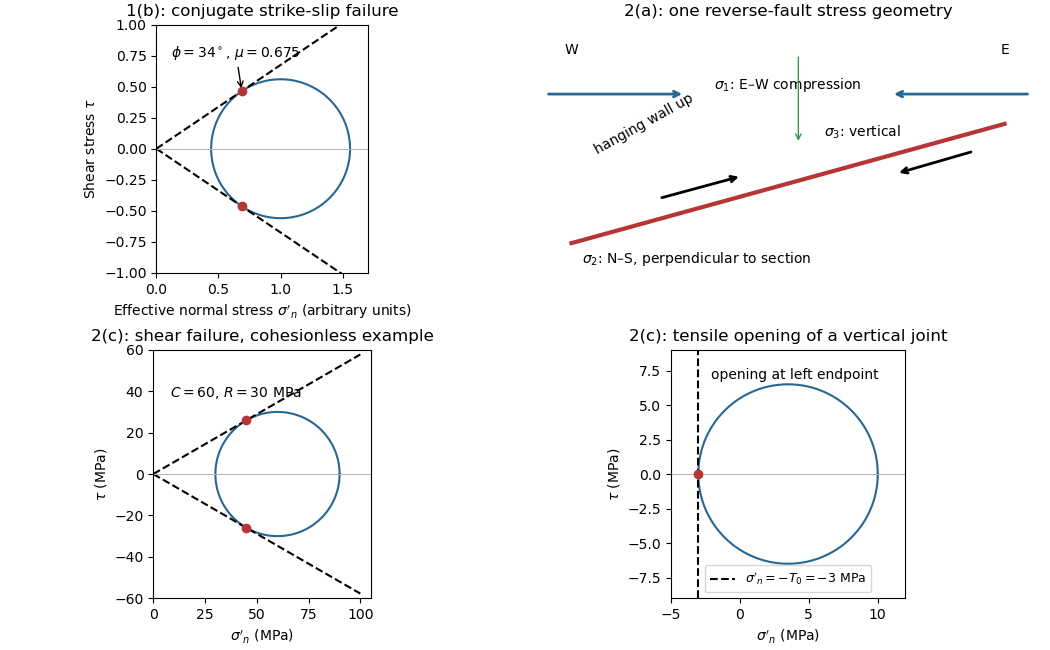
Let be the angle between either fault plane and . Tangency of Mohr's circle to , where is effective stress normal to the plane and is cohesion, gives and . ThusIn the Mohr circle, the fault planes are apart around the circle, because a physical plane rotation is doubled. The figure uses to display both tangencies; a common nonzero cohesion changes the intercept, not the inferred friction angle. The inference of requires optimally oriented conjugate faults at formation: the two fault strikes alone cannot measure a friction coefficient for arbitrarily reactivated faults.
Consistency limitation: the mapped westward motion of the Anatolian block corresponds to left-lateral strike-slip faulting on the East Anatolian strand and right-lateral strike-slip faulting on the North Anatolian strand. East–west maximum compression for the acute-bisector construction instead predicts the opposite pair. The stress orientation compatible with the mapped senses lies near the north–south, obtuse bisector; the planes are then about from , which would give in the optimal-formation formula. A negative friction angle is inadmissible for ordinary frictional strength. Thus is the formal magnitude inferred from unoriented angles, while the full map does not support a self-consistent positive-friction, optimally formed conjugate pair. The common-stress assumption can still describe inherited or anisotropically controlled faults, but then their orientations no longer determine a unique coefficient.

For a heterogeneous fault slip distribution, seismic moment iswhere is the shear modulus, the fault plane area, and the area-averaged fault slip. The peak colour cannot be used as : most of the illustrated fault plane has much smaller fault slip.
One reproducible graphical estimate divides the approximately long and down-dip panel into seven strips and a final strip. Reading area averages from the colour scale, from southwest to northeast, gives roughly . This includes the pale, nearly unslipped lower part of each strip. Henceand . A reasonable graphical range is approximately –, dominated by colour averaging and the down-dip extent of small fault slip. The corresponding moment magnitude is about , using . This is an estimate from the supplied distribution, rather than a substitution of a catalogued earthquake magnitude.
Effective stress and frictional strength generally increase with depth through the shallow crust undergoing brittle fracture. At , small overburden and often weak, fractured near-surface materials limit the shear stress and elastic energy that can accumulate. Some shallow materials also undergo stable sliding rather than unstable earthquake nucleation. Near , a locked fault prone to brittle fracture can sustain a much larger differential stress before frictional instability releases stored elastic energy.
This depth is plausibly near the lower, strong part of the seismogenic layer: below it, increasing temperature eventually promotes material creep across the brittle-ductile transition. Once nucleated at depth, a dynamic finite-source rupture can propagate into shallow regions that could not independently nucleate the same event. Depth alone does not determine the nucleation point: local pore pressure, frictional stability and stress heterogeneity also matter.
The star is near the southwestern end of the main fault slip patch, so a much longer part of the finite-source rupture propagates northeastward. For comparable distances, ground conditions and buildings, the northeastern site receives the stronger, shorter direct pulse; the southwestern site receives the weaker, longer direct shaking. This is rupture directivity.[ref]
What is Directivity by United States Geological Survey. Explanation of focusing by successive rupture elements
For a segment of length , rupture velocity and seismic wave speed , successive arrival times span approximatelyForward arrivals overlap and concentrate energy into a shorter pulse. Backward arrivals spread out. The supplied finite-source rupture is not perfectly unilateral, so the prediction concerns the dominant contribution. Seismic radiation patterns, seismic attenuation, sediment amplification and building response can alter the ranking of actual damage or total coda duration.
Articles by others on the same topic
There are currently no matching articles.