A phase-conjugate mirror is an optical device that implements phase conjugation at its return surface. It may generate the return using an independently supplied beam, as in digital optical phase conjugation; its name specifies the field transformation, rather than a particular reflecting material. Conjugating the transverse complex amplitude and launching the returning longitudinal carrier produces the complete reversed wavevector. A spatially constant leaves the shape of the wavefront unchanged; a spatially varying would add its own wavefront error.
An ordinary flat mirror obeys the law of reflection. At a surface , its reflected plane wave has wavevector , whereas a phase-conjugate mirror returns . Ordinary specular reflection preserves the tangential wavevector. At normal incidence a single plane wave can therefore look identical in the two cases, apart from an overall wave phase and strength; oblique incidence or a curved wavefront reveals the distinction. In boundary-envelope notation an ideal ordinary mirror multiplies the incident complex amplitude by a constant reflection factor , while an ideal phase-conjugate mirror returns its complex conjugate times .
Consider an optical point source at , a uniform transparent medium, and a flat return surface . A light ray with slope reaches . A phase-conjugate mirror reverses its full direction and returns it to . An ordinary mirror reverses only its normal direction; its returning light ray reaches at . Thus rays with at return to with ordinary specular reflection, but all return to under ideal phase conjugation. These are stipulated geometric coordinates, not laboratory measurements.
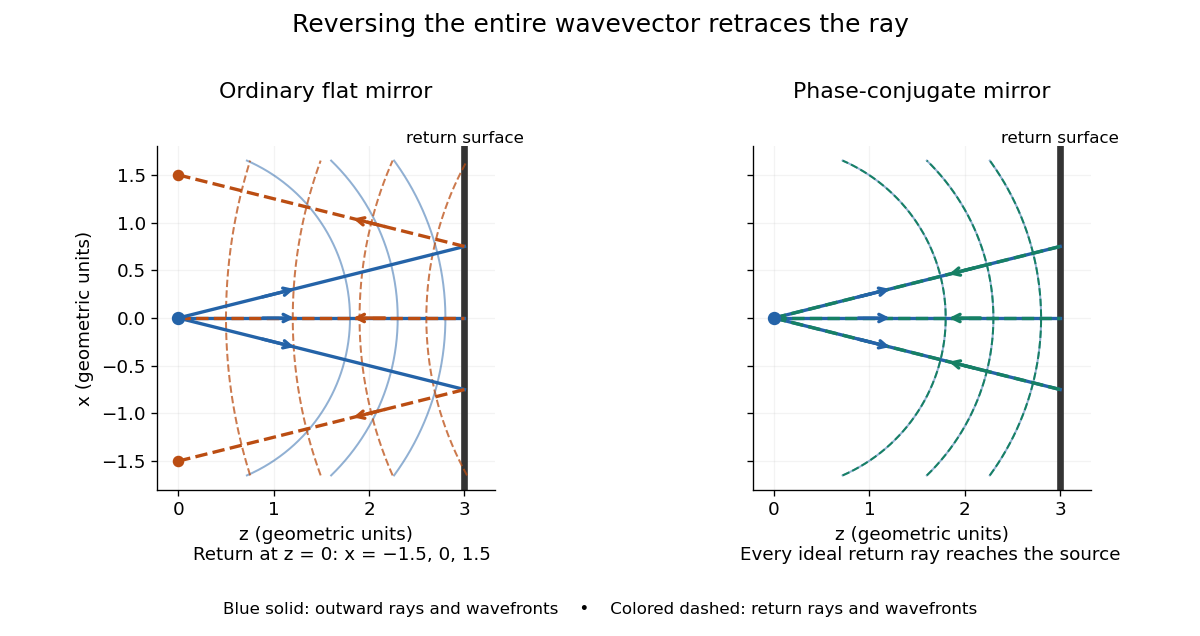

Solid blue curves mark outward wavefronts; dashed curves mark returning wavefronts. In the phase-conjugate mirror panel the returning curves coincide with the outward ones, and the arrows reverse on the same light rays. The diagram uses equal spatial scales. In geometrical optics, reversing each light ray in an unchanged medium with wave reciprocity retraces its route. At the optical point source itself, the ray construction becomes singular and diffraction sets the physical focal size.
A wave-level proof outline applies to a stationary scalar medium with real refractive index and no wave absorption. Writing for the vacuum speed of light, its Helmholtz equation isAll coefficients are real, so complex conjugation gives the same Helmholtz equation for . The conjugated outgoing boundary data select the incoming solution. This explains the connection between phase conjugation and retracing, provided the required incoming field is supplied over the necessary aperture. It also exposes the limits: wave reciprocity alone does not imply absence of wave absorption; conjugation of complex material coefficients would describe a different medium. Loss, an incomplete aperture, a changing medium or failure of wave reciprocity can prevent exact reconstruction. Intensity-dependent material changes need a separate analysis and are not covered by this linear proof.
Articles by others on the same topic
There are currently no matching articles.