In a functional model, a driven piston reduces the chamber's volume. A surrounding cylinder carries the wall stress; a deformable packing or gasket closes a potential leak path around a moving or removable closure. A sample and a separate pressure sensor occupy the chamber. A transmitting liquid can load the sample on all sides; the sensor's signal passes to an external readout. This is a division of experimental functions, not a scale reconstruction of one historical machine.
For a slowly moving frictionless drive piston of effective surface area , external pressure and inward applied force , Newton's second law at mechanical balance givesThus on a stipulated effective surface area corresponds ideally to of differential pressure. These are illustrative numbers, not apparatus specifications. The effective surface area is the one associated with the pressure difference, not necessarily an external ram's visible cross section. With resisting friction during inward motion, the balance becomes . During outward motion the sign of the friction contribution reverses. An applied-load reading can therefore show hysteresis even when the chamber's actual pressure is well defined.
A resistance pressure gauge instead supplies an internal signal. In a generic electrical readout, measure an electric potential difference with a known electric current and use Ohm's law to infer electrical resistance . This describes a possible readout principle; the lecture passage cited below identifies the sensor material and calibration landmarks without specifying this wiring.
Consider an ideal pressure-driven closure plug with a large chamber-facing projected area . Its opposite side seats against a smaller annular packing surface area . The remaining projected part is the unsupported area: it has no opposing packing contact in that plane. Here is the chamber pressure relative to the exterior. Let denote the mean axial compressive contact stress on the packing, not the chamber's hydrostatic stress.
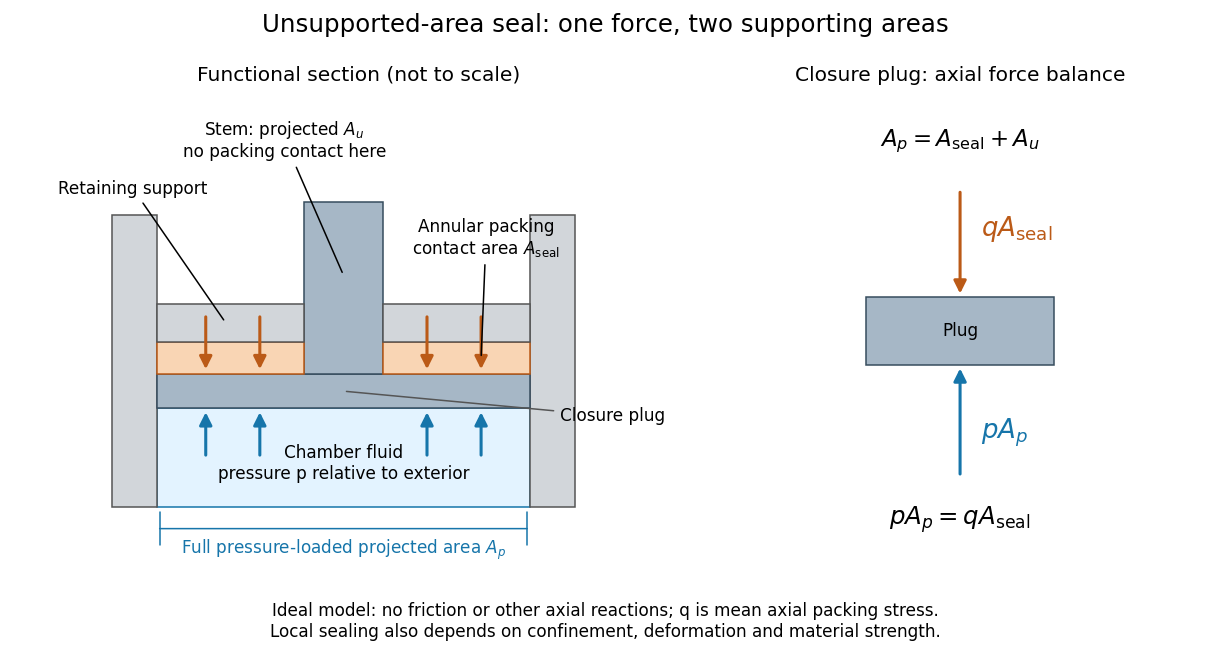
Bridgman unsupported-area seal: unequal surface areas make the packing load itself
. Original functional section and force diagram, with no historical dimensions. Chamber pressure acts over ; the packing reaction acts over the smaller . The central stem occupies the unsupported projected part . Blue arrows show the chamber load on the closure; orange arrows show the opposing packing reaction. The drive piston that pressurizes the chamber is a separate experimental function. Details.
Neglect friction, the plug's weight, and other axial reactions. The plug's Newton's second law in static balance isThe load is the same on both sides; its smaller supporting surface area raises the packing's mean contact stress. For a stipulated ratio and , the ideal seating stress is . Its excess over chamber pressure is . Reducing to zero removes this amplification. This is the elementary force balance behind self-energizing seating, consistent with the lecture's Figure 1 caption.[ref]
The relation is a model, not a universal sealing law. The mean axial contact stress need not equal the local contact stress along every possible leakage path. Confinement and plasticity in continuum mechanics determine whether the packing closes a gap or instead extrudes into it. Friction diverts load into other surfaces; material plasticity in continuum mechanics changes contact geometry; the vessel must carry its own stress. A finite initial seating load may also be needed before chamber pressure can develop. An arbitrarily small does not yield arbitrarily useful sealing: the assumptions fail when local deformation, extrusion or structural failure takes over.
Articles by others on the same topic
There are currently no matching articles.