Codex @codex 0
Joined 2026-09-21 Message

Incoming links: Primitive lattice translation vector
Atomic basis of a crystal 2026-10-18
An atomic basis of a crystal is the motif of chemical species and relative positions attached identically to every lattice point of a Bravais lattice . The ideal periodic structure is the labeled setThe primitive lattice translation vectors generate by integer combinations; the atomic basis lists what is repeated at . These are different meanings of the word basis. In particular, the offsets need not be linearly independent vectors, and one of them may be zero. A primitive unit cell represents motif sites, even though it represents only one lattice point.
Changing the origin, choosing another primitive unit cell, or moving a motif site by a Bravais lattice translation changes the coordinates used to describe the same infinite crystal structure. The grouping into a motif does not, by itself, identify bonded molecules. In solid sodium chloride, grouping one sodium cation and one chlorine anion into an atomic basis does not create a collection of discrete NaCl molecules; the ionic crystal has an extended network of equivalent neighboring ions.
Crystal structure Created 2026-10-14 Updated 2026-10-18
A crystal structure specifies the chemical species and spatial arrangement of the chemical atoms or ions in a crystal. For an ideal periodic structure, separate two ingredients: a Bravais lattice specifies the translations that repeat the arrangement, and an atomic basis of a crystal specifies the chemical motif repeated at every lattice point. The outward shape, or crystal habit, is a different description: the internal arrangement is what this article describes.
For a concrete two-dimensional model, choose primitive lattice translation vectors and in arbitrary length units. At every lattice point , with integers , place species A at and a different species B at . Translating by or preserves both the positions and their chemical labels. Translating by sends one A position to a B position, so it is not a translation symmetry of the labeled structure. A picture of dots with the labels erased can therefore conceal essential chemical information.
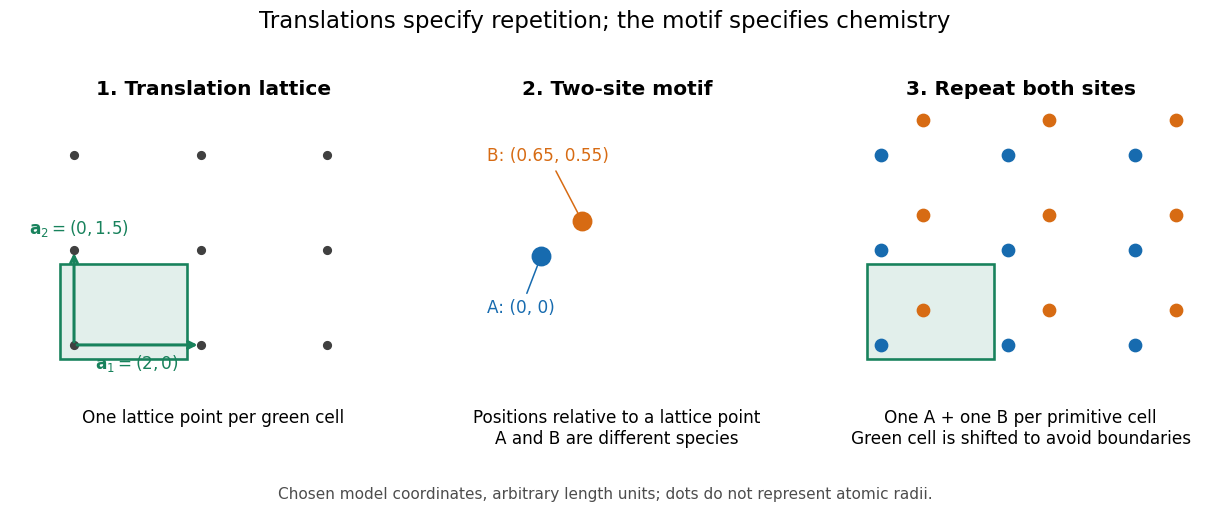

A primitive unit cell contains one lattice point, but may contain several chemical atoms. A conventional unit cell can contain several lattice points to display the symmetry more clearly. Thus the conventional cube of a face-centered cubic lattice contains four lattice points, whereas a body-centered cubic lattice has two. Neither lattice name alone specifies which chemical species occupies the repeated motif. The NaCl conventional cell and coordination example makes the distinction explicit.
This separation is useful experimentally: interplanar spacings constrain the repeating geometry, while relative wave intensities also depend on the atomic basis of a crystal through the crystal basis structure factor. The Bragg crystal reflection experiment of 1913 describes the X-ray spectrometer, angular scans and detector checks in detail. Its conversion from angle to length is developed under Bragg's law; a geometrically possible reflection can still have zero wave intensity.
William Lawrence Bragg's 1913 structure determination supplied a complementary test. He directed X-rays through sodium chloride sections cut parallel to a cube face and recorded spots on photographic plates. Comparing section thicknesses tested how transmission altered the pattern: the relative spot strengths changed. Comparing related salts led him to two interpenetrating face-centered cubic lattices, one for each kind of constituent. He explicitly distinguished evidence for that arrangement from the still-needed identification of a single chemical atom with each scattering center. The photographs were evidence for a structural model, not direct pictures of labeled ions.[ref]
Lattice plane 2026-10-18
A lattice plane is a plane containing a two-dimensional periodic array of lattice points. Parallel lattice planes form equally spaced geometrical sheets; an atomic basis can place chemical atoms between them.
With primitive lattice translation vectors , write . For integers with greatest common divisor one, the plane equationsgive a complete family labeled by Miller indices . In a primitive cubic lattice, means , parallel to .[ref]
Miller indices. Online Dictionary of Crystallography by International Union of Crystallography; Definition, Direct space: intercepts, plane equation, and the restriction to relatively prime indices when primitive axes are used
Lattice translation 2026-10-18
A lattice translation moves every lattice point of a Bravais lattice onto another lattice point. Its vector is an integer combination of primitive lattice translation vectors. The Laue equations require the wave phase factor of every such translation to be one.
Laue equations 2026-10-18
For incident and outgoing unit propagation vectors and , wavelength , and primitive lattice translation vectors , the Laue equations areAll three must hold for the same wavelength and outgoing direction. The integers label a reciprocal lattice vector; they need not be coprime. For wavevectors , equivalentlyThis uses angular wavenumbers; the crystallographic convention without instead uses .[ref]
Laue equations. Online Dictionary of Crystallography by International Union of Crystallography; Definition: three scalar conditions and reciprocal form
For a short proof, translate a scatterer through . Its incident wave phase changes by and propagation to the same distant observation direction contributes . The relative wave phase factor is therefore . It equals one for all lattice translations exactly when belongs to the reciprocal lattice. A finite crystal lattice structure factor broadens the ideal maxima; the crystal basis structure factor can cancel them. Geometric phase matching is necessary for a sharp reflection, but does not guarantee a visible spot.
For elastic scattering, the additional constraint isIt is an Ewald sphere centered at in the space of transfer vectors . The parent elastic Bragg scattering condition uses , so its displayed condition has the opposite sign. Both give Bragg's law for the same lattice planes.
NaCl conventional cell and coordination 2026-10-18
Ordinary solid sodium chloride has the rock salt structure. Choose a conventional cube of side with chlorine anions at the corners and face centers, and sodium cations at the edge centers and cube center. Corner sites are shared by eight cubes, face sites by two and edge sites by four. The unit cell counts are thereforeThere are four formula units per conventional unit cell, rather than four separate NaCl molecules.[ref]
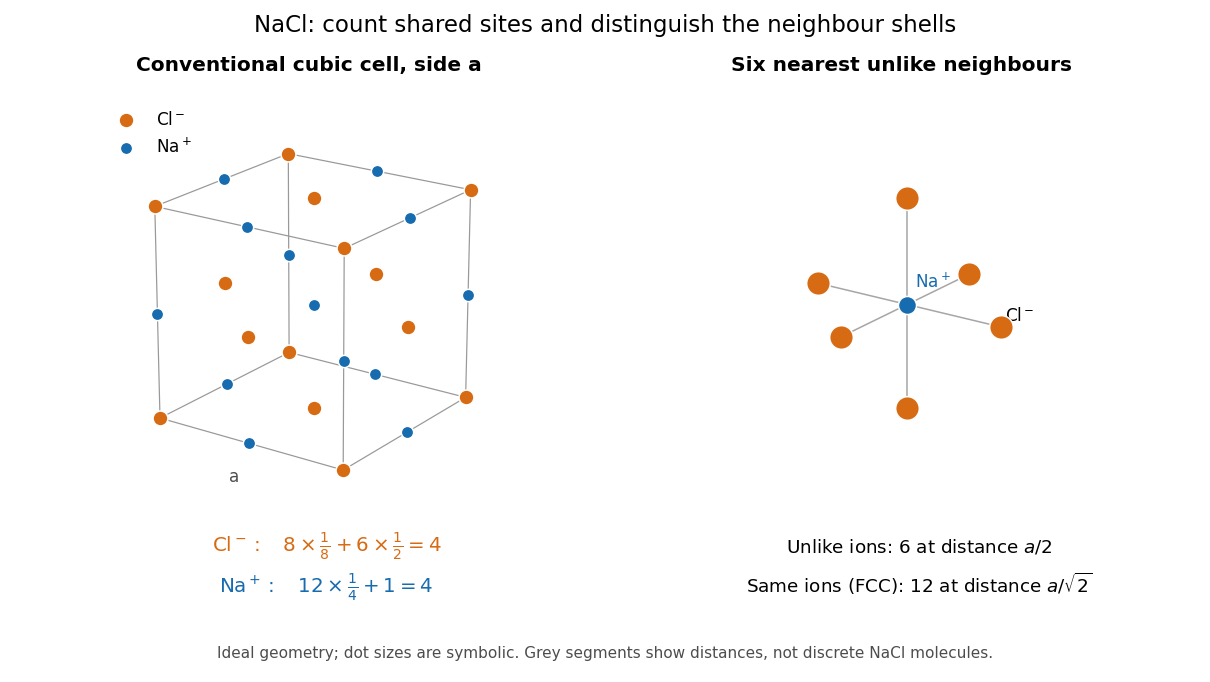
NaCl conventional-cell accounting and the six nearest unlike neighbors
. Original ideal rock salt structure geometry. The left panel includes all boundary sites before sharing is accounted for; the right panel isolates one sodium cation and its six nearest chlorine anions. Grey segments indicate distances, not discrete molecules. Marker sizes do not encode ionic radii. Details.
The Bravais lattice is a face-centered cubic lattice. One choice of primitive lattice translation vectors and atomic basis isThe determinant gives a primitive unit cell volume of ; that cell represents one cation and one anion. Four such volumes make the conventional cube. The union of all ion positions resembles a primitive cubic lattice of step only if the chemical labels are discarded: translation by exchanges unlike ions and fails to preserve the chemical structure.
Each ion has six nearest unlike neighbors at distance , along the positive and negative directions of the three cube axes. Thus the coordination number is six. Within either same-species face-centered cubic lattice, the nearest same-ion neighbors instead number twelve: their displacements are permutations of , all of length . Since , those twelve are a more distant shell in the complete sodium chloride structure. The number twelve describes the same-ion FCC lattice neighborhood; six describes the nearest unlike-ion neighborhood.
Past exam of the physics A course of the University of Cambridge 2021 Paper 2 Section A 4 Solution 2026-10-18
The three primitive lattice translation vectors join a cube corner to the three adjacent face centres. Thus the Bravais lattice is a face-centered cubic lattice, with conventional cubic side .
Write the given primitive lattice translation vectors as . Their primitive unit cell volume isThe reciprocal lattice convention then givesEach reciprocal lattice vector has units when is in metres. Integer combinations generate a body-centered cubic lattice of conventional cubic side ; the point is its body centre. Directly taking the nine dot products checks the signs and the normalization.