A Pt100 has nominal electrical resistance at .[ref]
Mercury Thermometer Alternatives: Platinum Resistance Thermometers (PRTs) by National Institute of Standards and Technology. Platinum Resistance Thermometers, opening explanation: conventional 100-ohm element at 0 °C
Here is the reference for the nominal element designation; it is distinct from the water triple point used in SPRT calibration. The following Pt100 local linear model deliberately stipulates one approximate response for calculations.Choose the illustrative local modelHere is the Celsius temperature, measured relative to , so is dimensionless. For this chosen affine function, the derivative and inverse relation areCalculated values are , , , and . These are model outputs, not measurements or an assertion that any real Pt100 follows this line exactly. The number here is the chosen slope parameter; it is not a universal local derivative for all platinum resistance thermometers. Curvature, manufacturing differences, and the fitted calibration interval matter. A wider-range calibration uses a validated response curve rather than extrapolating this line indefinitely.
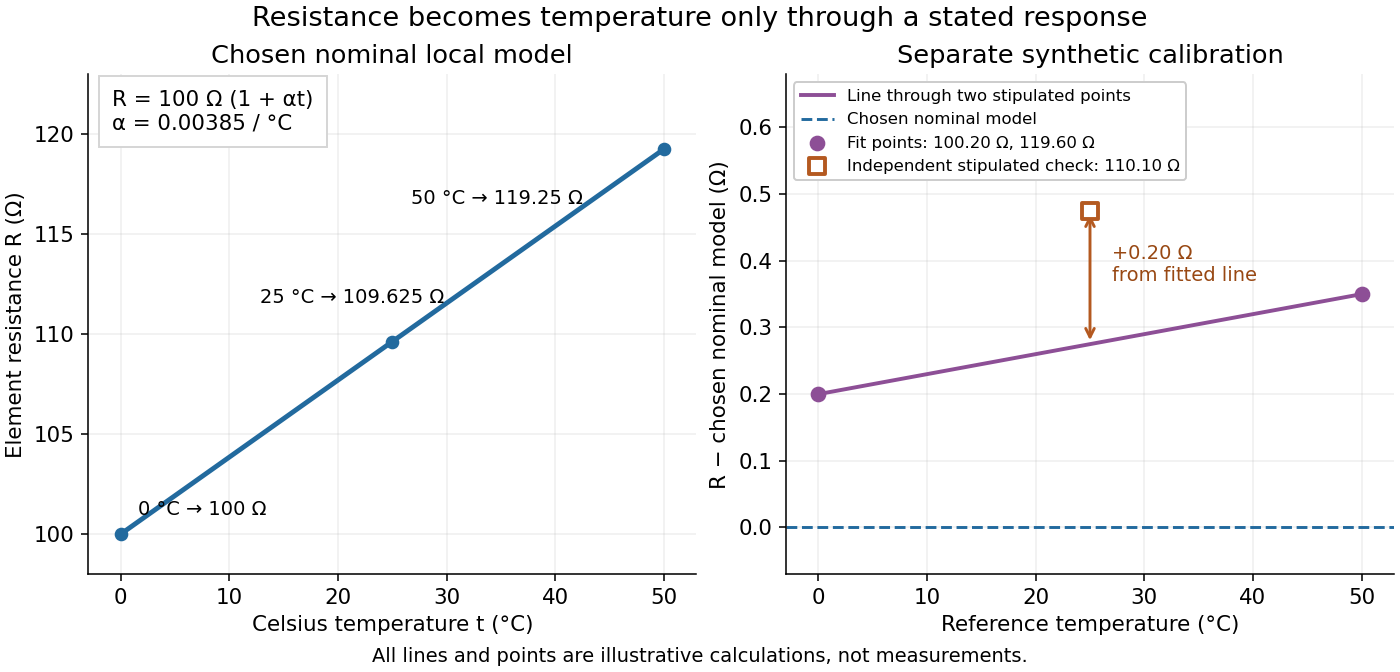
Chosen Pt100 line and an illustrative calibration with an independent check
. The left panel plots the Pt100 local linear model. The right panel uses stipulated values for a different illustrative element: two points set a line, while a third point tests it. Every point is synthetic; none is measured calibration data or a tolerance band. Source. Details.
For a separate synthetic thermometer calibration, stipulate at and at . A two-point affine function has slope and givesThus would indicate . If an additional synthetic check at reference instead supplied , the line would indicate . The residual exposes disagreement that two fitted points cannot reveal. This separate example changes both offset and slope; it is not a replacement specification for the nominal Pt100 local linear model.
Articles by others on the same topic
There are currently no matching articles.