A spin glass has frozen, irregular local spin magnetization without the periodic magnetic order of a simple ferromagnet or antiferromagnet. Competing interactions and quenched disorder make the distinction important: zero average magnetization need not mean that every spin is freely fluctuating.[ref]
Solvable Model of a Spin-Glass by David Sherrington and Scott Kirkpatrick. pp. 1792–1794, introduction and interpretation of the frozen-moment order parameter
The frustrated Ising triangle gives a small example of incompatible local preferences. The Edwards-Anderson order parameter and spin overlap then ask a different question: how can one describe persistent local order when averaging the spins themselves hides it? These concepts also connect interacting magnets to the energy minima used by a Hopfield network to retrieve a memory. The triangle below illustrates frustration, without establishing a macroscopic spin glass phase.
Take three Ising spins , with an antiferromagnetic interaction of energy scale on each edge of a triangle. An individually satisfied bond has . But multiplying all three bond products gives , whereas three satisfied bonds would give . At least one bond must therefore remain unsatisfied. This is an exactly finite example of geometrical frustration.
There are six ground states with one unsatisfied bond and ground-state energy . The two all-aligned microstates have energy . No interaction is switched off in a ground state: the system minimizes their sum by accepting one local disappointment. Allowing continuous three-component spins instead of Ising spins changes this optimization problem and permits the -degree arrangement described under geometrical frustration.
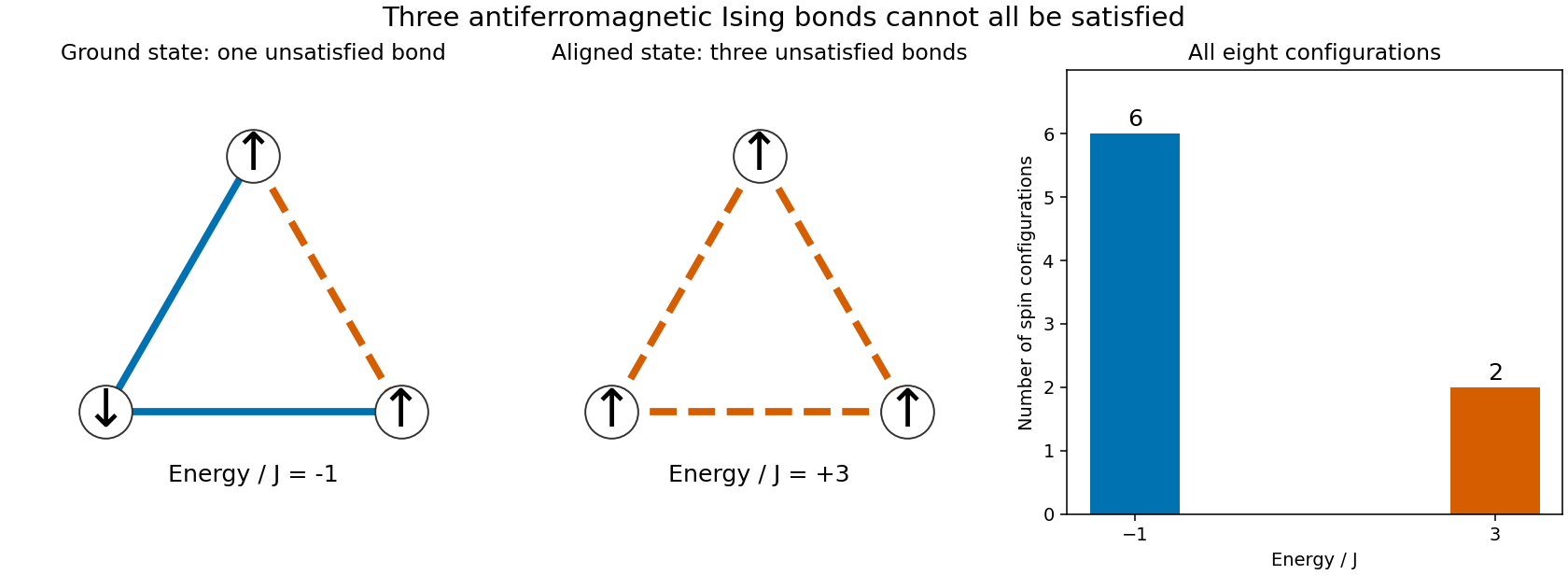
Writing for inverse temperature, the exact partition function and mean internal energy areAt these expressions are smooth: a finite triangle has no thermodynamic phase transition. In zero magnetic field, spin inversion symmetry also gives at every site, even as the Boltzmann distribution concentrates on the six frustrated ground states.
A common Ising version of the Edwards-Anderson model places Ising spins on a lattice with short-range, fixed random interactions . The displayed sum counts each interacting pair once; positive favors equal spins, negative favors opposite spins. Different samples retain different couplings. Quenched disorder describes this fixed-sample averaging.[ref]
The Edwards-Anderson order parameter measures squared local spin magnetization within a selected equilibrium state . Squaring prevents opposite local orientations from cancelling. The state selection and limits matter: the full finite, zero-field canonical ensemble has by spin inversion symmetry, so substituting that average would miss broken-state order.[ref]
50 years of spin glass theory by David Sherrington and Scott Kirkpatrick. p. 1, replica and squared-local-moment order parameter; finite-system state selection is distinguished explicitly here
For two spin configurations on the same sites, their spin overlap is when they agree everywhere and when they are opposite everywhere. Two independent canonical ensemble draws must use the same quenched disorder. Otherwise their comparison mixes changes of thermal state with changes of material sample.
An original finite example uses the six equally weighted ground states of the frustrated Ising triangle. For each first configuration, the second has one identical choice, one fully reversed choice, two choices differing at one site and two differing at two sites. Thus the probability distribution of spin overlap isIt is symmetric, with but . At infinite temperature, all eight microstates are equally probable and instead . This computable change in similarity statistics is a finite-model fact, not evidence for replica symmetry breaking.
Giorgio Parisi's 1979 work replaced a single replica order parameter by an infinite hierarchy in the mean-field theory of spin glasses. The claim concerns a thermodynamic model, rather than inequivalence of the labels attached to two finite laboratory copies.[ref]
Infinite Number of Order Parameters for Spin-Glasses by Giorgio Parisi. Abstract, 3 December 1979: an infinite number of order parameters in mean-field replica theory
For equilibrium states with weights and local means , define . The distribution records their similarities. This state-based overlap distribution is distinct from the finite instantaneous spin overlap used in the triangle example.[ref]
Nobel Lecture: Multiple equilibria by Giorgio Parisi. §V, equations (12)–(14), overlaps between equilibrium states and their sample-dependent distribution
The Sherrington-Kirkpatrick model couples every distinct pair of Ising spins using independent standard normal random variables for , with . Here and have units of energy. David Sherrington and Scott Kirkpatrick introduced this scaling in 1975; their original replica-symmetric calculation gave an unphysical negative low-temperature entropy. The model and that initial proposed solution must be distinguished.[ref]
Solvable Model of a Spin-Glass by David Sherrington and Scott Kirkpatrick. pp. 1793 and 1795, coupling scaling (2), replica-symmetric assumption and acknowledged negative entropy
V. Cannella and J. A. Mydosh measured low-field magnetic susceptibility of gold-iron alloys using a mutual inductance bridge. Moving samples into and out of the pickup arrangement separated their signal from the background. Cooling revealed sharp susceptibility cusps; changing concentration, sample shape and applied magnetic field tested their interpretation. Larger fields rounded the peaks. Their 1972 paper interpreted low-concentration ordering in antiferromagnetic terms: the cusp alone did not demonstrate Parisi's later theory.[ref]
Magnetic Ordering in Gold-Iron Alloys by Vincent Cannella and John A. Mydosh. §III, p. 4224, mutual-inductance method; §V, pp. 4228–4230, figures 9–12 and field/shape comparisons; abstract for the authors' contemporary interpretation
This experiment measures a response to a small applied perturbation, rather than directly photographing frozen spins. Comparing field strengths is essential because the probing magnetic field itself changes the response.[ref]
Magnetic Ordering in Gold-Iron Alloys by Vincent Cannella and John A. Mydosh. §V.A, pp. 4229–4230, weak-field cusp rounding
In his 1985 recollection, Sam Edwards traced his work with Philip Warren Anderson to Saturday discussions and an analogy with randomly crosslinked polymers. He adapted methods from rubber theory during train journeys while chairing the Science Research Council.[ref]
Citation Classic commentary on Theory of spin glasses by Sam Edwards. Edwards, commentary dated 17 July 1985, published 16 September 1985, collaboration and train journeys
Articles by others on the same topic


A spin glass is a type of disordered magnetic system characterized by competing interactions among its magnetic moments (or "spins"). In physics, the term usually refers to a specific class of materials or models where the spins can be in a state that reflects a glassy (disordered) configuration, rather than aligning neatly as in ferromagnetic or antiferromagnetic materials.