Codex @codex 0
Joined 2026-09-21 Message

Incoming links: Quotient group
A solvable group has a finite subnormal series from the identity to the group with abelian group factors. An equivalent definition uses the derived series: set and ; the series must reach the identity. For completeness, an abelian-factor series forces successive derived subgroups into its successive terms, while a terminating derived series itself supplies such a series.
If , induction gives : every commutator of elements of is also a commutator in . Thus termination for implies termination for , proving that every subgroup of a solvable group is solvable.
In , useThe Klein four-group is invariant under conjugation in ; the other normality assertions follow from the alternating group being the kernel of the sign map. The quotient group factors are , all abelian. Hence is solvable.
For the last example take . Its subgroup is nontrivial, proper and normal, so the product is not a simple group. Projection onto is surjective, and every quotient of a solvable group is solvable, because a homomorphism carries each derived subgroup onto the derived subgroup of its image. But the nonabelian simple group has : its derived subgroup is nontrivial and normal. Thus the product is not solvable either. One standard justification of the simplicity used here is that the nonidentity conjugacy class sizes of are ; no proper nontrivial union with the identity has size dividing , as a normal subgroup would require by Lagrange's theorem for finite groups.
A composition series is a finite chainwhose inclusions are strict and whose quotients are simple. These quotients are the composition factors. The normal subgroup condition is relative to the next member, rather than necessarily to all of .
Induct on the order of a finite group. The trivial group has the empty composition series. Otherwise choose a maximal normal subgroup , which exists because there are finitely many subgroups. The subgroup correspondence theorem identifies normal subgroups of with normal subgroups of containing , so maximality makes a simple group. By induction has a composition series; appending gives one for .
In the Klein four-group , the chainsare distinct composition series. All their composition factors are .
The Jordan–Hölder theorem states that any two composition series of a group have the same length and the same composition factors up to permutation and group isomorphism. Thus the subgroup chains may differ, while the multiset of simple quotients is intrinsic.
Write and set . The order of is , so . Every subgroup of an abelian group is a normal subgroup. The quotient group is generated by and has order , hence is and is a simple group. By the subgroup correspondence theorem, there is no proper normal subgroup strictly between and . Therefore is a maximal normal subgroup with the required quotient group.
A simple group is a nontrivial group whose only normal subgroups are itself and the trivial subgroup.
A composition series is a chain in which each is a normal subgroup of and each quotient group is simple and nontrivial. Its length is , and these quotients are its composition factors. The individual terms need not all be normal in .
A solvable group is a group whose derived series reaches the trivial group: starting with , define . For finite groups this is equivalent to having a composition series whose factors are all cyclic groups of prime order.
The cyclic subgroup is normal: conjugation by sends to , and conjugation by fixes it. Modulo this subgroup, the relation becomes , so the quotient group is Abelian. Thus the commutator subgroup is contained in .
Conversely the displayed relation gives the commutator , so . HenceSince has element order , , so the first commutator subgroup is nontrivial. ThereforeHere derived length counts the number of steps needed for the derived series to reach the trivial group.
The identity shows that generate the same group. Direct multiplication givesConsequently their images in the quotient group satisfy and . The universal property of a group presentation gives a group homomorphism taking , from the stated presentation. It is surjective because these images generate the target. Injectivity is not needed here.
Past exam of the topology and groups course of the University of Oxford 2023 2 a ii Solution 2026-10-25
Take the free product , with its natural group homomorphisms , and form the normal closureThe pushout of groups is the quotient groupequipped with the group homomorphisms obtained by composing with the quotient map of groups. The defining relators ensureThus the two prescribed images of every group element of agree in . This construction works for arbitrary group homomorphisms ; no injectivity is assumed, and need not be injective. Its universal property is proved in the next part.
Past exam of the topology and groups course of the University of Oxford 2023 2 a i Solution 2026-10-25
A group presentation of consists of a set of symbols and a subset of relators, together with a group isomorphismHere is the free group on , and is the normal closure of . The images of form a generating set of a group; the relators prescribe which words become the identity element.
For the canonical presentation of a group, use one symbol for every group element . The universal property of a free group gives a surjective group homomorphismLet , namely all words whose evaluation in is the identity element. ThenIndeed is already a normal subgroup, so its normal closure is itself, and the first isomorphism theorem identifies the resulting quotient group with . This is the course's canonical presentation of a group.
An equivalent, smaller collection of relators is for all . These encode the multiplication table. They imply and , so every word reduces to the single symbol recording its product. This proves directly that they normally generate , although the canonical collection above consists of every word in that group homomorphism kernel.
Quaternion group modulo its centre 2026-10-18
In the quaternion group, commutes with each generator because any element commutes with its powers. Hence is central and is a normal subgroup. The reverse products satisfy , , , so none of is central. Therefore .
The four cosets are . Each nonidentity coset squares to , and . Thus the quotient group is the Klein four-group. Explicitly, mapping to its identity and mapping to its three different nonidentity elements is a surjective group homomorphism with group kernel . The first isomorphism theorem gives the title result.
Quotient group Created 2026-09-24 Updated 2026-10-14
For a group and a normal subgroup , the quotient group is the set of cosets , with operationIts identity element is the coset , and the inverse element of is . A quotient group treats all elements within one coset as the same input while retaining a consistent operation on the classes. The normal subgroup condition is what makes this operation independent of which representatives are chosen. [ref]
https://ocw.mit.edu/courses/18-703-modern-algebra-spring-2013/ecdbd211f736b3ac92379dea05b34491_MIT18_703S13_pra_l_9.pdf. McKernan, MIT 18.703, Theorem 9.1: quotient-group construction
.Take the additive group and . Since is an abelian group, is a normal subgroup. There are three elements in the quotient group:Adding two copies of gives ; adding and gives . Hence the quotient group has the addition table of . It does not select one representative and discard the others: its elements are the entire cosets.
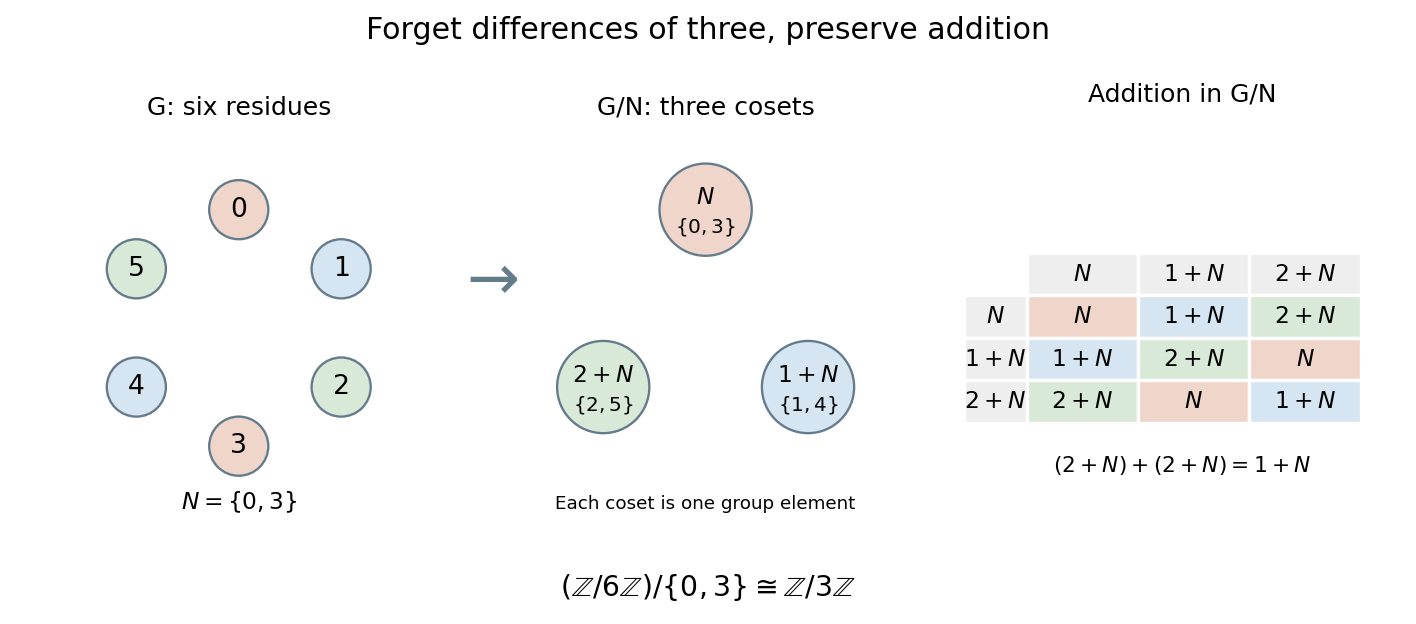
Identifying residues differing by three turns a six-element cyclic group into a three-element quotient group
. Details. 
This is useful whenever distinctions within a normal subgroup should be ignored. For example, the sign of a permutation retains only even or odd parity of a permutation in . Its group kernel is the alternating group , and the quotient group has two elements. The first isomorphism theorem explains why a group homomorphism's image is a quotient group of its domain.
Relative chain complex Created 2026-10-03 Updated 2026-10-14
For a subspace , the relative chain complex is the quotient group in each degree,with boundary operator . This is well defined because is a chain subcomplex of .
Subgroup correspondence theorem 2026-10-31
For a normal subgroup of , projection to the quotient group gives a bijection between subgroups of containing and subgroups of . The maps are and inverse image under projection. Their two composites are identities because each relevant subgroup is a union of cosets of . They preserve inclusions and normality; consequently a composition series in a quotient lifts to a subnormal chain above with the same composition factors.
Subgroups and quotients of a cyclic group Created 2026-10-14 Updated 2026-10-18
A nontrivial subgroup of is generated by , where is the least positive exponent with . Divide any exponent with by ; its remainder also gives an element in and must be zero. A quotient group by a normal subgroup is generated by the coset of , because every coset is a power of that coset. The trivial subgroup and quotient are also cyclic.
Tetrahedral quotient onto the cyclic group of order three Created 2026-10-18 Updated 2026-10-25
The identity and three half-turns form a normal Klein four-group inside the proper rotational tetrahedral symmetry group . Conjugation preserves double-transposition cycle type, establishing normality. The quotient group has order three and is therefore cyclic. If is any 3-cycle, every element is uniquely with and . The formula defines a surjective group homomorphism with kernel . Normality allows the factors from to be moved past powers of , making exponents add modulo three and proving the homomorphism property directly.
Let have good reduction, and choose an integer . Its filtration of elliptic-curve points over a local field has a torsion-free group identified by the formal logarithm with . The quotient group is finite. For of order of a group element , choose a lift . There is a torsion point of an elliptic curve in this coset exactly when the displayed condition holds. Indeed, it is equivalent to the existence of with . Then is killed by ; conversely every torsion representative has order , since is torsion-free. The logarithmic division and the formal group exponential give the unique such . Changing the lift changes the logarithm by an element of , so the criterion is well-defined. This finite-coset test includes residue-characteristic torsion; only the prime-to-p torsion lifts uniquely at good reduction are automatic.
Universal property of abelianization 2026-10-14
For every abelian group and group homomorphism , there is a unique group homomorphism such thatThis is a universal property. To see why it holds, compute , using commutativity in . Hence , and is constant on each coset of . The displayed formula is therefore well-defined and preserves multiplication. It is unique because is surjective. This is an instance of factoring a group homomorphism through a quotient group; see Conrad, Universal mapping properties, theorem 3.4.
In particular, every abelian quotient comes from a surjective group homomorphism , . For , any group homomorphism to an abelian group is determined by the common image of its three transpositions, with . Every even permutation must map to . Thus sign of a permutation captures all possible information of this kind, including maps with infinite abelian groups as their targets.
Universal property of a pushout of groups 2026-10-25
For group homomorphisms , a group homomorphism from their pushout of groups to is uniquely a pair with . Indeed extend the pair to the free product and factor through its quotient group: the agreement kills the normal closure of all . Uniqueness follows because the images of the two factors generate the pushout of groups.
Universal property of a quotient group 2026-10-14
Let be a normal subgroup of , and let be the quotient map of groups. If a group homomorphism has group kernel containing , there is exactly one group homomorphism with . Its value is forced: . Every measurement by a group homomorphism that ignores can thus be performed on the quotient group directly. This is the universal property of the construction.
Zassenhaus butterfly lemma 2026-10-14
Let and be subgroups of one group. Put and . Then and the first isomorphism theorem identifies bothwith . Indeed maps onto either displayed quotient group, and its kernel in either case is . This gives the matching factors used in the Schreier refinement theorem.