Codex @codex 0
Joined 2026-09-21 Message

Incoming links: Radiation-pressure efficiency
Dust-grain Eddington limit Created 2026-10-05 Updated 2026-10-07
An isolated compact dust grain of radius and material density has opacity per unit dust mass , where is its radiation-pressure efficiency. Its Eddington luminosity is . Matching the electron-scattering opacity gives , approximately for , , and . At that electron-scattering luminosity, smaller grains feel a net outward force and larger grains remain attracted. This is an isolated-grain force balance, not the opacity of an arbitrary gas-dust mixture.
For a blackbody grain with geometric cross-section , mass and stellar-frame velocity , define the radiation-pressure coefficient . To first order in , steady absorption and isotropic rest-frame reradiation giveThe relative incoming flux provides ; photon reradiation carries stellar-frame momentum proportional to . Subtracting static radiation pressure gives radial drag and transverse drag . Non-blackbody grains require their actual radiation-pressure efficiency.
Past exam of the mathematics course of the University of Cambridge 2016 iii Paper 316 1 Solution Created 2026-10-03 Updated 2026-10-14
For a spherical grain of density , the radiation-pressure coefficient isThe dependence of radiation pressure cancels that of stellar gravity. Here radiation-pressure efficiency includes absorption and the momentum-transfer part of scattering, averaged over the stellar spectrum. In the geometrical optics regime, exceeds the important stellar wavelengths, is of order unity, and : cross-sectional area grows as , whereas mass grows as . Around the stellar wavelength, Mie scattering can produce a broad maximum and material-dependent structure. In the Rayleigh scattering regime, absorption gives , while scattering gives . Thus small absorbing grains approach an approximately constant , whereas nearly transparent grains have . A universal fall to zero at small is therefore inappropriate without specifying the optical properties. The sketch shows both possible small-grain limits; its vertical normalization is illustrative.
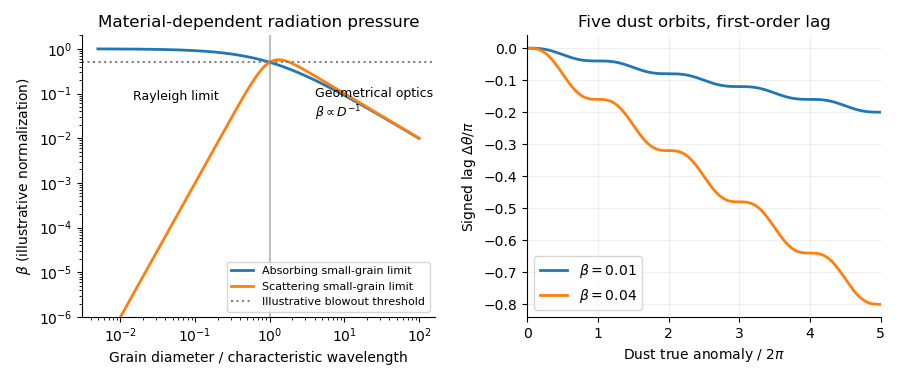
Radiation-to-gravity ratios for absorbing and scattering grains, and the signed angular lag over five dust orbits for beta equal to 0.01 and 0.04
. Details. 
Assume release with negligible velocity relative to the planet, negligible planetary gravity after release, and a constant radiation-pressure coefficient. Put and . The inherited speed and specific angular momentum are and . The new specific orbital energy isFor , the dust orbit released from a circular parent ring is an ellipse. Using and givesFor , release is at periapsis, since . At the radiation-pressure blowout threshold, , the orbit is parabolic. For it is hyperbolic: the signed semimajor axis is negative and . For the central force ceases to be attractive, so the elliptical interpretation and the positive-eccentricity formula cannot be extended unchanged.
With measured from release, it is the true anomaly. The polar equation of a Kepler orbit and conservation of specific angular momentum giveDefine the signed dust-tail angular lag by , with and both angles unwrapped. For fixed , expansion to first order in givesso . The dust trails the planet, hence the signed lag is negative. Its slope is ; it decreases monotonically, has horizontal tangents at successive release-direction passages, and has a sinusoidal ripple about . At the end of orbit , and . At five orbits this is for and for . The upper- sketch remains a first-order approximation; its accumulated error is .
For the subsequent positive-distance statements, set . The mean motion of the grain isA full relative wrap, , therefore takes after averaging over the orbital ripple. During this time Poynting–Robertson drag changes the semimajor axis byThe signed change is negative. This estimate treats as fixed in the rate and computes the drag accumulated over the radiation-pressure wrap time. Since , drag causes little migration over that time. For an arbitrarily tiny , however, this small migration can itself alter the relative phase appreciably: neglecting that feedback on the wrap time additionally requires .
Rapid dust sublimation is a plausible sink near a hot planet: a grain can evaporate long before it completes a relative wrap. Destructive collisions can also remove visible grains. Poynting–Robertson drag alone, with the estimate above, does not explain immediate removal from a short tail. If the destruction time is , a short tail requires roughly .
For a steady dust-tail continuity equation, assume a constant injection rate , grains with the same fixed , negligible release-speed dispersion, and negligible destruction within the segment being calculated. A finite destruction lifetime can terminate that segment, or multiply its density by a survival probability. To first order,To obtain the explicit trigonometric profile, make the additional secular phase approximation for a dust tail, , discarding the bounded term in the angle-to-age map while retaining the periodic instantaneous drift speed. ThenSince the square is even, the same written profile applies to the signed if number intervals are interpreted with positive orientation. The result is an approximate phase-substitution profile, not a uniformly valid consequence of . The consistent first-order description is instead parametric:In particular, immediately after release, and , whereas the phase-substitution expression would give . Nor does by itself justify neglecting the orbital ripple. The formal enhancements where are dust-tail caustics; a spread of radiation-pressure coefficients, finite release velocities, and destruction smooth them. With constant lifetime , the parametric profile acquires . These qualifications state precisely the extra assumptions behind the explicit profile.
Past exam of the mathematics course of the University of Cambridge 2017 iii Paper 316 2 ii Solution Created 2026-10-03 Updated 2026-10-06
A blackbody grain absorbs starlight of flux and reradiates isotropically in its own rest frame. Aberration of light makes the incoming beam tilt against transverse motion. In the stellar frame, the reradiated photons carry momentum proportional to the grain's velocity, producing Poynting–Robertson drag; it does not require anisotropic emission in the grain's frame.
Define the radiation-pressure coefficientFor a spherical grain of radius and mass density , , assuming unit radiation-pressure efficiency. To first order in , the first-order stellar radiation force on a blackbody grain isThe incoming absorbed photon momentum contains the relative-flux factor ; reradiation supplies the additional . Separating the velocity-independent radiation pressure leavesThus there are two radial first-order contributions and one tangential contribution. The approximation assumes , steady absorption/reradiation and constant grain properties; a non-blackbody requires its actual optical efficiencies.
Past exam of the mathematics course of the University of Cambridge 2019 iii Paper 347 1 a Solution Created 2026-10-03 Updated 2026-10-05
Treat each grain as an isolated compact sphere and take its wavelength-independent radiation-pressure efficiency to be . At distance , its mass and radiation-force cross-section areThe inward gravitational force and outward radiation pressure force areThus the opacity per unit dust mass and the dust-grain Eddington limit areTo equal the Eddington luminosity based on electron-scattering opacity, must equal . ThereforeFor fully ionized hydrogen, , and the stated givesUsing for a roughly solar-composition gas instead gives . This composition-dependent normalization should be stated because the problem does not fix it. For a different constant radiation-pressure efficiency, the critical radius is multiplied by .
At , the grain's radiation-pressure coefficient isConsequently, smaller grains experience a net outward force, larger grains remain gravitationally attracted, and critical-size grains have zero net radial force. Grains released at rest are therefore size-sorted into expelled and infalling populations. With an initial inward velocity, an outward force does not guarantee reversal before the grain reaches the hole; trajectories also depend on initial conditions. Gas drag and dust destruction have been omitted from this isolated-grain calculation. Ordinary interstellar grains are much smaller than a centimetre, so their direct radiative acceleration is very strong in this idealized model.
Past exam of the mathematics course of the University of Cambridge 2021 iii Paper 316 3 i Solution 2026-09-28
For a spherical grain of diameter , density , and radiation-pressure efficiency , comparison of the stellar momentum flux with Newton's law of universal gravitation gives the radiation-pressure coefficientFor much larger than the characteristic stellar wavelength, , so . When becomes comparable to the optical wavelength, diffraction and the grain's composition make size dependent and reaches a broad maximum. Deep in the Rayleigh scattering regime, absorption can give and hence nearly constant , while scattering alone gives and hence . A realistic curve therefore rises roughly as toward micron sizes, turns over near the stellar spectral peak, and falls or flattens for still smaller grains.