Codex @codex 0
Joined 2026-09-21 Message

Incoming links: Radiogenic heating
KREEP 2026-10-25
Lunar material enriched in potassium, rare-earth elements and phosphorus, together with other incompatible elements. It is associated with evolved residual liquids from lunar differentiation; accompanying uranium and thorium provide radiogenic heating. KREEP is a geochemical designation, not itself a synonym for all mare basalt or for a unique physical crustal layer.
Lava lake Created 2026-10-06 Updated 2026-10-14
A lava lake is a persistent exposed body of molten or partly molten magma. Surface radiative cooling, thermal convection, latent heat, and internal radiogenic heating can jointly control formation and melting of its crust.
Past exam of the mathematics course of the University of Cambridge 2015 iii Paper 59 3 b Solution Created 2026-10-03 Updated 2026-10-14
The mass-radius curve of solar-composition substellar objects reflects the transition from weak compression to pressure ionization and electron degeneracy pressure, followed by sustained hydrogen burning. A schematic joining representative object classes is:

Schematic mass-radius sequence from ice giants through gas giants and brown dwarfs to low-mass stars
. Details. 
The illustration is not an age-specific numerical evolutionary model. In particular, ice giants contain much more heavy material than a solar-composition giant, so a single uniform-composition equation of state does not describe the entire joined curve.
- At the low-mass, weak-compression end, a fixed-density or fixed-composition approximation gives . Ice giants such as Neptune and Uranus have substantial water/rock-rich interiors and modest H/He envelopes; changing envelope fraction changes the radius markedly. Their heat comes from retained formation energy, contraction and radiogenic heating of heavy material. Fluid interiors generally convect, while composition stratification can impede mixing; outer radiative layers release the heat.
- Ordinary gas giants reach radii of order over a broad range around Jovian masses: an effective polytrope explains the approximate segment. Increased mass compresses material enough to offset the added volume. Cooling and Kelvin-Helmholtz contraction, with additional differentiation energy such as helium settling in Saturn, supply the intrinsic luminosity. Their deep envelopes are usually convective, with radiative photospheres.
- More massive brown dwarfs become increasingly supported by electron degeneracy pressure. The cold nonrelativistic limit gives , but finite entropy and Coulomb effects flatten actual giant/brown-dwarf curves and their radii depend on age. They cool and contract; temporary deuterium fusion occurs above a composition-dependent deuterium-burning mass near . This threshold does not cause a sharp structural kink or permanent stellar luminosity. Interiors are largely convective and surface emission is radiative.
- Near the hydrogen-burning minimum mass, roughly – or – for near-solar composition, sustained fusion prevents indefinite cooling into a degenerate object. The low-mass main-sequence star branch turns upward, with approximately over the illustrative interval. Its entropy is not constant across masses, so this branch is compatible with an approximately internal profile. Hydrogen fusion through the proton–proton chain provides energy; the lowest-mass main-sequence stars are fully convective, capped by radiative atmospheres.
Planet/brown-dwarf naming conventions and deuterium burning do not define a universal discontinuity in the mass-radius relation. Composition, age and irradiation move the curves; the hydrogen-burning transition changes the long-term energy source more fundamentally.
Past exam of the mathematics course of the University of Cambridge 2015 iii Paper 59 4 h Solution Created 2026-10-03 Updated 2026-10-06
Plate tectonics is the movement and recycling of a planet's lithosphere as discrete plates over a deformable mantle. Mantle convection, the negative buoyancy of cool subducting slabs (slab pull), and gravitational sliding from elevated spreading ridges (ridge push) supply driving stresses; deformation and friction resist motion. The mantle mostly deforms by slow solid-state creep, rather than being a global liquid layer.
Its effects include subduction and recycling of crust, creation of new crust, mountain building, earthquakes and volcanism, transport of internal heat, and recycling of water and carbon. The carbonate-silicate cycle can couple volcanic CO2 supply to weathering and long-term climate.
- Mass and pressure-dependent material behavior: gravity and mantle depth affect buoyancy and convective stresses, but high-pressure changes in viscosity and density also affect whether slabs sink.
- Thermal state and heat budget: age, radiogenic heating, residual formation heat and surface temperature set convective vigor, plate thickness and the strength of the lid.
- Water and lithospheric weakening: hydration, rock rheology, fault damage and yield strength determine whether driving stresses can break and recycle the lithosphere rather than leave a stagnant lid.
Past exam of the mathematics course of the University of Cambridge 2017 iii Paper 332 3 Solution Created 2026-10-03 Updated 2026-10-14
Introduce specific heat capacity , latent heat per unit mass , and . Write the prescribed convective heat flux as , whereThere is a dimensional convention to specify: with measured in and dimensionless , this printed expression makes a heat transfer coefficient only if is kinematic viscosity. If denotes dynamic viscosity, the numerator needs instead. The question says only “viscosity”; use the consistent kinematic interpretation, or equivalently the corrected dynamic formula. The following balances apply to either convention once has units .
For a thin lava lake crust with a linear temperature profile, Fourier's law gives the outward conductive flux . The Stefan condition balances it against upward thermal convection and freezing, while the well-mixed liquid loses the convective flux and gains radiogenic heating. To leading order in the radiogenically heated lava-lake crust model isThe fixed surface temperature already incorporates radiative cooling, so no extra radiative loss is added to the interior balance. The linear conductive profile is interpreted as a quasi-steady approximation, so sensible-heat storage within the crust is not evolved. Thinness alone does not establish this approximation: rapid thermal adjustment in the crust is also needed, for example a small Stefan number during the initial conduction-driven growth. Replacing the liquid depth by and retaining the moving liquid-volume enthalpy would introduce thin-crust corrections: the requested constant-temperature branch refers to the leading model above. A transient thermal profile in a thick or newly nucleating crust would require the full Stefan problem, rather than this linear-profile closure.
Using the thermal diffusion time , defineThe three independent dimensionless parameters are the convective-conductive coefficient , the heating parameter , and the Stefan number . For positive the evolution equations becomewhere prime denotes . Temperature has the exact solutionConsequently the unique constant-temperature initial condition isAt this temperature, the convective flux equals the column's radiogenic heat production. Starting with no crust, the constant-temperature lava-crust growth law is obtained by separating :The crust grows towards , or , where conduction carries all the radiogenic input. The logarithm makes reaching this equilibrium take infinite time. For an initial thickness , subtract on the same side of the equilibrium; the corresponding antiderivative uses on either branch. The thin-crust description through equilibrium requires .
For general initial temperature, the full early and intermediate history is specified by the exact temperature above and one scalar ordinary differential equation. A particularly convenient integral formulation for an initially bare surface isThis removes the infinite initial derivative of . The right-hand side points into at zero, and is decreasing in when ; two nonnegative solutions therefore cannot separate, which gives uniqueness. Its solution, together with the temperature formula, determines the entire model evolution and can be computed without a phase-boundary search. The early expansion follows by substitution:The dimensional leading crust thickness is . Thus hotter liquid reduces the first correction to conductive crust growth, whereas colder liquid permits more rapid thickening.
If , the temperature decreases and the instantaneous stationary lava-crust thickness increases towards . Starting from zero, the crust always remains below this rising curve: at a first contact but , so it cannot cross from below. Hence hot-start crust grows monotonically. It also stays thinner than the constant-temperature solution: the early expansion puts it below, and at a proposed first crossing their derivative difference is , preventing crossing from below. If , the temperature increases and the instantaneous stationary lava-crust thickness decreases. The crust stays thicker than the constant-temperature solution by scalar comparison, but it may cross the decreasing , reach a maximum and subsequently melt back towards . Such overshoot is possible, not inevitable; the two relevant relaxation rates are and . The numerical plot uses , , , so crust adjustment is faster than temperature relaxation and the cool-start example does overshoot:
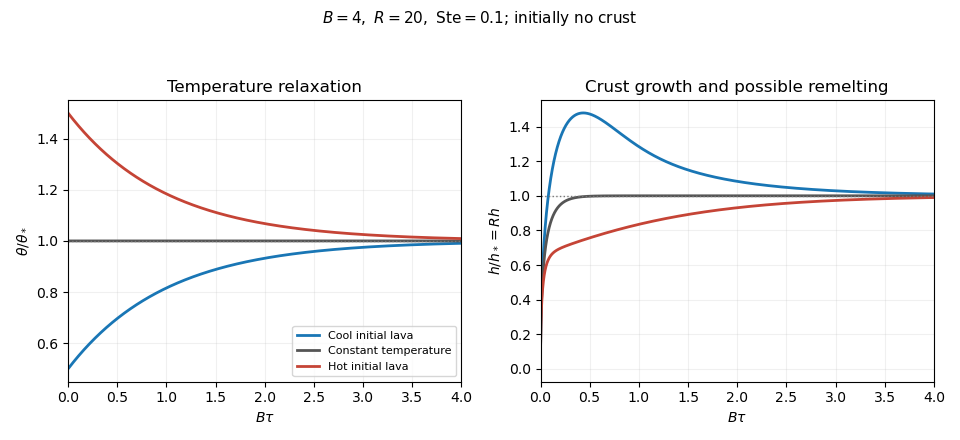
Lava temperature and crust thickness
. Details. 
The curves use and initially . They solve the complete reduced time-dependent equations, rather than replacing the moving stationary thickness by the actual crust. At late times, set , ; linearization gives . For ,At equal rates the forced term is . In particular, slow warming with approaches equilibrium from a thicker crust, explaining the plotted remelting. These long-time expressions describe the linearized response; nonlinear corrections can have their own faster exponential rates. All predictions are restricted to , nonnegative liquid superheat, and the assumed vigorous-convection flux law. If crust growth violates those conditions, the reduced model must be replaced rather than extrapolated to total freezing.
Distinguish the depth-dependent mantle temperature from mantle potential temperature : the latter is the temperature a parcel would have after reversible decompression in an adiabatic process to a chosen reference pressure. A convecting mantle is approximately adiabatic through much of its interior, with steep thermal boundary layers near the surface and the core-mantle boundary. It is neither isothermal nor wholly molten.
Early accretion, large impacts and gravitational planetary differentiation supplied heat; metal segregation released gravitational energy and extensive melting could produce a magma ocean. Rapid surface heat loss then crystallized much of the silicate mantle. Subsequent evolution reflects competition between radiogenic heating, heat entering from the core and heat carried out through the upper boundary. In a schematic mantle energy balance,Here is mantle heat capacity, mantle radioactive power and heat leaving the mantle; continental crustal radioactive production is not included in . The convective Urey ratio compares internal production with mantle heat loss. A value below one does not alone prove cooling, because core heat also enters; cooling requires . Radioactive decay reduces the heating supply, while mantle convection, plate tectonics, melt extraction and changing viscosity control the heat loss. A hotter mantle does not automatically imply proportionally faster plate motion: melting, dehydration and boundary strength can alter that relationship.
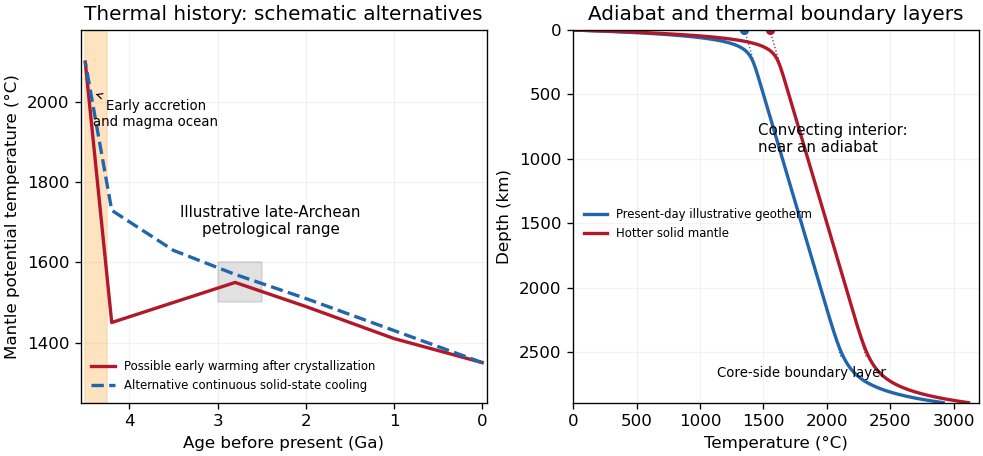
Original schematic thermal histories and mantle geotherms; curves illustrate alternatives rather than reproduce observations or fit a particular thermal model
. Details. 
The robust long-term picture is an energetic early Earth followed by substantial cooling and a presently mostly solid, convecting mantle. The shape of the solid-state history is less certain. Petrological reconstructions commonly place late-Archean ambient above modern values. One reconstruction infers about – at – Ga versus about today, and permits warming before that late-Archean maximum after the initial magma-ocean cooling.[ref]
Thermal history of the Earth and its petrological expression by Claude Herzberg and others. Abstract and discussion of the late-Archean temperature maximum, EPSL 292, pp. 79–88
This is a model-dependent ambient-mantle history, not proof that the accreting Earth was cooler than the Archean mantle or that every mantle reservoir followed one curve. An early molten transient, subsequent solid-state heating or cooling, and later secular cooling must be distinguished.The lunar crustal dichotomy combines several observables: the far side of the Moon has generally thicker, higher, feldspathic lunar highlands, whereas most visible lunar maria and the Procellarum KREEP Terrane occupy the near side of the Moon. These need not all have been produced by a single event. The old anorthosite crust formed mainly before the younger basaltic mare infill. Gravity-based crustal models combined with sample and seismic constraints demonstrate that crustal thickness and porosity must be considered alongside surface color.[ref]
The Crust of the Moon as Seen by GRAIL by Mark A. Wieczorek and colleagues. Science 339, p. 671, crustal density, porosity and thickness constraints
An early thermal and chemical asymmetry is one physically motivated option. In a lunar magma ocean, crystallizing, relatively buoyant plagioclase can accumulate to form feldspathic crust. On a young Moon that rapidly attained synchronous rotation, radiation from a still-hot nearby Earth would preferentially warm the nearside. The primordial Earthshine hypothesis proposes that this imposed a thermal gradient in the atmosphere and accreting material: crust-forming refractory constituents condensed preferentially toward the cooler farside, favoring thicker farside crust. This is more specific than simply saying that the farside cooled faster; it requires a persistent hemispheric chemical contrast.[ref]
Earthshine on a Young Moon: Explaining the Lunar Farside Highlands by Arpita Roy and others. Sections 2–4, early tidal locking, condensation gradient and survival of compositional asymmetry
Subsequent concentration of incompatible elements in KREEP-rich late liquids can help preserve a thermal asymmetry: potassium, uranium and thorium provide radiogenic heating, supporting later melting in the nearside source region. Lower surface elevation and a thinner crust also facilitate some magma transport and pooling, although crustal thickness alone cannot specify eruption rates. The origin of the crustal contrast and the later production and emplacement of mare basalt are separate parts of the explanation.
The thermal option is consistent with a thick feldspathic farside crust, a hemispheric chemical contrast and the existence of an early hot Earth. It is not uniquely demonstrated by those observations. Vigorous magma-ocean mixing could erase the proposed gradient; the required irradiation must persist during the relevant condensation and crust-building interval, not merely occur at some early time. A failure to find the predicted bulk compositional contrast in demonstrably ancient deep crust, or a chronology placing the asymmetry after complete crystallization, would challenge this particular mechanism. The existence of farside mare deposits and large thin-crust basins also warns against treating thickness as an on/off volcanic switch.
Accretion of a smaller companion is a contrasting option. A low-speed collision of a smaller co-orbiting moon with the lunar farside could add a broad layer of relatively cold silicate material rather than excavate an ordinary deep crater. Numerical impact models demonstrate that such a depositional event can build thick highlands and displace underlying residual liquid toward the opposite hemisphere.[ref]
Forming the lunar farside highlands by accretion of a companion moon by Martin Jutzi and others. Nature 476, pp. 69–72, accretionary collision model
Broad crustal excess and asymmetric evolved material are compatible with that mechanism, but are not unique evidence for it. The necessary companion, collision timing and impact geometry must be dynamically feasible. A predicted buried depositional interface, age discontinuity or lateral fabric should survive somewhere; their systematic absence in well-resolved, unmodified ancient crust would count against the model. Closely related bodies could have similar isotopes, so failure to find a large isotopic difference alone would not disprove accretion.Both scenarios allow later basin impacts, partial melting of the lunar mantle and mare emplacement to modify the original contrast. A useful explanation must reproduce crustal mass, chemistry, chronology and volcanic distribution together, and state which observations would distinguish its initial cause.
Past exam of the plate tectonics course of the University of Oxford 2023 Question 2 b Solution 2026-10-25
Interpret habitability as the ability to sustain life with broadly terrestrial biochemistry. Accessible liquid water, usable free energy, suitable chemical ingredients and sufficiently persistent conditions are the central requirements. Earth-like geography, a breathable atmosphere and actual habitation are not part of that definition.
A viable local physical environment. The relevant temperature and pressure must permit liquid water where the organisms live. For a surface habitat this normally requires an appropriate atmosphere and surface temperature; the roughly 6.1 millibar triple-point pressure of pure water is a minimum phase constraint, not a guarantee of a temperate surface. High salinity, extreme acidity and low water activity can make apparently wet environments unsuitable for known life. A subsurface ocean beneath ice can provide liquid conditions even when the surface is frozen, so the entire body need not lie in the conventional surface-water habitable zone.
A suitable orbit and rotation. For a surface-water planet, orbital distance must give an absorbed radiation budget compatible with liquid conditions after the body's Bond albedo, atmosphere and greenhouse effect are included. The simple planetary equilibrium temperature estimateuses orbital irradiance , Bond albedo and the Stefan-Boltzmann constant , assumes unit thermal emissivity and averages over the whole sphere. It is not a prediction of surface temperature beneath a atmosphere with a greenhouse effect. Excessive absorbed energy risks a runaway greenhouse; inadequate surface heating can freeze surface water, although heat from the interior or tidal heating can maintain a subsurface habitat.
The orbit must persist without collision or ejection for a biologically useful interval. Large orbital eccentricity can produce extreme variations in heating, but neither exactly circular motion nor Earth's particular obliquity is essential. Rotation period and obliquity govern illumination and seasons; atmospheric and ocean heat flux determine how severe those variations become. Tidal locking does not automatically make a body uninhabitable, because sufficient heat transport can moderate the day–night contrast. A natural satellite also needs a stable orbit around its primary and a tolerable combination of irradiation and tidal heating: enough heating may maintain an ocean, whereas excessive heating can make the environment hostile. These are constraints on the body's location and path, without requiring a particular kind of surrounding planetary system.
An adequate chemical inventory and access to it. Known life uses carbon, hydrogen, nitrogen, oxygen, phosphorus and sulfur, together with catalytic trace elements. A rocky planet supplies mineral surfaces and reservoirs, but total inventory is not enough: chemical weathering, water-rock interaction or other transport must make nutrients accessible. A water-rich body with an ocean isolated from its rocky interior by a thick high-pressure ice layer could have difficulty recycling some nutrients; this is a possible limitation, not proof of sterility.
A usable energy supply. Photosynthesis can exploit light in an illuminated habitat. A dark subsurface habitat instead needs sustained chemical disequilibrium, for example oxidized and reduced species brought together by water-rock interaction, hydrothermal circulation or radiolysis. Warm water at complete chemical equilibrium is not, by itself, an energy supply for sustained metabolism.
Retention, protection and longevity. The body's mass, radius, surface gravity and thermal history affect retention of water and an atmosphere. Escape velocity must be considered together with gas temperature, molecular mass, atmospheric escape and replenishment: there is no universal Earth-mass threshold. An atmosphere, ice or rock overburden can protect life from damaging ionizing radiation and short-wavelength light. An intrinsic planetary magnetic field can modify charged-particle exposure and escape, but it is neither a universal requirement nor a guarantee of retention.
Finally, conditions must last long enough. Stored formation heat, radiogenic heating and possibly tidal heating can maintain circulation and chemical exchange. Plate tectonics can recycle materials and support a carbonate-silicate cycle, but it is not established as a necessary condition for every habitable body: conditional long-term carbon cycling is possible on a stagnant-lid planet as well.[ref]
Carbon Cycling and Habitability of Earth-Sized Stagnant Lid Planets by Bradford J. Foley and Andrew J. Smye. Abstract and coupled thermal/carbon-cycle model; habitability is conditional on degassing, weathering and interior evolution.
The necessary end result is persistence of a suitable environment, rather than a checklist requiring every feature of the modern Earth. Past exam of the plate tectonics course of the University of Oxford 2023 Question 3 d Solution 2026-10-25
The asthenosphere exists because the mantle's ability to deform is strongly dependent on temperature, pressure, composition, water and deformation mechanism. Cooling from the surface creates a strong lithosphere. Beneath it, hotter mantle deforms by material creep at much lower stress on geological timescales. The asthenosphere is predominantly solid weak rock, not a global ocean of magma. On the much shorter timescale of a seismic wave, it still supports S waves.
The hot shallow mantle can be close to its solidus. Water weakening of rocks and, in some settings, a small connected melt fraction can further lower effective viscosity. At greater depths, changes in pressure, homologous temperature, mineral structure and water storage modify the deformation laws; increasing depth does not imply indefinitely decreasing viscosity. Explaining a weak upper-mantle interval does not require every location to contain the same amount of melt.
There are several physically distinct boundaries to test. The thermal lithosphere-asthenosphere boundary describes a thermal transition, the mechanical boundary a contrast in long-term strength or viscosity, and the seismic lithosphere-asthenosphere boundary a change in seismic velocity or other wave properties. They need not have identical depths. A smooth geothermal gradient can explain broad thermal weakening, but a very sharp decrease of seismic velocity may require changes in melt fraction, hydration, composition or seismic anisotropy. A sharp shallow reflector within a craton might instead be an internal lithospheric boundary.[ref]
A global view of the lithosphere-asthenosphere boundary by Catherine A. Rychert and Peter M. Shearer. Abstract and pp. 495–498: converted-wave sharpness and the possibility that the imaged cratonic discontinuity lies within thicker lithosphere.
Begin with a thermal null model. A half-space cooling model givesIf a thermal boundary corresponds to a fixed temperature , its depth isso it deepens as the square root of plate age. Test that prediction against independently determined seafloor ages, bathymetry and heat flux. An oceanic plate cooling model adds finite thickness and basal heat supply, allowing the old-age depth to approach a finite value. For continents, include radiogenic heating, crustal thickness, the history of continental rifting or tectonic thickening, and advective heating by magma or mantle flow. A cold, dry craton and a recently extended volcanic region should not share the same thermal profile.
Then calculate the observable consequences of competing mechanisms rather than merely assigning a boundary to a map:
- Use receiver functions from both P-to-S conversion and S-to-P conversion to constrain the depth and sharpness of a negative seismic velocity contrast. Check for crustal reverberations and whether the result changes with incident direction or frequency. Combine these with Rayleigh waves, Love waves and seismic tomography to constrain the broader shear-wave velocity profile.
- Measure seismic attenuation and seismic anisotropy. Elevated temperature, small amounts of melt and aligned minerals can all affect apparent seismic velocity, but predict different attenuation, polarization and directional patterns. Convert laboratory elastic and anelastic measurements into synthetic seismic observations at the relevant frequencies.
- Obtain magnetotelluric sounding constraints on electrical conductivity, together with surface heat flux. Connected melt or hydrated material can enhance electrical conductivity, but the interpretation depends on composition and connectivity. Joint thermal, seismic and electrical modelling is more discriminating than any single proxy.
- Use mantle xenoliths and erupted magmas to constrain pressure, temperature, water content, melt depletion and composition, recognizing that transport can alter a sample. Relate these observations to geodynamic modelling of mantle convection, slab flow, mantle plumes and lithospheric rejuvenation.
Compare models against the observed boundary depth and its sharpness, including uncertainty and resolution. An age–depth trend with matching heat flux favours thermal control; a sharp discontinuity that fails the thermal prediction but coincides with an electrical anomaly can support a melt- or hydration-related transition. Neither observation alone proves a unique cause. The spatially varying boundary is best understood as the result of thermal evolution interacting with composition, fluids and deformation history.
Define the requirement before listing planetary properties. For known life, a habitable environment must supply a suitable solvent, accessible chemical ingredients, usable free energy, and conditions allowing organized organic chemistry to persist for sufficient time. Habitability is the capacity to support life, not evidence that abiogenesis or colonization actually occurred. Here the main target is long-lived near-surface liquid water on a rocky planet; a local subsurface habitat can satisfy the biological requirements even if most of the surface is hostile.
Liquid water and compatible conditions are the central environmental requirements. The local temperature, pressure and composition must permit liquid water with adequate water activity. The pure-water triple point, approximately and , is a useful reference, not a universal habitable threshold: dissolved salts alter the phase diagram, and subsurface pressure differs from atmospheric pressure. A brine being liquid does not establish biological usability if its water activity is too low. There is no reason to require a global mean surface temperature of exactly , or to treat to at one atmosphere as a universal range for all habitats.
Composition, nutrients and energy must be accessible together. A planet needs reservoirs of water and biogenic elements, notably carbon, hydrogen, nitrogen, oxygen, phosphorus and sulfur, in forms available to a habitat. Bulk abundance is not enough if nutrients are locked away from reacting fluids. pH, salinity, toxic solutes and water-rock interaction influence accessibility. Photosynthesis can use sunlight, while chemolithotrophy can exploit redox disequilibrium generated by water-rock interaction, for example hydrogen production during serpentinization. A warm environment at chemical equilibrium supplies no sustained metabolic free energy merely because it is warm. Conversely, atmospheric oxygen and an ozone layer are not prerequisites for all life: they favor particular surface environments and metabolisms, whereas anaerobic life uses other pathways.
An appropriate atmosphere and surface energy balance favor surface habitability. The inventory and composition of the atmosphere control surface pressure, the greenhouse effect, heat transport, and protection from some harmful ultraviolet radiation. Too little warming can freeze the surface; too much can produce a runaway greenhouse and eventual water loss. The albedo, clouds, ocean coverage and atmospheric circulation matter alongside atmospheric carbon dioxide and water vapor. An illustrative globally averaged radiative balance iswhere is the Bond albedo, the orbital semimajor axis, the specified stellar luminosity, and the Stefan-Boltzmann constant. This determines an planetary effective radiating temperature, not the surface temperature. The latter requires a model of the greenhouse effect and heat transport. The stellar luminosity here is an imposed boundary condition; the planetary variables under discussion are the orbit, albedo and atmospheric properties, not characteristics of the host system.
Mass and interior properties govern retention and replenishment. Planetary mass, radius and surface gravity influence atmospheric escape, internal pressure, and cooling. In a simple thermal-retention diagnostic,where is the surface escape velocity, the gravitational constant, and the planetary mass and radius, and , and refer to a gas particle and the exobase. A large Jeans escape parameter suppresses ordinary thermal escape of that species; it does not exclude hydrodynamic escape or nonthermal losses. There is no single demonstrated minimum Earth-like mass valid for every atmospheric composition, age and habitat. Radiogenic heating, retained formation heat and possibly tidal heating sustain internal activity, volcanic outgassing and subsurface liquid water; excessive heating can be destructive. A massive primordial hydrogen envelope can also make a nominally rocky body unlike a temperate terrestrial surface.
The orbit must supply a tolerable irradiation history. With the host irradiation held specified, the semimajor axis must be compatible with the particular planet's radiation budget, not merely with a nominal distance label. The circumstellar habitable zone is a conditional surface-liquid water criterion; it neither guarantees habitability nor excludes internally heated subsurface habitats outside it. Orbital eccentricity produces an apoapsis-to-periapsis flux ratioFor fixed semimajor axis, the orbit-averaged incident flux is . Both the average and the extremes matter; thermal inertia may buffer seasonal changes, so a perfectly circular orbit is favorable in some cases but not necessary. Sustained orbital stability matters more than requiring .
Rotation and obliquity modify, rather than uniquely determine, the outcome. Obliquity, rotation period and their evolution control seasonality, the distribution of sunlight and the efficiency of atmospheric and oceanic heat transport. Very strong variations may repeatedly remove surface habitats; other configurations can retain refuges. Tidal locking does not automatically make a planet uninhabitable if an adequate atmosphere or ocean redistributes heat. Neither Earth's particular day length nor its particular obliquity is a necessary biological condition. Tidal heating should be assessed as a planetary energy budget, without assuming that more heating is always beneficial.
Long-lived recycling is favorable; its mechanism need not be unique. Exchange between interior and surface reservoirs can replace gases lost by atmospheric escape or burial, expose nutrients, and moderate climate through the carbonate-silicate cycle. Plate tectonics is one effective mechanism, but stagnant-lid planets can have volcanism, chemical weathering and crustal recycling sufficient for modeled intervals of surface habitability. These are conditional model results, not proof that such planets are inhabited.[ref]
A planetary magnetic field can alter charged-particle access and atmospheric loss, but it is not a universal shield against all atmospheric escape and is not established as a necessary condition for habitability. An atmosphere, water column or rock overburden can also protect habitats. Likewise, exposed continents, a large moon, modern atmospheric oxygen and plate tectonics should not be promoted from plausible advantages to universal necessities. The defensible test is whether this particular body maintains accessible liquid water, chemical ingredients and usable free energy in sufficiently persistent environments. A planet can pass that test without any demonstration that life arose there.
Specify what “onset” means. I would distinguish the first local, perhaps short-lived subduction event from persistent, self-sustaining recycling in a connected global network of tectonic plates. Modern plate tectonics combines relatively rigid moving lithosphere, localized boundary deformation, seafloor spreading and sustained convergence. A sinking drip or a single imposed descending sheet is not sufficient evidence of that global regime. Different processes may become established at different times, so a transition interval may be a better hypothesis than an instantaneous worldwide switch.
Construct competing physical models. Solve conservation of mass, momentum and energy for evolving mantle convection and lithosphere, including temperature- and stress-dependent rheology, brittle yielding, plastic deformation, melting, compositional buoyancy and relevant phase changes. Use geodynamic modelling to compare a stagnant lid, episodic overturn, drip-dominated recycling and a sustained mobile lid. In a simplified incompressible creeping-flow framework,Here is velocity, pressure, effective viscosity, the strain-rate tensor, density, gravitational acceleration, specific heat capacity, thermal conductivity, radiogenic power per unit mass, and dissipative heating per unit volume. These equations are a framework: compressibility, latent heat and chemical transport may require additional terms. A simple yield stress law represents cohesion , friction coefficient and pore pressure , illustrating why hydration and interface weakening can change the outcome.
Vary the early-planet controls rather than assuming the answer. Explore plausible initial mantle potential temperature, radiogenic heating, crust thickness and composition, water inventory, grain-size evolution, surface temperature, and boundary strength. Hotter mantle lowers viscosity but can produce thicker buoyant basaltic crust; it does not automatically make sustained subduction easier. A cold strong plate can transmit slab pull yet resist bending and initiation. Water weakening of rocks, melt-induced weakening, inherited faults and mechanically weak sediments can change this balance. Test proposed triggers such as mantle plume impingement or gravitational instability without presupposing an established global plate-force system.
Useful diagnostics include the Rayleigh number,with thermal expansion coefficient , layer thickness , thermal diffusivity and temperature contrast , together with surface mobility, the localization of deformation, plate longevity, melt production and material recycling. A large Rayleigh number establishes vigorous convection under suitable conditions, not necessarily a mobile lid. A convincing model should sustain one-sided subduction, connected boundary evolution and seafloor spreading after any artificial trigger is removed. Compare initiation thresholds with continuation thresholds: hysteresis can allow an established regime to persist under conditions in which it would not spontaneously start.
As an example of the type of experiment, three-dimensional models have tested mantle plume-induced subduction initiation, finding sensitivity to plate buoyancy, magmatic weakening and hydration of the interface. The scientific use of such results here is to identify a feasible mechanism and its predicted signatures, not to adopt their success as a direct measurement of an ancient onset date.[ref]
Plate tectonics on the Earth triggered by plume-induced subduction initiation by Taras V. Gerya and others. 2015, modeled initiation conditions and alternative dripping behavior
Connect a model regime to a date through independent evidence. Couple the experiments to candidate planetary cooling histories, then predict observable pressure-temperature-time paths, magmatic compositions, deformation patterns and recycling rates for each regime. If independently dated rocks constrain a thermal or compositional state, ask which regimes can reproduce that state and the observed geological associations. Repeat over uncertain initial conditions and constitutive parameters, check numerical resolution, and compare two- and three-dimensional results where geometry matters. Models that prescribe a descending slab, fix plate velocity, or insert a weak boundary may be excellent forward models of a working subduction zone but do not demonstrate spontaneous initiation.
The result is a conditional statement: persistent plate tectonics is physically feasible under a range of conditions, and dated geological observations may favor that range at a particular time. Uncertain cooling histories, several feasible regimes and uncertain rheology prevent numerical feasibility alone from dating onset. The strongest constraint comes when the same parameter range explains multiple independently dated observations and alternative regimes fail those tests.
Radioactive decay Created 2026-09-24 Updated 2026-10-18
Radioactive decay is the spontaneous transformation of an unstable atomic nucleus or nuclear state. Its timing can be unpredictable for an individual atomic nucleus while a large population has a reproducible average behavior. A constant nuclear decay constant gives the familiar exponential decay law. The half-life describes how quickly the parent population falls, while radioactive activity describes its rate of transformations.[ref]
10.3 Radioactive Decay. University Physics Volume 3 by Samuel J. Ling and others; Radioactive Decay Law, equations 10.7–10.20: decay constant, half-life and activity
This connection between randomness and a regular population law makes radioactive decay useful for measuring elapsed time and for understanding sources of radiogenic heating. It also distinguishes two questions in an experiment: what the source emits, and what an instrument records. Becquerel's uranium-radiation experiment used a photographic plate; the Curie ionization-current measurement measured an electrical consequence of radiation. Their readouts reveal different aspects of the same investigation.
Urey ratio 2026-10-25
The ratio of radiogenic heating to heat loss for a stated planetary reservoir, named for Harold Urey. A convective mantle Urey ratio uses mantle radioactive production and heat leaving the mantle; a bulk-silicate or surface ratio uses a different reservoir and heat budget. It must be labeled accordingly. A ratio below one is consistent with drawing on stored heat, but core heat or other inputs must also be included before inferring the sign of the mantle's temperature change.