The thermal diffusion time , with the thermal diffusivity, is a characteristic scale for smoothing a temperature variation over length . It is the thermal instance of the diffusive time scale. Rescaling and removes and from the constant-coefficient heat equation. Doubling length therefore multiplies comparable internal equilibration times by four; increasing thermal diffusivity by four divides them by four.
This scale is not a universal time of complete thermal equilibrium. A nonzero Fourier mode decays exponentially and never becomes exactly zero at finite time. The geometry, boundary conditions, initial pattern and accepted residual determine the numerical factor. For example, an insulated bar's slowest nonuniform Fourier mode has decay time , and reducing its amplitude to a fraction requiresExternal heat transfer can impose a longer cooling time even when internal temperature differences smooth quickly. Thermal diffusivity alone does not determine cooling to the room's temperature.
With thermal diffusivity , a Fourier mode of angular wavenumber decays at rate . To avoid confusing this with thermal conductivity, use and angular wavenumber below: the same rate is , with units .
Consider an insulated bar with constant thermal diffusivity, no sources and no heat flux through either end or the sides. An original initial temperature profile and its exact evolution areThe cosine has zero temperature gradient at both ends, satisfying the insulated Neumann boundary conditions. Its spatial mean is zero, so conservation of energy leaves the mean temperature unchanged while the nonuniform part disappears. A short derivation substitutes into the heat equation: the second spatial derivative supplies , hence . The exponential decay time is ; doubling angular wavenumber quarters this time. If cycles-per-length spatial frequency is used instead, and the rate is .
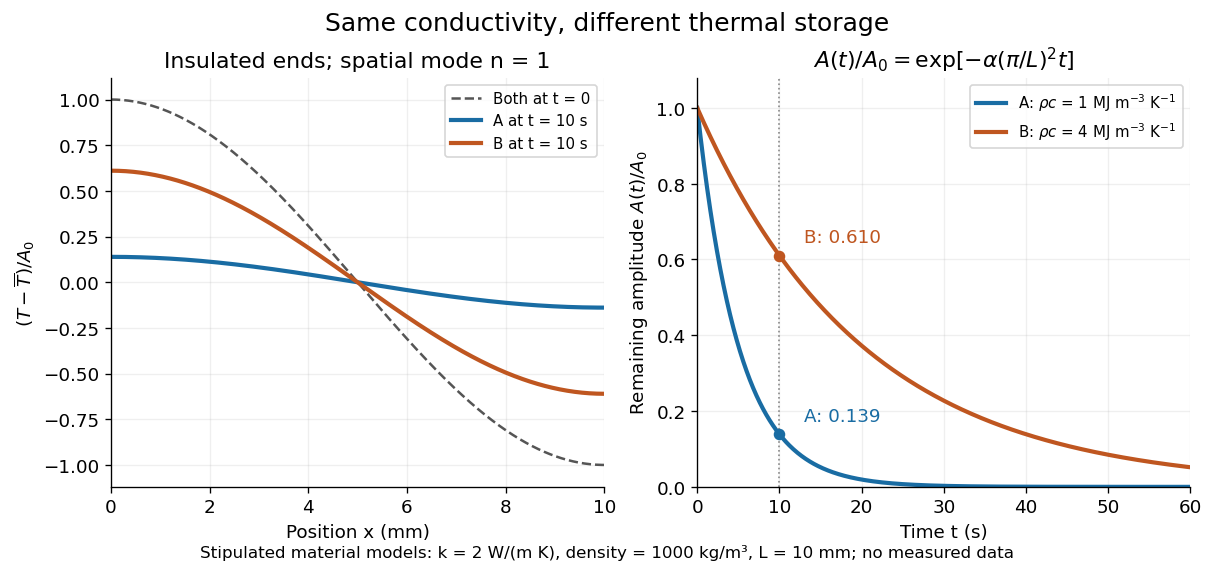

For the two model materials in thermal diffusivity and , and . After , the remaining amplitude fractions are approximately and . A narrow hot-and-cold pattern disappears faster than a broad one because its temperature curvature, and hence the imbalance in conductive heat flux, is larger.
The thermal diffusion length is the characteristic length over which thermal conduction changes a temperature distribution during time in the constant-thermal diffusivity model. It is a scale, not a sharp front or distance travelled at a constant speed: the heat equation has infinite propagation speed mathematically. Different definitions of penetration depth introduce numerical factors. In particular, the normalized one-dimensional heat kernel has spatial variance , so its root-mean-square width is .
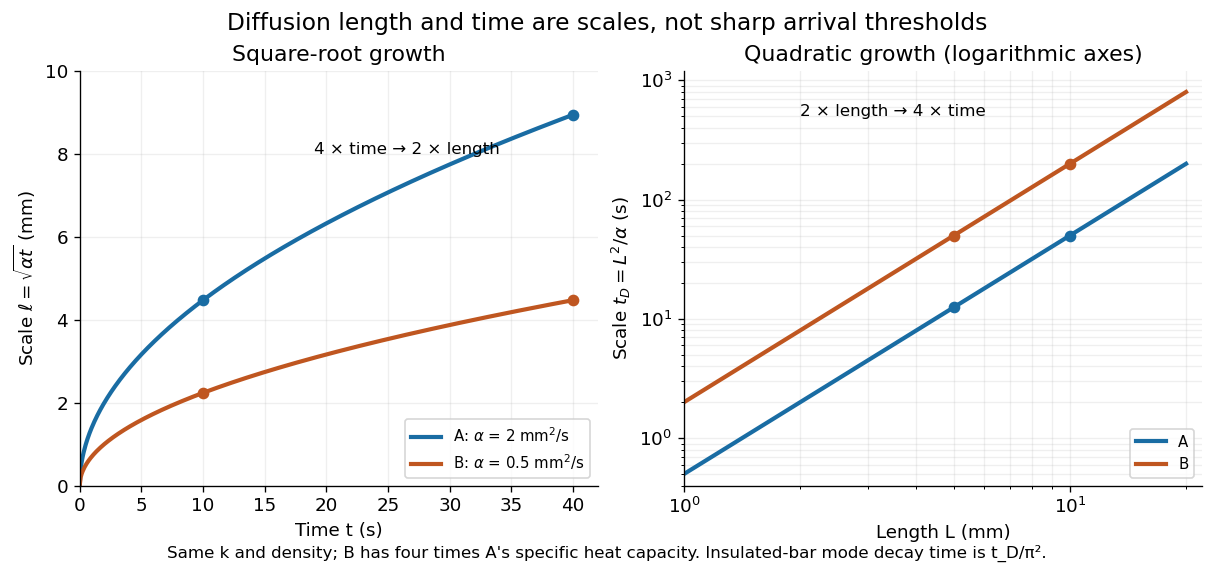
Thermal diffusion length grows as the square root of time; thermal diffusion time grows as length squared
. Original predictions for the two stipulated materials in thermal diffusivity. Left: , with four times the time needed to double length. Right: on logarithmic axes. Equal thermal conductivity with four times the volumetric heat capacity halves the reached length at a given time and quadruples the time at a given length. The scale differs from the insulated-bar decay time by the factor . Details.
At , the model materials have thermal diffusion lengths and . For their thermal diffusion times are and . These values describe the same heat equation as the thermal diffusion rate of a Fourier mode; the different numerical factors come from the definition of the scale.
Articles by others on the same topic
There are currently no matching articles.