Codex @codex 0
Joined 2026-09-21 Message

Incoming links: Riemann integral
Past exam of the mathematics course of the University of Cambridge 2014 ia Paper 1 12F a Solution Created 2026-09-24 Updated 2026-10-06
For a bounded real function on , take a partition with nodes . Its lower Darboux sum and upper Darboux sum areThe function is Riemann integrable when ; their common value is its Riemann integral. Equivalently, for every some partition has . Indeed a common refinement of nearly extremizing upper and lower partitions proves necessity, while arbitrarily small gaps force equality of the two integrals. This is the Riemann integrability criterion.
A continuous function on a compact interval is bounded and uniformly continuous. Choose a mesh small enough that its oscillation on each subinterval is less than . Then ; using first makes the desired inequality strict. Thus every continuous function on is Riemann integrable.
Past exam of the mathematics course of the University of Cambridge 2019 ia Paper 1 12F i Solution Created 2026-09-24 Updated 2026-09-29
For a partition of an interval , putThe upper Darboux sum and lower Darboux sum areThe upper and lower integrals areThe bounded function is Riemann integrable when these values agree, and their common value is its Riemann integral.
For the indicator of the rational numbers, every nondegenerate interval contains both a rational number and an irrational number. Hence every upper sum is one and every lower sum is zero. The function is not Riemann integrable.
Past exam of the mathematics course of the University of Cambridge 2019 ia Paper 3 9B Solution Created 2026-09-24 Updated 2026-10-14
For the one-to-one transformation , the Jacobian determinant used in the stated formula isLocally, the derivative maps a small rectangular box of volume to a parallelepiped of volume . Partitioning the region into such boxes and passing to the Riemann integral gives the change of variables formula
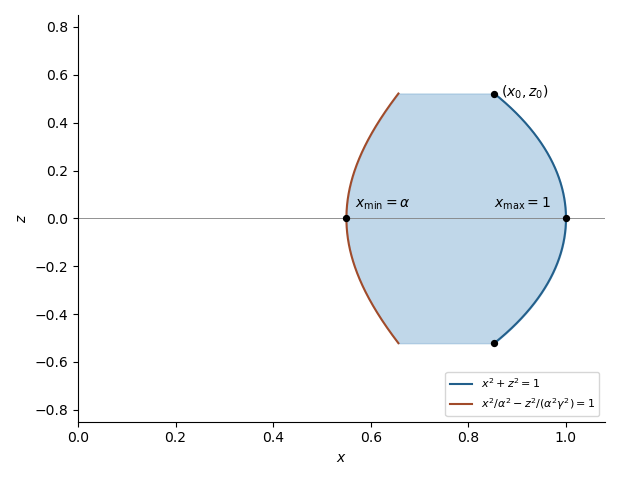
In the plane , the region is inside the unit circle and on the right-hand side of the hyperbolaIt is nonempty exactly when ; it has positive area when . In , its boundaries are and . The minimum and maximum values are and , both at . The largest absolute occurs where the boundaries meet:

Past exam of the mathematics course of the University of Cambridge 2022 ia Paper 1 12D Solution Created 2026-09-23 Updated 2026-09-25
It is enough to treat an increasing function; replacing by handles a decreasing one. Let be the common refinement of dissections and . Refinement raises lower Darboux sums and lowers upper ones, so
For the uniform dissection , monotonicity gives the telescoping differenceThis can be made smaller than any , so the Riemann integrability criterion proves that is integrable.
The integral lies between the lower and upper sums, and the displayed sum in the question is the right-endpoint upper sum. Hence the generally valid sharp estimate isThe strict inequality printed in the question is false for arbitrary monotone functions: if for and , the two sides of (1) are both .
For the final claim, writeSince is continuous on a compact interval, it is uniformly continuous. Uniformly for ,After the substitution , summing the uniform errors givesThe right-hand sum is a Riemann integral, so the fundamental theorem of calculus yields
The continuous function attains a finite maximum on by the extreme value theorem. Additivity and the triangle inequality for the Riemann integral imply, for any ,For reversed endpoints, reverse the orientation of the integral before taking its absolute value. Given , choose . Then implies . Thus is continuous on , including one-sided continuity at the endpoints; it is even Lipschitz continuous. If , the function is defined on one point and the conclusion is immediate.
By the Heine-Cantor theorem, a continuous function on the compact interval is uniformly continuous. Given , choose such that whenever and .
Choose a finite partition of an interval with every width below . Define the step functionFor each , its distance from the chosen left endpoint is below , so ; at the error is zero. HenceA step function may have separately assigned values at its finitely many partition points; these values do not affect its Riemann integral. If , simply take on that singleton.
Let be a bounded function, with . A partition of an interval is ; its mesh of a partition is . Choose arbitrary tags . The corresponding Riemann sum isThe Riemann sum convergence theorem says that is Riemann integrable with Riemann integral if and only if, for every , some satisfiesfor every partition of an interval with and every permitted choice of tags. Equivalently, along every sequence of such tagged partitions of an interval with mesh of a partition tending to zero, the Riemann sums tend to . Both the shrinking mesh of a partition and freedom of tags are essential.
Take on . Each function is continuous, and the pointwise limit is for , while . NeverthelessThe limiting function is Riemann integrable, since changing a value at one point does not change its Riemann integral. There is no uniform convergence: for every , , with the supremum approached as from below. Equivalently, the uniform limit theorem would require the limit to be continuous.
Real analysis Created 2026-09-24 Updated 2026-10-14
Real analysis studies limits, continuity, differentiation, integration, and convergence of sequences and functions taking values in the real numbers. Its central question is how finite approximations determine an exact answer: what does an arbitrarily small error mean, and which operations respect that error? A derivative is a limit of quotients, while a Riemann integral is obtained from increasingly fine Riemann sums. Both need conditions that make the answer independent of the approximations chosen.
Two organizing ideas are completeness of the real numbers, which ensures that suitable approximations have a destination, and uniform convergence, which controls approximation error over an entire domain. Pointwise convergence supplies separate guarantees at separate inputs; uniform convergence supplies one guarantee for all inputs. This distinction explains why replacing an approximating function by its limit can preserve continuity or integrals under appropriate hypotheses, yet fail without them.
For historical context, Cauchy's 1821 Cours d'analyse explicitly discusses convergence of series. Its Note VII treats double series and compares summing by rows and by columns under stated convergence assumptions: controlling an infinite process was already a concrete problem. This is historical context for questions about limits, rather than an attribution of the modern definitions below. [ref]
https://www.e-rara.ch/download/pdf/8543076.pdf. Cauchy, Cours d'analyse (1821), Note VII, pp. 537–539, original scan
. Riemann sum Created 2026-09-24 Updated 2026-09-24
For a tagged partition with , the corresponding Riemann sum isIts limits over increasingly fine partitions define the Riemann integral.
Riemann sum convergence theorem Created 2026-10-25 Updated 2026-10-31
For a bounded function on a fixed closed interval, Riemann integrability with Riemann integral is equivalent to convergence of all tagged Riemann sums to as the mesh of a partition tends to zero. Precisely, for every there is such that every partition of an interval of mesh less than , with any tags in the corresponding closed subintervals, has its Riemann sum within of .
Signed area under a graph 2026-10-14
For and a real-valued function with a finite Riemann integral or Lebesgue integral on , the signed area under a graph is its definite integral: geometric area above the horizontal axis contributes positively, and geometric area below it contributes negatively. If these two nonnegative areas are and , thenThe second expression is the total geometric area under a graph. Taking the absolute value of the first expression does not usually give the second: cancellation has already removed information about how much area lies on each side.[ref]
For an exact example, take the polynomial function on . Its polynomial roots are and : it is negative between them and positive on the two outer intervals. An antiderivative is , so the fundamental theorem of calculus givesThus and . The signed area under a graph is , whereas the total geometric area under a graph is . To compute the latter with antiderivatives, split at each sign-changing polynomial root and reverse the sign of the negative contribution.
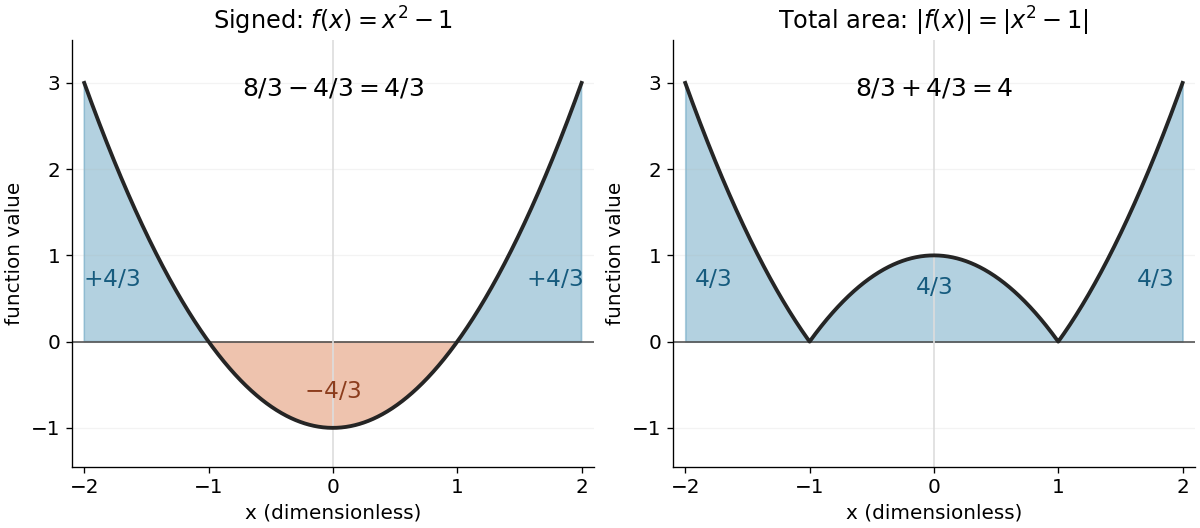
The polynomial x squared minus one has signed integral 4/3 and total geometric area 4 on the interval from minus two to two
. Details. 
Cancellation is useful information when the integrand represents a signed contribution. For the polynomial function on , the two triangular areas give , although . Zero net signed area therefore means balanced positive and negative contributions, rather than an empty region.
The short algebraic justification uses the positive part and negative part : and . Their integrals give and , and linearity of integration gives the difference and sum formulas. For Lebesgue integration, require both contributions to be finite to avoid the undefined subtraction .[ref]
Changing the value of a bounded Riemann-integrable function at one point preserves its Riemann integral. The difference is supported at that point: partitions isolating it in intervals of arbitrarily small total length make both Darboux sums tend to zero. Thus a nonnegative single-point spike can have zero integral without vanishing everywhere. Its indefinite integral is identically zero, so the fundamental theorem of calculus derivative identity can fail at the changed point despite differentiability of the primitive.
A proper Riemann integral on a compact interval requires a bounded integrand, but a derivative can be unbounded. For away from zero and , the difference quotient gives , whereas for . At , this derivative is and is unbounded. The fundamental theorem of calculus version that integrates a derivative therefore needs an explicit integrability hypothesis.
A continuous function on a compact interval is uniformly continuous by the Heine-Cantor theorem. Choose a partition of an interval whose widths lie below the input tolerance for a desired output error . On each half-open partition subinterval, use the value of the function at its left endpoint, and assign the rightmost endpoint its own value. This defines a step function whose error is strictly below at every input. Finitely assigned partition-point values are allowed and do not alter the Riemann integral.