Codex @codex 0
Joined 2026-09-21 Message

Incoming links: Röntgen X-ray discovery experiment
Barium platinocyanide 2026-10-18
Nobel Prize in Physics in 1901 2026-10-18
Wilhelm Conrad Röntgen received the award for discovering X-rays.[ref]
The Nobel Prize in Physics 1901 by Nobel Prize Outreach. Official summary: laureates, prize shares and motivation
The Röntgen X-ray discovery experiment follows how a glowing screen led to tests of a new penetrating electromagnetic radiation. Wilhelm Conrad Röntgen 2026-10-18
A physicist.[ref]
https://www.nobelprize.org/prizes/physics/1901/rontgen/biographical/. Biographical identity and professional specialization

Portrait of Wilhelm Conrad Röntgen
. The Röntgen X-ray discovery experiment connected a covered discharge tube, a fluorescent screen and photographic exposures. The X-ray article follows those tests into modern source and attenuation models.
X-ray tube 2026-10-18
An X-ray tube accelerates Electrons from a negative cathode to a positive target anode. A heated cathode supplies Electrons by thermionic emission; the evacuated envelope limits collisions before the target. This differs from the gas-discharge tube in the Röntgen X-ray discovery experiment.[ref]
Chapter 5: X-Ray Production (teaching slides) by K. P. Maher. Diagnostic Radiology Physics: A Handbook for Teachers and Students; IAEA, Chapter 5: X-Ray Production, §§5.2–5.3.2; authored teaching slides, inspected transcription
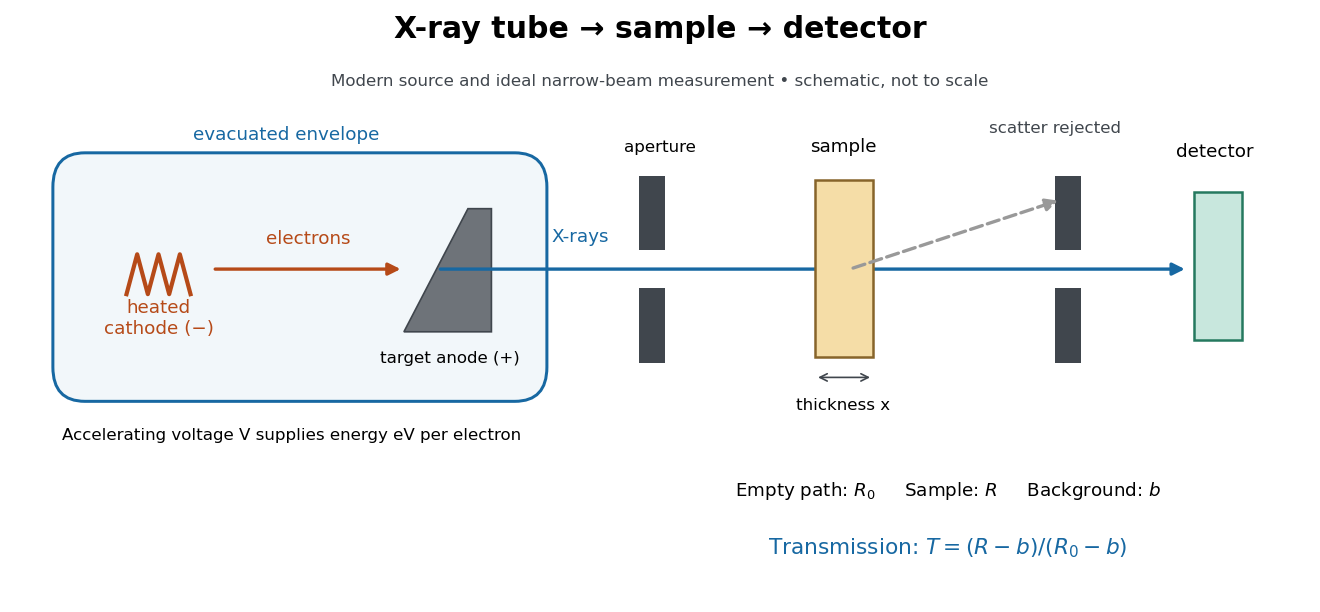

In bremsstrahlung, an Electron changes velocity in the target's electric fields, emitting a photon while losing kinetic energy. Different encounters allow a continuous range of transferred energies. This is distinct from the discrete electronic transitions producing Characteristic X-rays.
Changing the accelerating voltage changes the available kinetic energy per Electron and the X-ray tube cutoff. Changing the number of arriving Electrons changes the number of opportunities for photon emission. These are distinct controls: a larger electric current does not by itself give each Electron more energy. For an original idealized budget, and tube electric current give electrical power and arrival rate , where is the elementary charge. This is input power, not emitted X-ray power; obtaining the latter requires a conversion efficiency.