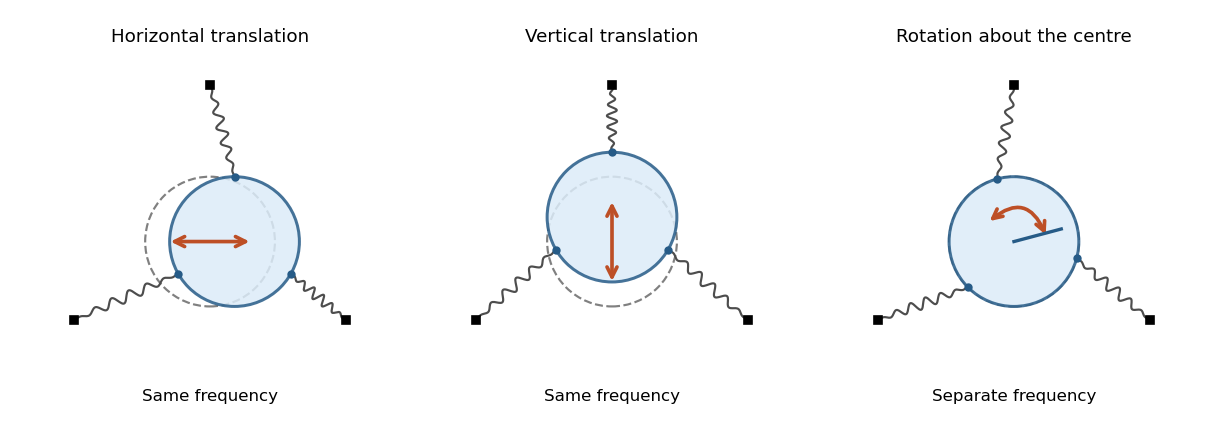
A uniform rigid body disk of mass and radius moves in a frictionless plane. Let identical springs attach equally spaced rim points to fixed anchors in their radial directions. The equilibrium spring length is , natural length , and spring constant . Write the small centre displacement as and the rotation as . For a spring with radial and tangential unit vectors , its length isThis follows by a second-order Taylor series for the distance between and . In the elastic potential energy , the equilibrium tension multiplies the second-order change of length. Thus it contributes to the linearized stiffness even though the displacement is small.
The equally spaced directions satisfy and . Summing the spring energies givesThe kinetic energy is , using the moment of inertia of a uniform disc. The Euler-Lagrange equations give the displayed squared angular frequencies. The translational normal modes are degenerate; rotation is independent. At zero prestretch the rotational frequency vanishes at quadratic order, and finite-angle spring stretching first contributes at higher order.

Articles by others on the same topic
There are currently no matching articles.