For collected spectral radiant flux and a linear photodiode with spectral responsivity , the dark-subtracted electric current is . A reference optical spectrum sets the conversion from electric current to collected luminous flux. Applying it to another optical spectrum givesAssume nonzero calibration and test signals. Then is the corrected luminous flux. Multiplying either optical spectrum by an overall positive scale leaves unchanged. If is proportional to , for every optical spectrum. Uniformly overfilled aperture measurements use wavelength-resolved irradiance instead, multiplying the electric current expression by aperture area; the same ratio cancellation gives the illuminance correction. This is the algebra behind source-dependent calibration, rather than a new measured correction curve. [ref]
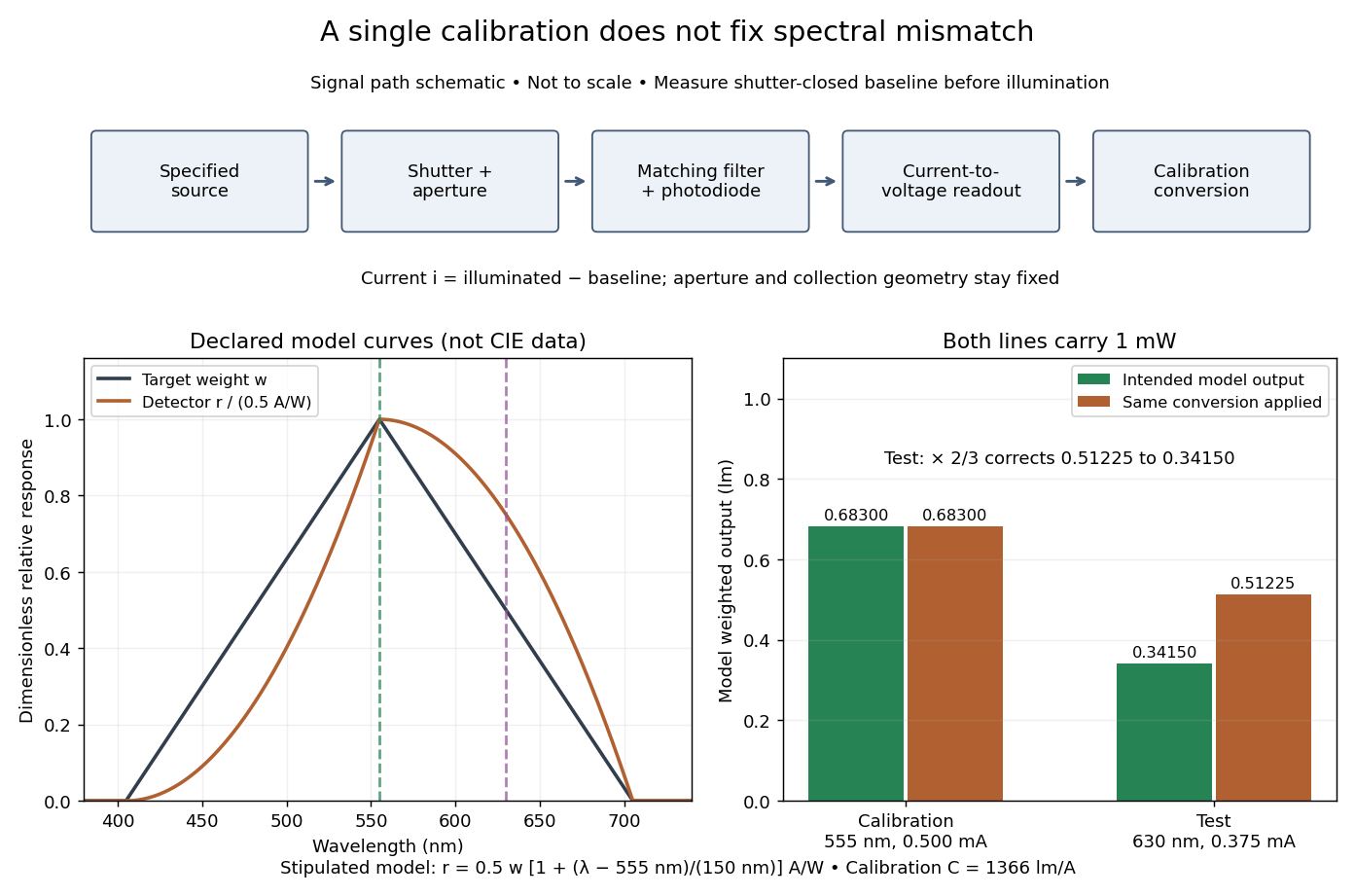
Use the triangular in equal radiant power under visual weighting and stipulate the detector's spectral responsivityThis model has nonnegative response: is zero outside –. For a ideal calibration line at , and , so . An equal-radiant flux test line at gives , and . The unchanged conversion indicates , whereas the model's intended weighted result is . The required spectral mismatch correction is : the uncorrected result is 50% too large. All these numbers are declared model outputs, not instrument measurements or standard photometry data.

Articles by others on the same topic
There are currently no matching articles.