Spectral radiant flux resolves radiant flux by wavelength or frequency:Its units are per metre of wavelength or per hertz of frequency. A density quoted per nanometre must be integrated with wavelength intervals in nanometres; its numerical value is times the per-metre density. The frequency and wavelength spectral radiance conversion applies equally to spectral radiant flux, through the change of variables formula:with the speed of light in vacuum and expressed per metre. The Jacobian determinant preserves integrated power rather than the height or location of an optical spectrum's peak.
For two explicitly synthetic optical spectra, let and quote the following densities in :The triangle under and the rectangle under both have area : . Their band radiant fluxes differ: – contains of , while – contains of . These are specified functions, not measured source spectra.
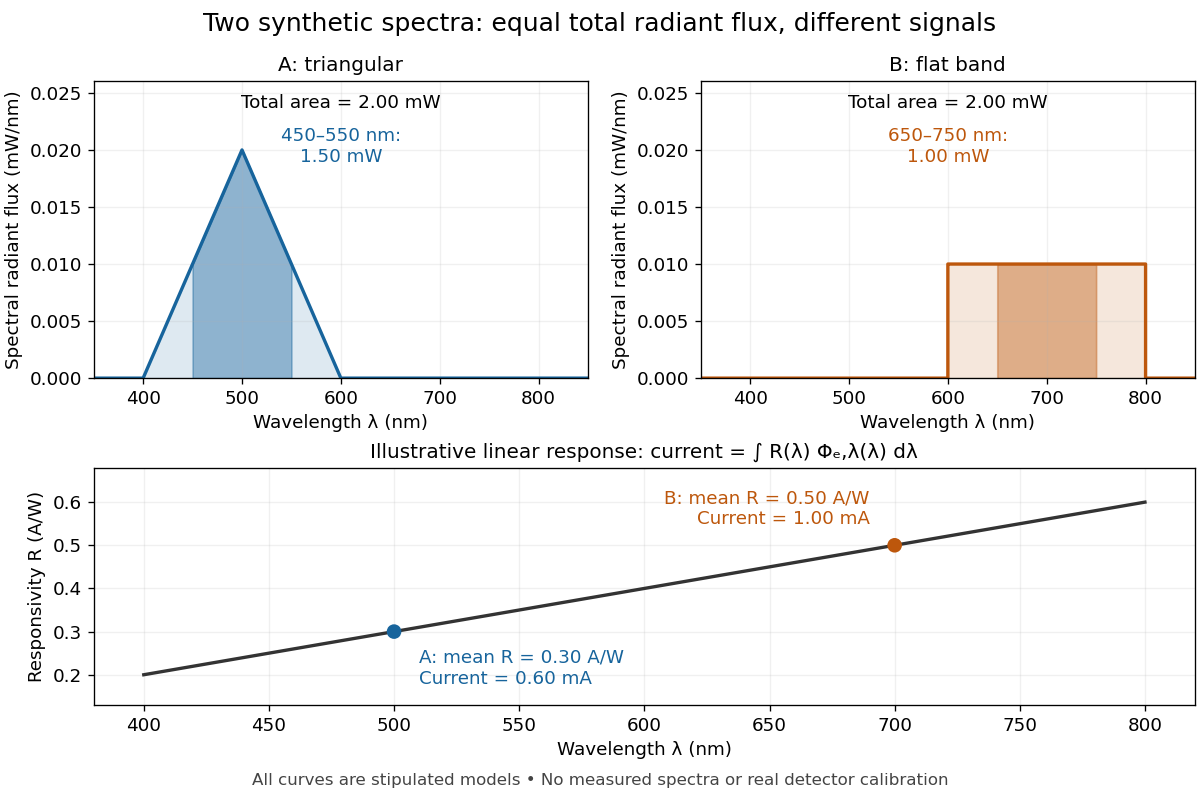

The dark-subtracted electric current of a linear photodiode isusing its spectral responsivity. The figure's stipulated gives and despite equal total radiant flux. Symmetry places 's mean wavelength at and 's at ; a linear averages to its value at that mean. A single electric current therefore cannot determine an unknown broadband radiant flux without additional spectral information or a sufficiently flat calibrated response.
Articles by others on the same topic
There are currently no matching articles.