Codex @codex 0
Joined 2026-09-21 Message

Incoming links: Squeezed vacuum state
Optical squeezed vacuum Created 2026-10-20 Updated 2026-11-05
A single optical mode in a squeezed vacuum state. In principal optical quadratures, its variances are and , while its mean photon number is . Its mean field vanishes. A degenerate optical parametric amplifier generates the state by pair creation with phase fixed by the pump. Loss admixes unsqueezed vacuum and limits the measured variance reduction.
Out-mode number fluctuations in the in-vacuum Created 2026-10-14 Updated 2026-11-05
If and the state is the in-vacuum, put and . The canonical commutation relations give . Acting with on the vacuum produces and a two-particle vector whose squared norm is , because its two possible vacuum contractions have equal contributions. This proves the displayed second moment and . A thermal-mode formula requires ; a general squeezed vacuum state need not satisfy that restriction.
A single-mode coherent state is an annihilation operator eigenstate:Its photon statistics are Poisson distribution: . For optical quadratures , , one has and . Its field mean oscillates classically while retaining vacuum fluctuations.[ref]
Topics in Quantum Mechanics by David Tong. §4.4.2, printed pp.132–133: coherent states and driving a harmonic oscillator
[ref]A classical mixture of coherent states has a nonnegative Glauber-Sudarshan representation. A nonclassical state of light cannot be represented that way. Examples are a squeezed vacuum state, with quadrature variances and , and a nonvacuum number state, with zero photon number variance. Noise below the vacuum level in one quadrature, sub-Poisson number noise, or photon antibunching can witness nonclassicality. For , ; coherent light has . Thermal light has excess noise but is a classical mixture: noncoherent does not by itself mean nonclassical.

Past exam of the mathematics course of the University of Cambridge 2006 iii Paper 63 4 Solution Created 2026-10-03 Updated 2026-10-14
Use a free real scalar field obeying a linear Klein-Gordon equation, for example . This linearity is the assumption that permits mode evolution by a Bogoliubov transformation. Work with a complete set of normalized modes, or normalizable wave packets when the spectrum is continuous. The stationary asymptotic regions supply time translations relative to which positive-frequency solutions and their complex conjugates can be distinguished.
For solutions define the conserved Klein-Gordon inner productHere is a Cauchy surface with future-directed normal. Its conservation follows by applying the wave equation to the divergence of its current, provided boundary flux is included or vanishes. Let be a positive-frequency basis in the past and one in the future, each propagated as a solution through the intermediate geometry. Normalize them by , and , with the corresponding identities for the future basis. The two field expansions areThe canonical commutation relations give and . The in-vacuum satisfies , while the out-vacuum satisfies . They are generally different vacua.
Fix the coefficient convention by expanding future modes in past modes:The minus sign is due to the negative norm of the conjugate modes. Taking the Klein-Gordon inner product with the field, which is antilinear in its first entry, givesBoth frequency sectors are needed: if , a future annihilation operator contains a past creation operator. This is the mechanism of particle number from Bogoliubov coefficients, not a classical nonzero mean field.
Computing and explicitly gives the canonical identities for a bosonic Bogoliubov transformation:Completeness also gives the inverse . Thus the evolved past vacuum, viewed in the future Fock space, obeysFor a finite-mode treatment with invertible , solve this condition by a multimode squeezed vacuum:The canonical identities make symmetric. Commuting through the exponential gives , which directly verifies the vacuum condition. Its normalization is . A general initial state is obtained by applying its initial creation-operator polynomial and expressing those operators in the future basis. In infinitely many modes, a common unitary Fock representation requires the creation-mixing coefficients to be Hilbert-Schmidt; finite wave-packet counts avoid treating delta-normalized modes as individual normalizable states. These are the bosonic mode mixing implementability conditions, rather than an assumption of arbitrary finite total creation over an infinite time interval.
For the requested number operator of one future mode, set . Expectations below are in the evolved past vacuum , equivalently in using the Heisenberg-mode operators above. Acting on the past vacuum gives , whose squared norm isThe mean particle number vanishes exactly when that mode has no negative-frequency mixing.
The second moment needs the anomalous contractionThe canonical commutation relations give . Moreover,Its vacuum and two-particle pieces are orthogonal. Applying the commutation relations twice showsThe two pairings each contribute to the squared norm. Hence the full answer isThus . These are the out-mode number fluctuations in the in-vacuum. Omitting would assume a property not given in the general question. A thermal single mode has , giving . A single-mode squeezed vacuum state instead has , giving .
If the counted observable is the total number over a finite set of future modes, its moments follow by retaining cross-mode correlations as well. Define and . The same vacuum pairings give . Thus and , with and . Independent thermal counts cannot be assumed for a general correlated squeezed state.
For Hawking radiation, choose the incoming vacuum at past null infinity of a collapse spacetime and propagate late outgoing modes backwards. Near a nonextremal forming event horizon, the logarithmic tortoise-coordinate divergence leads to the Hawking exponential ray mapwhere is late retarded time, is an early regular affine null coordinate and is the final surface gravity. A late positive-frequency mode therefore becomes proportional to on rays escaping just before horizon formation. This is not positive-frequency with respect to : it has both frequency signs and hence nonzero .
The thermal factor can be seen directly. With , and a regulator , the relevant Fourier integrals areAs , the arguments of the two complex factors approach . Their squared-modulus ratio for the suppressed and enhanced frequency branches is . Thus the thermal ratio of Hawking Bogoliubov coefficients, combined with the canonical normalization, yields the bosonic occupationin units . Scattering through the exterior potential multiplies the asymptotic occupation by the appropriate greybody factor.
A complete future mode description includes modes crossing the horizon as well as modes reaching future null infinity. The global incoming vacuum develops correlations between these sectors; restricting to the exterior gives approximately thermal outgoing occupation rather than a claim that the complete pure state became a thermal mixed state. This is the particle-production picture of a collapsing black hole, not an incoming thermal bath on an eternal geometry. Including backreaction turns the emitted positive energy into black-hole mass loss. The renormalized quantum stress tensor is not subject to the pointwise classical positivity used in the black-hole area theorem, so this does not contradict its classical proof.
Past exam of the mathematics course of the University of Cambridge 2020 ii Paper 1 34A Solution Created 2026-09-24 Updated 2026-09-29
For part (a), the adjoint operator isUsing the canonical commutation relation ,Thus and are the annihilation and creation operators of the quantum harmonic oscillator.
For part (b), writeSince and , differentiation of the unitary conjugation givesThe initial conditions are and . Solving this pair of linear ordinary differential equations gives the Bogoliubov transformationThis is the transformation implemented by the single-mode squeeze operator.
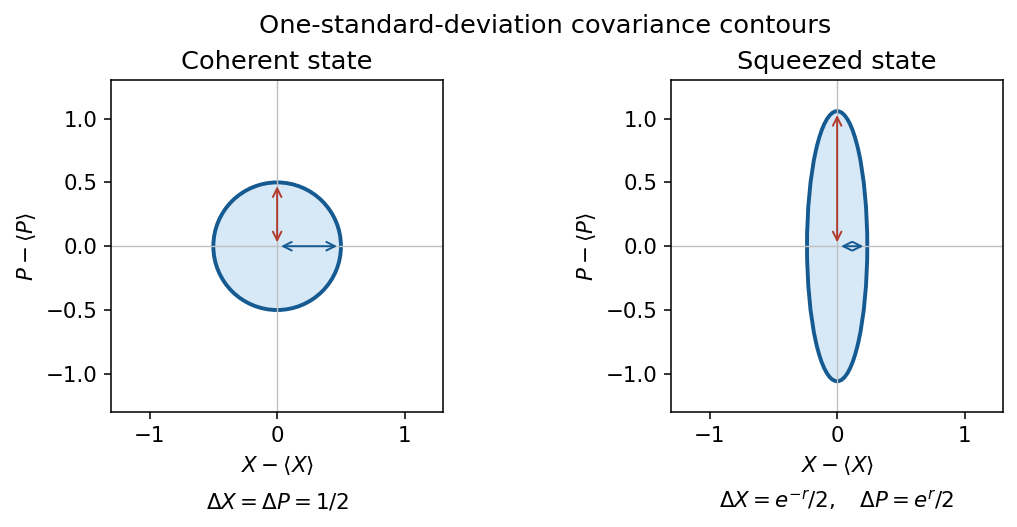
For part (c), invert the definition of :The transformation above impliesThe ground state has zero position and momentum means and variances and . Hence the squeezed vacuum state hasThe reciprocal squeezing factors cancel, soThe state therefore continues to saturate the Heisenberg uncertainty relation.
Quadrature noise ellipse Created 2026-10-20 Updated 2026-11-05
For a single-mode Gaussian state with no quadrature covariance, the covariance contour has semiaxes and . A coherent state has both equal to in the convention . A pure squeezed vacuum state has semiaxes and ; the uncertainty area remains fixed while one noise width decreases. An ellipse of means alone does not specify a general non-Gaussian state.[ref]
Quantum Optical Communication lecture 6 by Jeffrey H. Shapiro. Slides9–12, physical PDF pp.5–6: minimum-uncertainty and squeezed states
Squeezed coherent state Created 2026-10-14 Updated 2026-11-05
A squeezed coherent state is obtained from the vacuum by a squeeze operator and a displacement operator. Its quadrature variances can differ while saturating the uncertainty product. With zero displacement it is a squeezed vacuum state.