A step-index optical fiber has a nearly uniform refractive index throughout its optical fiber core, with an abrupt decrease to in its optical fiber cladding. In a straight, ideal guide, meridional rays stay in a plane containing the optical axis and trace a zigzag through repeated total internal reflection. This is a geometrical optics approximation; it is particularly useful for a multimode optical fiber whose core diameter is large compared with the wavelength.
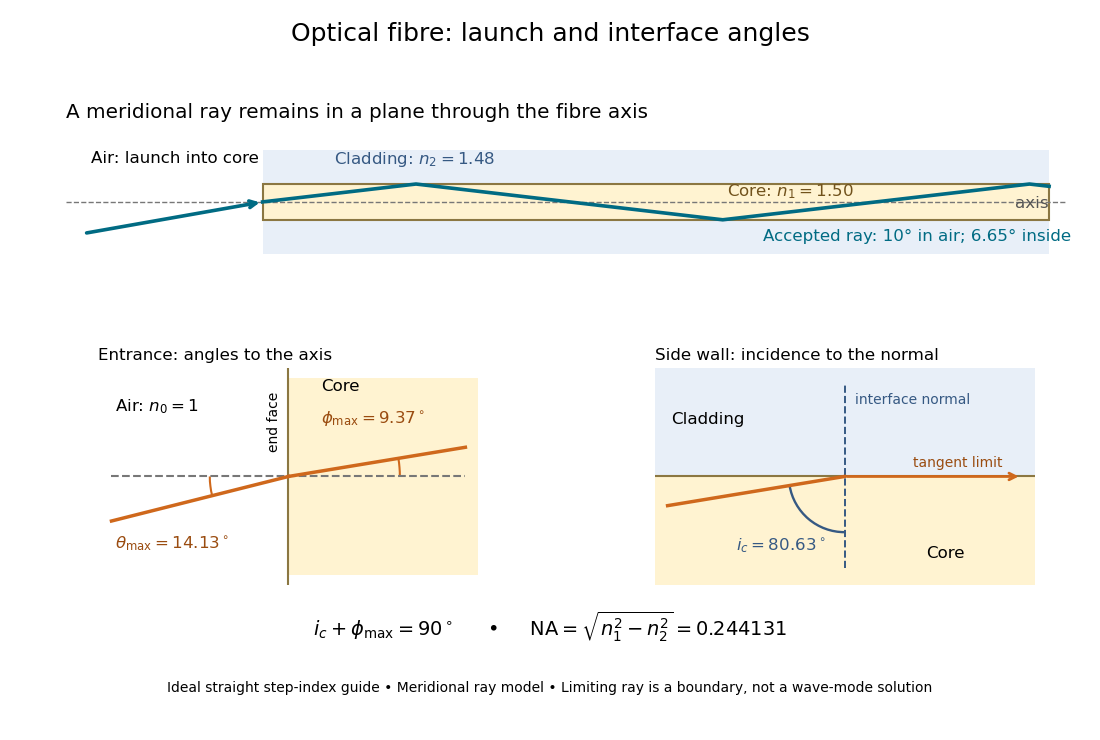

The upper panel shows an accepted meridional ray; the lower panel enlarges the limiting geometry. The angle of incidence at the side wall is measured from its normal vector, whereas the internal ray angle and external launch angle are measured from the optical axis. Thus . The limiting ray is a boundary of the ideal model, rather than a complete normal mode solution.
The dimensionless waveguide parameter combines radius, vacuum wavelength and the numerical aperture factor. In the weak-guidance scalar model the first additional spatial family appears at , the first positive zero of a Bessel function of the first kind. The fundamental family has no positive cutoff. Its two polarizations are not two distinct spatial profiles.
For a light ray launched on the centreline in the plane of a circular optical fiber bend, let be centreline radius, core radius and the internal launch angle from the tangent. The straight segment's distance from the bend centre is . Thus its outer-wall angle of incidence satisfies . Equating this to gives the limiting total internal reflection threshold in the title, provided . Radially displaced or nonplanar launches need different geometry; this is not a universal wave-optical loss cutoff.
The optical fiber acceptance angle is the largest launch half-angle admitted by the specified guide model. For a flat entrance face perpendicular to the optical axis, external refractive index , and a straight step-index optical fiber, Snell's law at the entrance givesAt the core–cladding interface, the critical angle for total internal reflection satisfiesFor a meridional ray, strict total internal reflection requires . At the limiting geometry , the refracted light ray is tangent to the interface, soThis identifies the numerical aperture with an entrance cone under these assumptions. With for air, the conventional inclusive boundary condition isfor a nonnegative launch angle ; a practical launch stays inside the boundary. If , this ideal model imposes no further restriction within the forward hemisphere, and must not be used. The light ray must also intersect the optical fiber core: a suitable angle alone does not correct a misplaced beam.
For an original example, take , and air at the entrance. ThenThe internal limiting angle is only , while the critical angle for total internal reflection is . A launch has and , so it satisfies total internal reflection. A launch has and , so it fails this test.
This cone is a geometrical optics result for meridional rays. A single-mode optical fiber requires the spatial overlap of the incident electromagnetic wave with its guided normal mode; its numerical aperture does not impose an exact angular cutoff on arbitrary beams. Diffraction, finite cladding, and bends require a physical optics description.[ref]
When does NA provide a good estimate of the fiber's acceptance angle? by Thorlabs. Insights into Optical Fiber, When does NA provide a good estimate of the fiber's acceptance angle?, Geometry Defines the Relationship and Single Mode Fibers are Different; revised January 20, 2020
Articles by others on the same topic
There are currently no matching articles.