Take an invented diatomic molecule with a Morse potential, setting the separated-atom energy to zero:Here is an inverse length, the equilibrium bond length, and , with reduced mass . These stipulated parameters describe a simple model, not a measured chemical substance. For the one-dimensional Morse oscillator, energy eigenvalues above the minimum areConsequently,The harmonic estimate is slightly larger than this model's exact zero-point energy. The physical bound-level restriction matters: the quadratic expression is not an infinite ladder of vibrational quantum states.
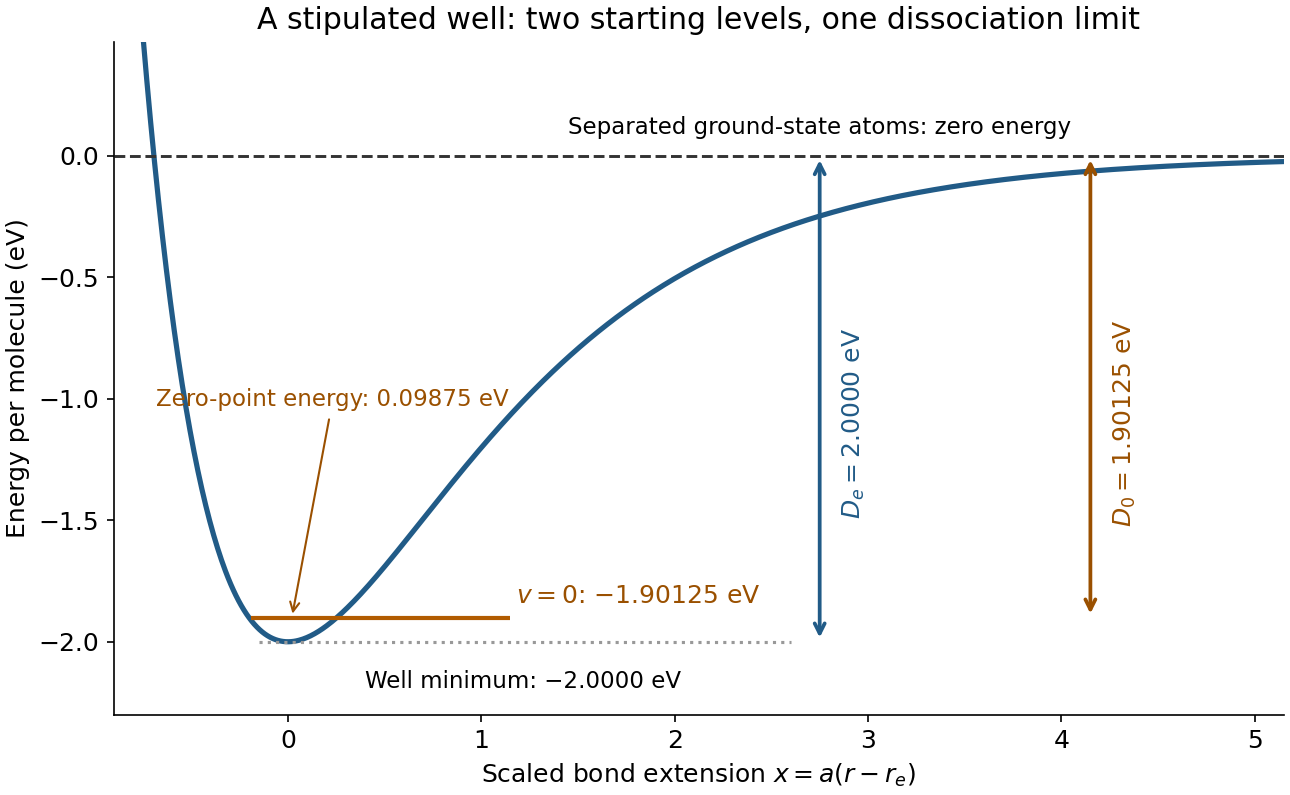
Bond potential-well depth and ground-state dissociation energy reach the same separated-atom limit from different starting energies
. Original stipulated Morse potential with and . The horizontal coordinate is ; the horizontal line is an energy eigenvalue, not a classical trajectory or a measured spectrum. Details.
For a separate thermal illustration using this same stipulated , assume an ideal gas, fully active molecular rotation of the parent, negligible thermal molecular vibration, and negligible electronic excitation for all species. Each monatomic product contributes ; the diatomic molecule contributes . Thus the net increment is , with molar gas constant . At ,This last result follows from the stated thermal model, not a universal correction for every chemical bond. Frozen rotations, accessible excited states, different fragment composition, or a condensed phase change the thermal increments.
Articles by others on the same topic
There are currently no matching articles.