A support polygon is the convex hull of a body's supporting contact positions, projected onto a horizontal plane. For a rigid body resting on that plane in a uniform gravitational field, with gravity as the only applied load besides support reactions, it describes which horizontal center of mass positions can admit static equilibrium. Widely separated feet can support a center of mass above empty space between them: the footprint's convex hull, rather than the material under every point, matters.[ref]
Robotic Systems by Kris Hauser. Chapter 12, Equilibrium conditions, support-polygon definition and Figure 3
The geometry follows directly from force and torque balance. Let the contact positions be and their upward normal forces be . The inequality expresses unilateral contact: an ordinary unbonded support can push the body upward but cannot pull it downward. For total mass , gravitational acceleration and horizontal center of mass projection , balance givesDivide by and write . ThenThus must be a convex combination of the contacts, which is exactly membership in their convex hull. Conversely, any such convex combination supplies nonnegative reactions satisfying this model's balance equations. The center of pressure of these vertical contact forces coincides with . This proves existence of allowable reactions; it does not determine every reaction uniquely when there are more contacts than independent balance equations.
For an original three-foot example, take contact positions , and in metres. The support polygon is the triangle described by , , . A body with requires the convex combination coefficientsWith , the corresponding normal forces are , and . Moving the projection to would require , a downward reaction at the first foot. No set of nonnegative normal forces can hold that configuration at rest under the stated loads.
A simple test uses a rigid plate on three small supports, a movable known mass, and three load cells measuring the upward reactions. Include the plate's own mass and center of mass when calculating the combined projection. As that projection approaches the edge , the first support's reading approaches zero. Beyond the edge, maintaining the same contact configuration would require the forbidden downward reaction; the observed motion or changed contact set marks the failure of the original static equilibrium. This is a proposed apparatus test of the balance equations, not reported experimental data.
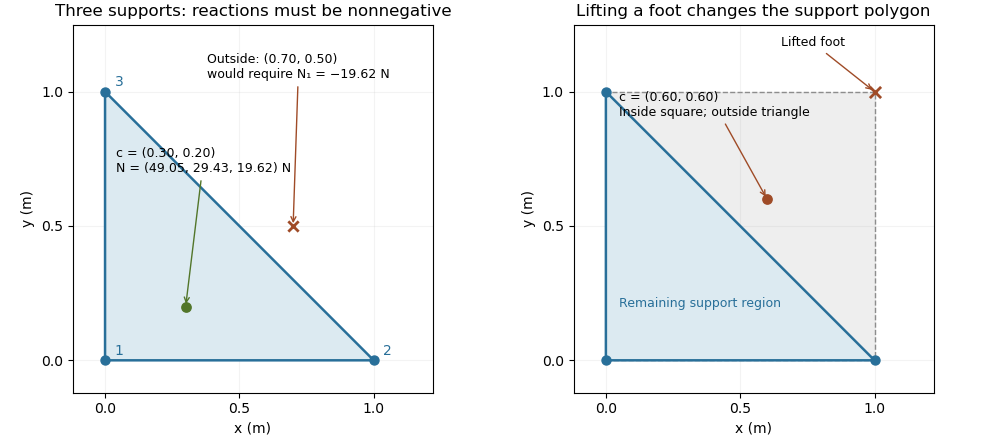
The distance from an interior projection to the polygon's nearest edge is a static tipping margin; here it is . A boundary projection has zero margin: some supports unload, and an arbitrarily small outward shift can make balance impossible. A strictly interior projection gives a positive geometric margin against small horizontal shifts under the same model. It is not a general certificate of dynamical stability for a flexible or articulated system.
This explains a constraint in a quadrupedal robot's gait. Four feet at the corners of a square give a square support polygon. Lifting the corner leaves the triangle , , . A center of mass projection at was inside the square but is outside that triangle, so the body must shift or use dynamics to lift that foot without losing the assumed balance. The contact set must be updated when computing the support polygon.
The assumptions matter when applying the test. Nonhorizontal contacts require the full balance equations and admissible contact forces, including Coulomb friction; a projected hull alone need not decide feasibility on irregular terrain.[ref]
Robotic Systems by Kris Hauser. Chapter 12, Contact modeling, Equilibrium conditions and Multi-modal motion planning, Example 1
Additional horizontal loads also change the balance problem. For example, a horizontal force applied at center of mass height produces an overturning torque about the relevant edge. If the inward horizontal distance to that edge is , incipient tipping of a rigid body satisfies . Whether the body slides first depends on static friction. The gravity-only support polygon contains no information about or that additional load.
