Surface water counted as ice needs warming but has already undergone melting. Its presence therefore biases a dry-ice estimate of latent heat of fusion downward. This is why drying the added ice is a quantitative control in ice-melting calorimetry, rather than cosmetic preparation. Let be the total added mass at , of which a fraction is already liquid and remains solid. The correct constant-property balance isIf an analysis incorrectly treats all as solid and sets , it obtainsThus gives a low estimate with no heat leak. Unaccounted incoming heat also lowers the estimate; outgoing heat raises it. These signs follow directly from the displayed energy balance. Conversely, dry ice initially below absorbs additional sensible heat; neglecting that term overestimates . These are different biases and may partially cancel, so agreement with a reference value alone does not validate the controls.
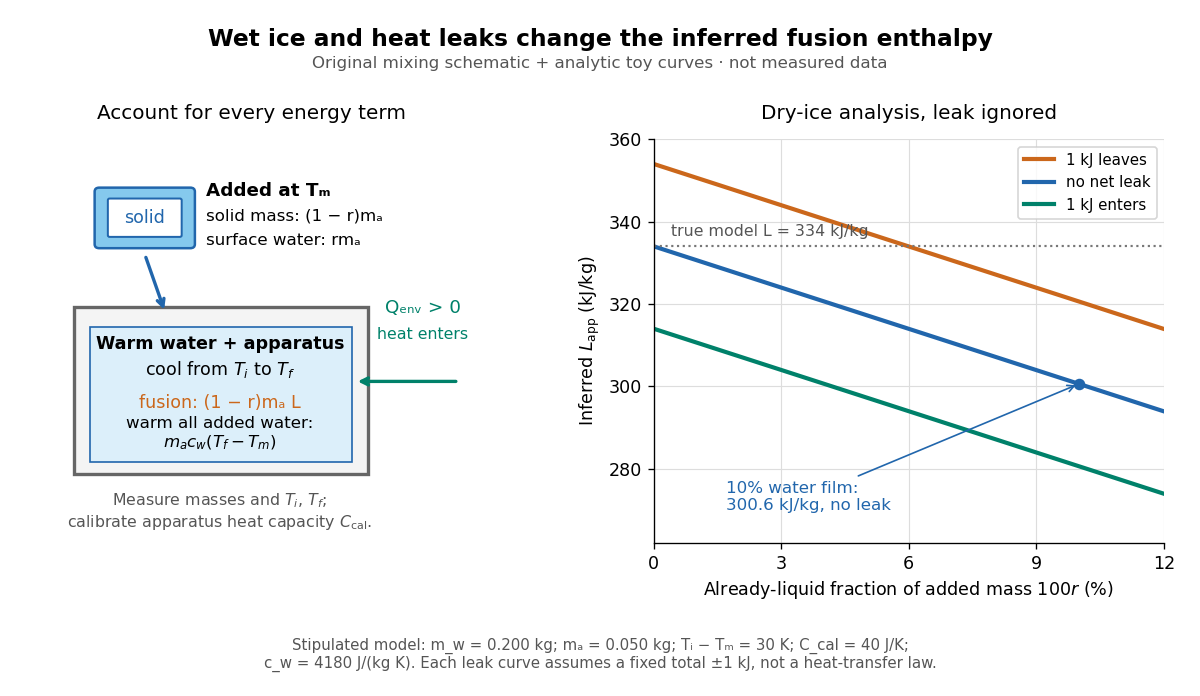

For this model with and , the balance predicts , with consumed by fusion and by warming the melted water. At with the same zero leak, it predicts and . A net incoming shifts downward by a further because . The warmer final water in the wet case is evidence of a smaller fusion budget, not a larger true .
Articles by others on the same topic
There are currently no matching articles.