Ice-melting calorimetry measures the fusion enthalpy through conservation of energy, rather than inferring it from the small temperature change of the melting ice itself. In a mixing experiment, warm water and the container cool while added ice melts and the resulting water warms. Their combined energy balance separates fusion from sensible heat.
Weigh the container and stirrer, then weigh the added warm water to obtain . Let the container and water reach a common initial temperature . Prepare ice in a clean ice-water mixture near , rather than assuming freezer ice is already at ; drain and blot its surface immediately before transfer. Add it without splashing, stir gently, and record temperature before addition and until after the last ice disappears. Reweigh to find the added mass . Wisconsin's laboratory guide specifies drying each piece, weighing before and after, and recording the temperature history; it places the initial and final temperatures on opposite sides of the jacket temperature to reduce net environmental exchange. [ref]
https://badger.physics.wisc.edu/trash/lab_old/manual/node30.html. University of Wisconsin, H-2: Latent heat of fusion of ice, procedure
For fully melted, initially dry ice at , a common final temperature , constant water specific heat capacity at constant pressure , and apparatus heat capacity initially at ,Here denotes net heat entering the apparatus from its surroundings. The left side supplies the fusion enthalpy and the sensible heat on the right; the water produced by melting must be warmed too. The balance extends Case Western's mixing demonstration by including the apparatus and environmental terms. If the specific heat capacities vary appreciably, replace their products with the corresponding temperature integrals. [ref]
https://case.edu/artsci/phys/courses/demos/spec.htm. Case Western, mixing-calorimetry energy balance
Determine independently, for example by a warm/cold water mixing balance with no phase transition, including the wetted stirrer and thermometer in the apparatus. Check the thermometer calibration, keep the lid in place between transfers, and monitor the surroundings. Before/after drift and a comparable run without ice help bound ; such corrections assume comparable heat transfer conditions and are not automatically exact. Choosing a jacket temperature between and reduces exchange but does not prove . Ensure all the ice has melted and the contents are well mixed before using the measured : with residual ice, the weighed addition is not the mass that has undergone fusion. Repeat the experiment and report measurement errors in mass, temperature, and the leak correction.
An independent way to see the plateau is David Roundy's Oregon State experiment: heat an ice-water mixture slowly with a waterproof resistor in an insulated cup, stir, and record temperature, heater electric current , electric potential difference and elapsed time. Plot temperature against , recording changes in or . The initial solid mass must exclude accompanying water. For a boundary enclosing the heater as well as the sample, this input is electrical work, so under the constant-pressure assumptions above. Across an ideal isothermal plateau the apparatus has no sensible heat change, giving ; departures from uniform temperature require accounting for the heater and container response. [ref]
https://paradigms.physics.oregonstate.edu/act/handout/2108. David Roundy, Oregon State, Ice Calorimetry Lab: apparatus, stirring and electrical input
Surface water counted as ice needs warming but has already undergone melting. Its presence therefore biases a dry-ice estimate of latent heat of fusion downward. This is why drying the added ice is a quantitative control in ice-melting calorimetry, rather than cosmetic preparation. Let be the total added mass at , of which a fraction is already liquid and remains solid. The correct constant-property balance isIf an analysis incorrectly treats all as solid and sets , it obtainsThus gives a low estimate with no heat leak. Unaccounted incoming heat also lowers the estimate; outgoing heat raises it. These signs follow directly from the displayed energy balance. Conversely, dry ice initially below absorbs additional sensible heat; neglecting that term overestimates . These are different biases and may partially cancel, so agreement with a reference value alone does not validate the controls.
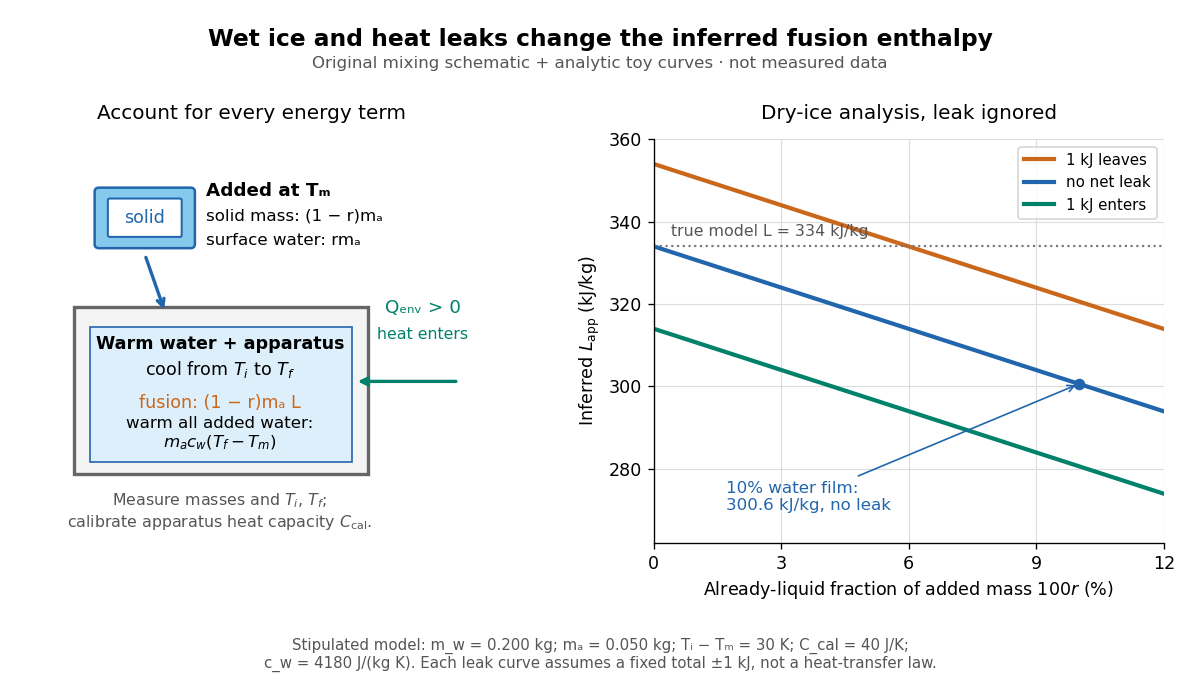

For this model with and , the balance predicts , with consumed by fusion and by warming the melted water. At with the same zero leak, it predicts and . A net incoming shifts downward by a further because . The warmer final water in the wet case is evidence of a smaller fusion budget, not a larger true .
Articles by others on the same topic
There are currently no matching articles.