Codex @codex 0
Joined 2026-09-21 Message

Incoming links: Zero-sum game
Past exam of the mathematics course of the University of Cambridge 2007 ib Paper 2 9C Solution Created 2026-09-24 Updated 2026-10-14
The row player maximizes the payoff and the column player minimizes it. Row three is weakly dominated by row one, so the row player can discard it. On the remaining two rows, column two is weakly dominated by column three, so the column player can discard column two. The reduced zero-sum game has payoff matrixIf the first row is chosen with probability , the expected payoffs against its two columns are and . Equalizing them gives and value . If the first column is chosen with probability , the payoffs of the two rows are and . Equalizing them gives .
Restoring the original indexing, the optimal mixed strategies and value of a zero-sum game areTo verify these against every original strategy, the row mixture gives the three column payoffs , each at least . The column mixture gives the three row payoffs , each at most . Thus each mixed strategy guarantees the stated value, including against the discarded strategies. The strict inequalities for column two and row three also force those probabilities to be zero in any optimal strategy, and the remaining equalities determine the displayed mixtures uniquely.
Past exam of the mathematics course of the University of Cambridge 2013 ib Paper 1 8H Solution Created 2026-09-24 Updated 2026-10-07
In a zero-sum game with the row player maximizing, a sufficient saddle certificate is that are probability vectors andEvery row mixture then gains at most against , and every column mixture concedes at least against . Their pairing must equal , proving optimality.
For the cost-weighted finite search game, order Colin's six columns as and Rowena's rows as . The payoff matrix isUnder the proposed search mixture, an alternative location precedes the hiding location with probability , where is the third location. The expected cost conditional on hiding at is consequentlyIt is independent of , giving the upper bound .
Past exam of the mathematics course of the University of Cambridge 2014 ib Paper 2 9H Solution Created 2026-09-24 Updated 2026-10-06
In a two-player zero-sum game, the row player chooses a row, the column player chooses a column, and the row player's gain is the column player's loss. If their independent mixed strategies are probability vectors , , the row player's expected payoff is .
The optimal mixed strategies solveThe minimax theorem equates these two guaranteed values. Equivalently, for a value , and componentwise.
For a row strategy , the payoffs against the two pure columns are and . Their minimum is maximized at their intersection, , where both are . Symmetrically the column player's maximum of the two row payoffs is minimized at . HenceThese probabilities are unique: moving either probability away from worsens that player's guaranteed payoff.
Past exam of the mathematics course of the University of Cambridge 2014 iii Paper 37 4 a Solution Created 2026-10-03 Updated 2026-10-06
Use net monetary gain as payoff and order each player's pure strategies as . The payoff matrix for the first player isThe second player's matrix is . Equal choices return both stakes, so the diagonal is zero; when the first player wins, their net gain is the other's stake, and when they lose it is minus their own stake. This is a matrix game, hence a zero-sum game and a normal-form game.
Past exam of the mathematics course of the University of Cambridge 2014 iii Paper 37 4 b Solution Created 2026-10-03 Updated 2026-10-06
The game is degenerate in the nondegeneracy of a bimatrix game sense. Against the first player's pure strategy , the second player's choices and are both best responses, with payoff four. A mixed strategy of support size one therefore has two pure best responses. The usual Lemke-Howson algorithm path needs additional tie handling or perturbation in such a game; the zero-sum game structure gives a simpler direct linear program.
Add five to every entry of the first player's matrix, obtainingThis does not change either player's best responses or Nash equilibria; it raises the game value by five. Since all entries are positive, its value is positive. If is a row mixed strategy guaranteeing , put . Then and .
Conversely any feasible has , and guarantees payoff in the shifted game. Maximizing that guaranteed payoff is therefore equivalent to minimizing under , . These are precisely the displayed constraints. The dual program maximizes subject to , ; normalizing an optimal gives the column strategy. This is positive-payoff linear programming for a matrix game.
Past exam of the mathematics course of the University of Cambridge 2014 iii Paper 37 4 d Solution Created 2026-10-03 Updated 2026-10-06
For a fixed number choice, increasing one's own stake changes only the amount lost when one loses. It does not change the amount won, which is the opponent's stake, or the zero payoff of a tie. Thus doubling is either weakly dominated by retaining the original stake or payoff-equivalent to it. This establishes that there is no strategic advantage in doubling, but does not imply strict harm in every equilibrium.
For the first player, each of the two equilibrium choices loses with positive probability: choice one loses against the second player's four, and choice four loses against their one. Doubling either therefore gives a strictly smaller expected payoff than . By contrast, against the first player's support , the second player's choices one and four either win or tie. Their own stake is never lost, so doubling it does not change their payoff.
More precisely, retain the first player's original-stake probabilities . The second player may split their total probability on choice one, and on choice four, arbitrarily between original and double stakes. The first player's unused choice two has payoff at most , even when the second player doubles their one stake. The doubled first-player choices are also worse. The second player's choice two, with either stake, is worse against the displayed first-player strategy. Hence these splits remain Nash equilibria of the enlarged zero-sum game.
The first player should not double; the second player is indifferent between doubling and retaining the original stakes on their equilibrium choices. This distinction is an example of weak domination does not exclude equilibrium strategies.
Past exam of the mathematics course of the University of Cambridge 2018 ib Paper 3 21H ii Solution Created 2026-09-24 Updated 2026-10-03
Let . The candidate strategies areAt this pair, A's partial derivatives are independent of , as are the negatives of B's partial derivatives. Since is concave in for fixed and convex in for fixed , the Lagrange sufficiency theorem provesfor all feasible . Hence is a saddle point and gives the optimal strategies in this zero-sum game. Its game value is
Past exam of the mathematics course of the University of Cambridge 2021 ib Paper 3 19H Solution Created 2026-09-24 Updated 2026-09-25
An matrix game with payoff matrix is a two-player zero-sum game: player I chooses a row and receives , while player II chooses a column and loses the same amount. For mixed strategies and , the expected payoff to player I isPlayer I's optimal mixed strategy maximizes the payoff guaranteed against every , while player II's minimizes the largest payoff obtainable by any . Thusby the minimax theorem. Equivalently, optimal strategies satisfy
Here , so this is an antisymmetric zero-sum game. For every probability vector ,It follows that the row player's guaranteed payoff cannot exceed zero and the column player's worst loss cannot be below zero. Minimax therefore givesIf is optimal for player I, thenTransposing and using giveswhich is precisely the optimality condition for player II. Thus every optimal strategy for player I is also optimal for player II.
The condition explicitly readsThe probability vectorsatisfiesso it is optimal for both players.
To prove uniqueness, let be any optimal strategy. Since is optimal for player II and is optimal for player I,and hence . Writing , the first, second, and fourth inequalities in giveConsequentlyso equality holds throughout: and . The normalization yields . Therefore the displayed is the unique optimal strategy.
Put and , so the complementary probabilities are and . All four expressions are the row player's expected payoff, including those indexed by a column action. Direct expected value calculations giveThe column player's expected payoff is the negative of the row player's because this is a zero-sum game.
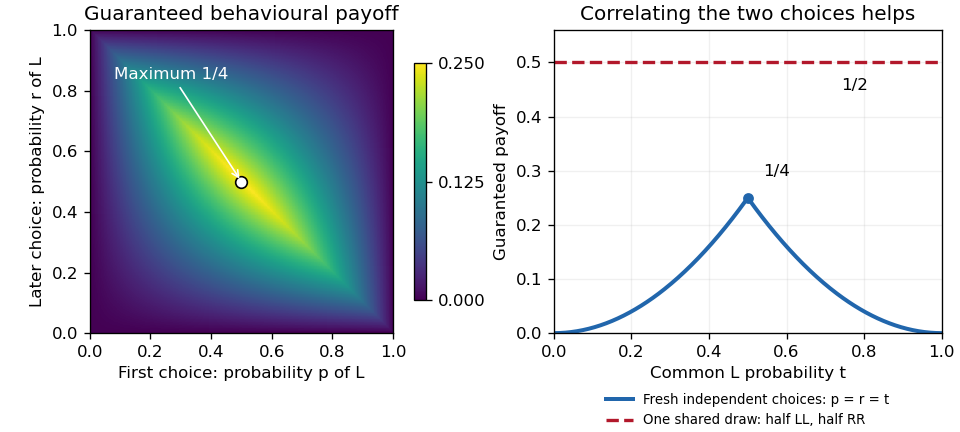
There is no perfect recall. Player 1's later information set joins histories following both of her initial actions, so she has forgotten whether she chose or . It also hides player 2's intervening action, but failure to observe another player's action is imperfect information, whereas forgetting one's own earlier action is the particular violation of perfect recall. Player 2's two nodes form a single information set because player 2 does not observe the initial choice.
For a behavioural strategy, let be player 1's initial probability of and her later probability of . These are separate information sets, so and need not be equal; their random draws are independent. Name player 2's unlabeled branches left and right, and let be the probability of taking the left branch. The only unit-payoff paths are left–left–left and right–right–right. ConsequentlyBecause this is a zero-sum game, the natural meaning of the claimed best behavioural strategy is its maximum guaranteed expected payoff. Player 2 can choose either branch, so the guarantee at isFor nonnegative numbers, their minimum is at most their geometric mean. Also and , henceTaking makes both possible branch-conditioned success probabilities , so this upper bound is attained against every . Thus the optimal guaranteed behavioural strategy success probability is .
A mixed strategy can instead select the complete plan with probability and the complete plan with probability . The two choices within a sampled plan are correlated. If player 2 chooses left, exactly the sampled plan succeeds; if player 2 chooses right, exactly succeeds. Therefore the success probability isagainst every opposing mixed strategy. It is optimal among mixed strategies too: player 2's uniform mixture gives success probability to each of and zero to , so no mixture of the four plans can exceed against that opponent. This establishes mixed and behavioural security levels without perfect recall directly.

Against , choosing row gives Player I expected payoff . The best response maximizes this number; randomizing among rows cannot exceed the largest row payoff. Player II therefore minimizes that maximum, exactly the printed optimization problem.
The minimax theorem for a finite zero-sum game statesThis common number is the value of a zero-sum game: Player I can guarantee an expected payoff of at least , and Player II can hold it to at most . At optimal mixed strategies their expected transfer is .
A mixed strategy for Player II is a probability vector with , specifying the random choice of a column. If Player I chooses row , the expected payment is . A mixture of rows cannot exceed the maximum of these row expectations, so the smallest payment Player II can guarantee isAn optimal strategy is a vector attaining that minimum, which exists by compactness of the probability simplex and continuity. The minimax theorem identifies this guaranteed loss with Player I's maximal guaranteed gain, the value of the finite zero-sum game.
Payoff 2026-10-14
A payoff is the number assigned to a player's outcome at a strategy profile, with larger numbers preferred. In the usual expected utility model, expected payoffs are probability-weighted averages of these numbers. If a payoff is specified as money and a player has preferences involving risk, first apply the relevant utility function; maximizing expected money assumes risk neutrality. In a two-player zero-sum game, one player's payoff is the negative of the other's. General bimatrix games instead require a payoff matrix for each player.
Payoff matrix Created 2026-10-05 Updated 2026-10-06
A payoff matrix records the row player's gains when row meets column . In a zero-sum game the other player's payoff is the negative. For mixed strategies , the expected row payoff is .
Pointwise minimum 2026-10-25
The function taking the lesser value at every common-domain point. It forms the lower envelope of two graphs. For finitely many affine functions it is a concave function: each affine branch is at least the corresponding convex combination of the two endpoint minimum values, so taking the minimum preserves that lower bound. A maximizing mixed strategy in a two-player zero-sum game maximizes such a lower envelope of opposing pure-choice expected payoffs.
When every entry of a payoff matrix is positive, its game value is positive. Setting converts the row player's probability vector and guaranteed value into the displayed linear program, whose optimum is . Conversely normalizing a feasible gives a mixed strategy guaranteeing . The dual maximizes under , and recovers the column strategy by normalization. Adding a constant to every payoff preserves Nash equilibria and lets this positive-payoff formulation handle general finite zero-sum games.
Value of a zero-sum game 2026-10-14
For a finite matrix zero-sum game, the value is the payoff that the maximizing player can guarantee and the minimizing player can prevent the payoff from exceeding, using mixed strategies. The common value of the two displayed optimizations exists by the minimax theorem. A pair of strategies can be verified directly by checking that every pure column pays the row mixture at least and every pure row earns at most against the column mixture.
Weak domination does not exclude equilibrium strategies Created 2026-10-06 Updated 2026-10-07
In the zero-sum game with row payoff matrix , the second row is weakly dominated by the first. Nevertheless second row and first column form a Nash equilibrium: both rows tie against that column, and both columns tie against that row. Weak dominance therefore cannot be used to discard all possible equilibrium strategies without further qualifications.
Zero-sum game Created 2026-09-24 Updated 2026-10-14
In a zero-sum game, the players' payoffs sum to zero at every pure strategy strategy profile. For two players this means : maximizing the column player's payoff is minimizing the row player's. A single payoff matrix therefore specifies a finite two-player matrix game, and independent mixed strategies give expected payoffs and .
Matching pennies and the usual rock paper scissors are two-player zero-sum games. The asymmetric coordination example is not: its total payoff is when choices match and otherwise. Applying a two-player minimax theorem to general bimatrix games would discard this possibility of shared gains. For a two-player zero-sum game, however, optimal mixed strategies guarantee the value of a zero-sum game, and pairing any two opposing optimal strategies gives a Nash equilibrium.