
Ciro Santilli once visited the chemistry department of a world leading university, and the chemists there were obsessed with NMR. They had small benchtop NMR machines. They had larger machines. They had a room full of huge machines. They had them in corridors and on desk tops. Chemists really love that stuff. More precisely, these are used for NMR spectroscopy, which helps identify what a sample is made of.
Introduction to NMR by Allery Chemistry
. Source. - only works with an odd number of nucleons
- apply strong magnetic field, this separates the energy of up and down spins. Most spins align with field.
- send radio waves into sample to make nucleons go to upper energy level. We can see that the energy difference is small since we are talking about radio waves, low frequency.
- when nucleon goes back down, it re-emits radio waves, and we detect that. TODO: how do we not get that confused with the input wave, which is presumably at the same frequency? It appears to send pulses, and then wait for the response.
How to Prepare and Run a NMR Sample by University of Bath (2017)
Source. This is a more direct howto, cool to see. Uses a Bruker Corporation 300. They have a robotic arm add-on. Shows spectrum on computer screen at the end. Shame no molecule identification after that!This video has the merit of showing real equipment usage, including sample preparation.
Says clearly that NMR is the most important way to identify organic compounds.
- youtu.be/uNM801B9Y84?t=41 lists some of the most common targets, including hydrogen and carbon-13
- youtu.be/uNM801B9Y84?t=124 ethanol example
- youtu.be/uNM801B9Y84?t=251 they use solvents where all protium is replaced by deuterium to not affect results. Genius.
- youtu.be/uNM801B9Y84?t=354 usually they do 16 radio wave pulses
Introductory NMR & MRI: Video 01 by Magritek (2009)
Source. Precession and Resonance. Precession has a natural frequency for any angle of the wheel.Introductory NMR & MRI: Video 02 by Magritek (2009)
Source. The influence of temperature on spin statistics. At 300K, the number of up and down spins are very similar. As you reduce temperature, we get more and more on lower energy state.Introductory NMR & MRI: Video 03 by Magritek (2009)
Source. The influence of temperature on spin statistics. At 300K, the number of up and down spins are very similar. As you reduce temperature, we get more and more on lower energy state.NMR spectroscopy visualized by ScienceSketch
. Source. 2020. Decent explanation with animation. Could go into a bit more numbers, but OK.
Extensive quantities are properties of a system that depend on the amount of material or the size of the system. In other words, they are additive properties that change when the system is divided into smaller parts. Extensive quantities are proportional to the size or extent of the system. Common examples of extensive quantities include: 1. **Mass** - The total amount of matter in a system. 2. **Volume** - The amount of three-dimensional space occupied by the system.
Used to identify organic compounds.
Seems to be based on the effects that electrons around the nuclei (shielding electrons) have on the outcome of NMR.
So it is a bit unlike MRI where you are interested in the position of certain nuclei in space (of course, these being atoms, you can't see their positions in space).
What's Nuclear Magnetic Resonance by Bruker Corporation (2020)
Source. Good 3D animations showing the structure of the NMR machine. We understand that it is very bulky largely due to the cryogenic system. It then talks a bit about organic compound identification by talking about ethanol, i.e. this is NMR spectroscopy, but it is a bit too much to follow closely. Basically the electron configuration alters the nuclear response somehow, and allows identifying functional groups.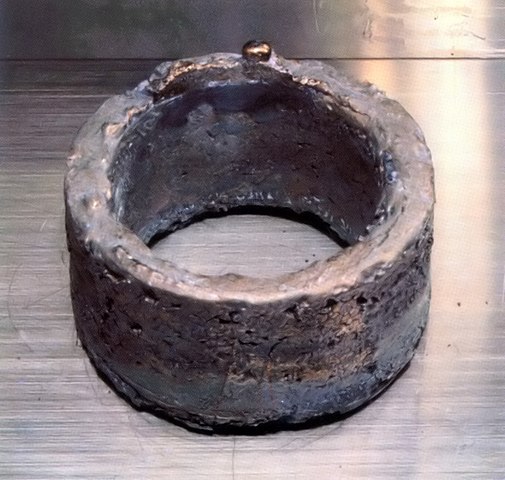
A weapons-grade ring of electrorefined plutonium, typical of the rings refined at Los Alamos and sent to Rocky Flats for fabrication
. Source. The ring has a purity of 99.96%, weighs 5.3 kg, and is approx 11 cm in diameter. It is enough plutonium for one bomb core. Which city shall we blow up today?Ciro Santilli is mildly obsessed by nuclear reactions, because they are so quirky. How can a little ball destroy a city? How can putting too much of it together produce criticality and kill people like in the Slotin accident or the Tokaimura criticality accident. It is mind blowing really.
More fun nuclear stuff to watch:
- Dr. Strangelove (1964)
- en.wikipedia.org/wiki/Chernobyl_(miniseries)
- The World Of Enrico Fermi by Harvard Project Physics (1970)
- Fat Man and Little Boy (1987) shows a possibly reasonably realistic of the history of the development of the Trinity
The Ultimate Guide to Nuclear Weapons by hypohystericalhistory (2022)
Source. Good overall summary. Some interesting points:- youtu.be/8uIPQBOCJ64?t=2946 talks about the difference between tactical and strategic nuclear weapons
- youtu.be/8uIPQBOCJ64?t=3291 mentions variable yield devices, this is the main new thing Ciro Santilli learned from this video
- youtu.be/8uIPQBOCJ64?t=3416 discusses if a strategic nuclear weapon usage would inevitably lead to tactical nuclear weapon escalation. It then mentions one case in which a possibly comparable escalation didn't happen: the abstinence of using chemical weapon during World War II.
Gun-type fission weapons are the simplest approach and they work with Uranium-235 bombs as you can ignite it with just one explosion.
But Gun-type fission weapons don't work with plutonium, and weapon grade Plutonium is cheaper than weapon grade Uranium, so it wasn't much used.
Implosion-type fission weapons are more complicated than gun-type fission weapon because you have to precisely coordinate the detonation of a bunch of explosives.

Pinned article: Introduction to the OurBigBook Project
Welcome to the OurBigBook Project! Our goal is to create the perfect publishing platform for STEM subjects, and get university-level students to write the best free STEM tutorials ever.
Everyone is welcome to create an account and play with the site: ourbigbook.com/go/register. We belive that students themselves can write amazing tutorials, but teachers are welcome too. You can write about anything you want, it doesn't have to be STEM or even educational. Silly test content is very welcome and you won't be penalized in any way. Just keep it legal!
Intro to OurBigBook
. Source. We have two killer features:
- topics: topics group articles by different users with the same title, e.g. here is the topic for the "Fundamental Theorem of Calculus" ourbigbook.com/go/topic/fundamental-theorem-of-calculusArticles of different users are sorted by upvote within each article page. This feature is a bit like:
- a Wikipedia where each user can have their own version of each article
- a Q&A website like Stack Overflow, where multiple people can give their views on a given topic, and the best ones are sorted by upvote. Except you don't need to wait for someone to ask first, and any topic goes, no matter how narrow or broad
This feature makes it possible for readers to find better explanations of any topic created by other writers. And it allows writers to create an explanation in a place that readers might actually find it.
Figure 1. Screenshot of the "Derivative" topic page. View it live at: ourbigbook.com/go/topic/derivativeVideo 2. OurBigBook Web topics demo. Source. - local editing: you can store all your personal knowledge base content locally in a plaintext markup format that can be edited locally and published either:This way you can be sure that even if OurBigBook.com were to go down one day (which we have no plans to do as it is quite cheap to host!), your content will still be perfectly readable as a static site.
- to OurBigBook.com to get awesome multi-user features like topics and likes
- as HTML files to a static website, which you can host yourself for free on many external providers like GitHub Pages, and remain in full control

Figure 3. Visual Studio Code extension installation.
Figure 4. Visual Studio Code extension tree navigation.
Figure 5. Web editor. You can also edit articles on the Web editor without installing anything locally.Video 3. Edit locally and publish demo. Source. This shows editing OurBigBook Markup and publishing it using the Visual Studio Code extension.Video 4. OurBigBook Visual Studio Code extension editing and navigation demo. Source. 
- Infinitely deep tables of contents:




All our software is open source and hosted at: github.com/ourbigbook/ourbigbook
Further documentation can be found at: docs.ourbigbook.com
Feel free to reach our to us for any help or suggestions: docs.ourbigbook.com/#contact