
Mr. SQUID Updated 2025-07-16
This is the cutest product name ever.
Since 1992, Mr. SQUID has been the standard educational demonstration system for undergraduate physics lab courses.
YBCO device, runs on liquid nitrogen.
Double star Updated 2025-07-16
Star system Updated 2025-07-16
Stellar classification Updated 2025-07-16
Theory of everything Updated 2025-07-16
As of 2019, the Standard Model and general relativity are incompatible. Once those are unified, we will have one equation to describe the entirety of physics.
There are also however also unsolved problems in electroweak interaction + strong interaction, which if achieved is referred to as a Grand Unified Theory. Reaching a GUT is considered a sensible intermediate step before TOE.
The current state of Physics has been the result of several previous unifications as shown at: en.wikipedia.org/wiki/Theory_of_everything#Conventional_sequence_of_theories so it is expected that this last missing unification is likely to happen one day, potentially conditional on humanity having enough energy to observe new phenomena.
Subatomic particle Updated 2025-07-16
Parameters of the Standard Model Updated 2025-07-16
The growing number of parameters of the Standard Model is one big source of worry for early 21st century physics, much like the growing number of particles was a worry in the beginning of the 20th (but that one was solved by 2020).
Standard Model Lagrangian Updated 2025-07-16
Why do symmetries such as SU(3), SU(2) and U(1) matter in particle physics? Updated 2025-07-16
Physicists love to talk about that stuff, but no one ever has the guts to explain it into enough detail to show its beauty!!!
Perhaps the wisest thing is to just focus entirely on the part to start with, which is the quantum electrodynamics one, which is the simplest and most useful and historically first one to come around.
Perhaps the best explanation is that if you assume those internal symmetries, then you can systematically make "obvious" educated guesses at the interacting part of the Standard Model Lagrangian, which is the fundamental part of the Standard Model. See e.g.:
- derivation of the quantum electrodynamics Lagrangian
- Physics from Symmetry by Jakob Schwichtenberg (2015) chapter 7 "Interaction Theory" derives all three of quantum electrodynamics, weak interaction and quantum chromodynamics Lagrangian from each of the symmetries!
Notably, axelmaas.blogspot.com/2010/08/global-and-local-symmetries.html gives a good overview:so it seems that that's why they are so key: local symmetries map to the forces themselves!!!
A local symmetry transformation is much more complicated to visualize. Take a rectangular grid of the billiard balls from the last post, say ten times ten. Each ball is spherical symmetric, and thus invariant under a rotation. The system now has a global and a local symmetry. A global symmetry transformation would rotate each ball by the same amount in the same direction, leaving the system unchanged. A local symmetry transformation would rotate each ball about a different amount and around a different axis, still leaving the system to the eye unchanged. The system has also an additional global symmetry. Moving the whole grid to the left or to the right leaves the grid unchanged. However, no such local symmetry exists: Moving only one ball will destroy the grid's structure.Such global and local symmetries play an important role in physics. The global symmetries are found to be associated with properties of particles, e. g., whether they are matter or antimatter, whether they carry electric charge, and so on. Local symmetries are found to be associated with forces. In fact, all the fundamental forces of nature are associated with very special local symmetries. For example, the weak force is actually associated in a very intricate way with local rotations of a four-dimensional sphere. The reason is that, invisible to the eye, everything charged under the weak force can be characterized by a arrow pointing from the center to the surface of such a four-dimensional sphere. This arrow can be rotated in a certain way and at every individual point, without changing anything which can be measured. It is thus a local symmetry. This will become more clearer over time, as at the moment of first encounter this appears to be very strange indeed.
axelmaas.blogspot.com/2010/09/symmetries-of-standard-model.html then goes over all symmetries of the Standard Model uber quickly, including the global ones.
The Machiavellian Stack Overflow contributor Updated 2025-07-16
- always upvote questions you care about, to increase the probability that they will get answered
- never upvote other people's answers unless you might gain from it somehow, otherwise you are just giving other high reputation users more reputation relative to you
- only mark something to close or as a duplicate if it will bring you some advantage, because closing things creates enemies, especially if the OP has a high profileOne example advantage is if you have already answered the question (and the duplicate as well in case of duplicates), because this will prevent competitors from adding new better answers to overtake you.
- protect questions you've answered whenever someone with less than 10 reputation answers it with a bad answer, to prevent other good contributors from coming along and beating you
- when you find a duplicate pool answer every question with similar answers.Alter each answer slightly to avoid the idiotic duplicate answer detector.If one of the question closes, it is not too bad, as it continues netting you to upvotes, and prevents new answers from coming in.
- follow on Twitter/RSS someone who comments on the top features of new software releases. E.g. for Git, follow GitHub on Twitter, C++ on Reddit. Then run back to any question which has a new answer.
- always upvote the question when you answer it:
- the more upvotes, more likely people are to click it.
- the OP is more likely to see your answer and feel good and upvote you
- if a niche question only has few answers and you come with a good one, upvote the existing ones by other high profile users.This may lead to them upvoting or liking you.
- always upvote comments that favor you:
- "I like this answer!" on your answers
- "also look at that question" when you have answered that question
- if you answer a question by newbie without 15 reputation, find their other questions if any and upvote them, so that the OP can upvote your answer in addition to just accepting
- if a question has 50 million answers and you answer it (often due to a new feature), make a comment on the question pointing to your answer
- if you get a downvote, always leave a comment asking why. It is not because you care about their useless opinion, but because other readers might see the comment, feel sorry for you, and upvote.
- ask any questions under a separate anonymous accounts. Because:
- intelligent people are born knowing, and don't ever ask any questions, so that would hurt your reputation
- downvoting questions does not take 1 reputation away from the downvoter, and so it greatly opens the door for your opponents to downvote you without any cost.
Stack Overflow Vote Fraud Script Updated 2025-07-16
How do you think Ciro got his rep? Just kidding.
Stack Overflow later forbade Ciro from advertising this project as described at: Section "Ciro Santilli's Stack Overflow suspension for vote fraud script 2019". Those newbs know nothing about security through obscurity.
Bad Stack Overflow policies Updated 2025-07-16
Stack Overflow user Updated 2025-07-16
Stack Exchange Updated 2025-07-16
Rectangular wave Updated 2025-07-16
Ciro's Edict #8 Article metadata shown next to every header Updated 2025-07-16
This is a major feature: we have now started to inject the following buttons next to every single pre-rendered header:
This crucial feature makes it clear to every new user that every single header has its own separate metadata, which is a crucial idea of the website.
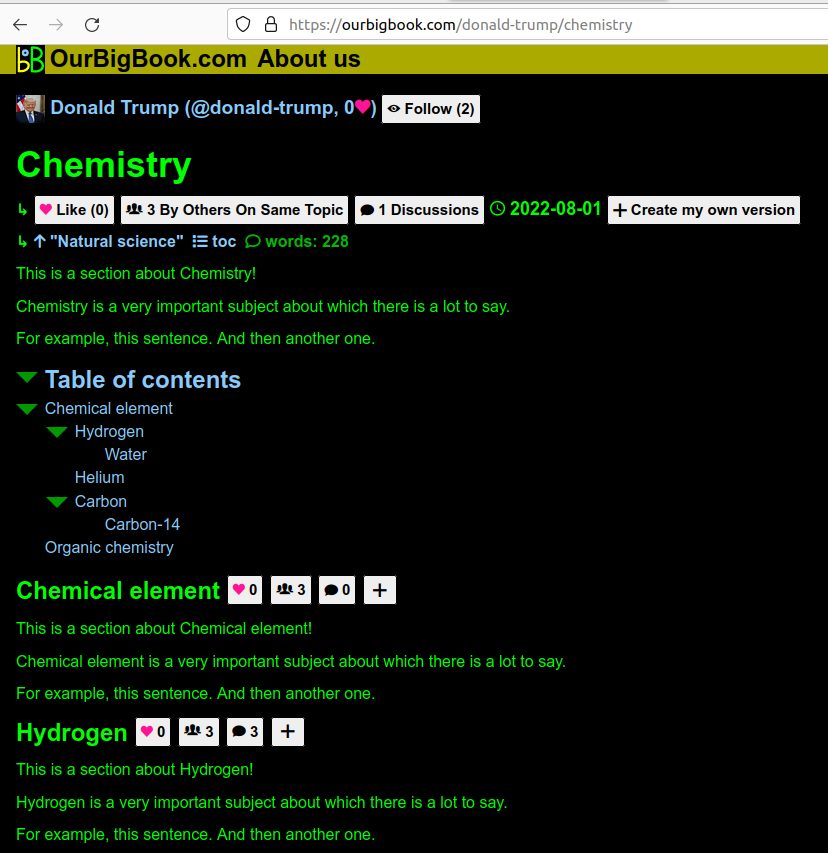
Screenshot showing metadata next to each header
. The page is: ourbigbook.com/donald-trump/chemistry. Note how even the subheaders "Chemical element" and "Hydrogen" show the metadata. Ciro's Edict #8 List topics on home page Updated 2025-07-16
The new default homepage for a logged out user how shows a list of the topics with the most articles.
This is a reasonable choice for default homepage, and it immediately exposes users to this central feature of the website: the topic system.
Doing this required in particular calculating the best title for a topic, since it is possible to have different titles with the same ID, the most common way being with capitalization changes, e.g.:would both have topic ID
JavaScript
Javascriptjavascript.The algorithm chosen is to pick the top 10 most upvoted topics, and select the most common title from amongst them. This should make topic title vandalism quite hard. This was made in a single SQL query, and became the most complext SQL query Ciro Santilli has ever written so far: twitter.com/cirosantilli2/status/1549721815832043522
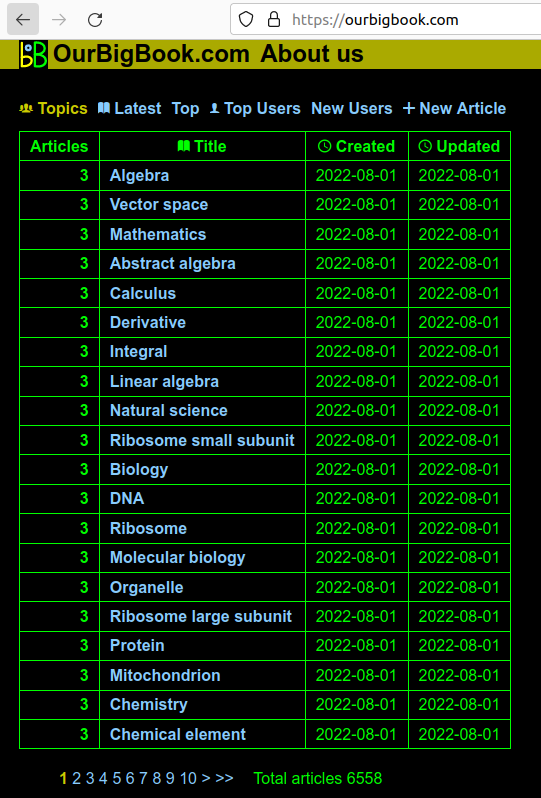
Screenshot showing the list of topics
. The page is: ourbigbook.com for the logged out user, ourbigbook.com/go/topics for the logged in user.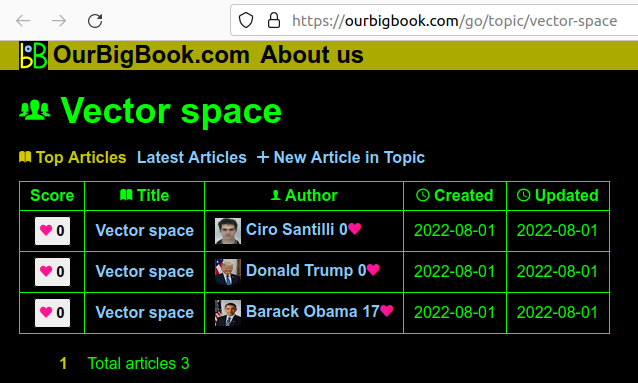
Screenshot showing a topic page
. The page is: ourbigbook.com/go/topic/vector-space. Before this sprint, we didn't have the "Vector Space" at the top, as it wasn't necessarily trivial to determine what the preferred title would be. Ciro's Edict #8 Article size and count limits Updated 2025-07-16
Limited the number of articles, and the size of article bodies. This, together with the reCAPTCHA setup from Email verification and reCAPTCHA signup protection should prevent the most basic types of denial-of-service attacks by filling up our database.
Ciro's Edict #7 Email verification and reCAPTCHA signup protection Updated 2025-07-16
Added this basic but fundamental protection layer to the website.
The email setup will of course be reused when notifications are eventually implemented.
Ciro's Edict #7 Issue tracker Updated 2025-07-16
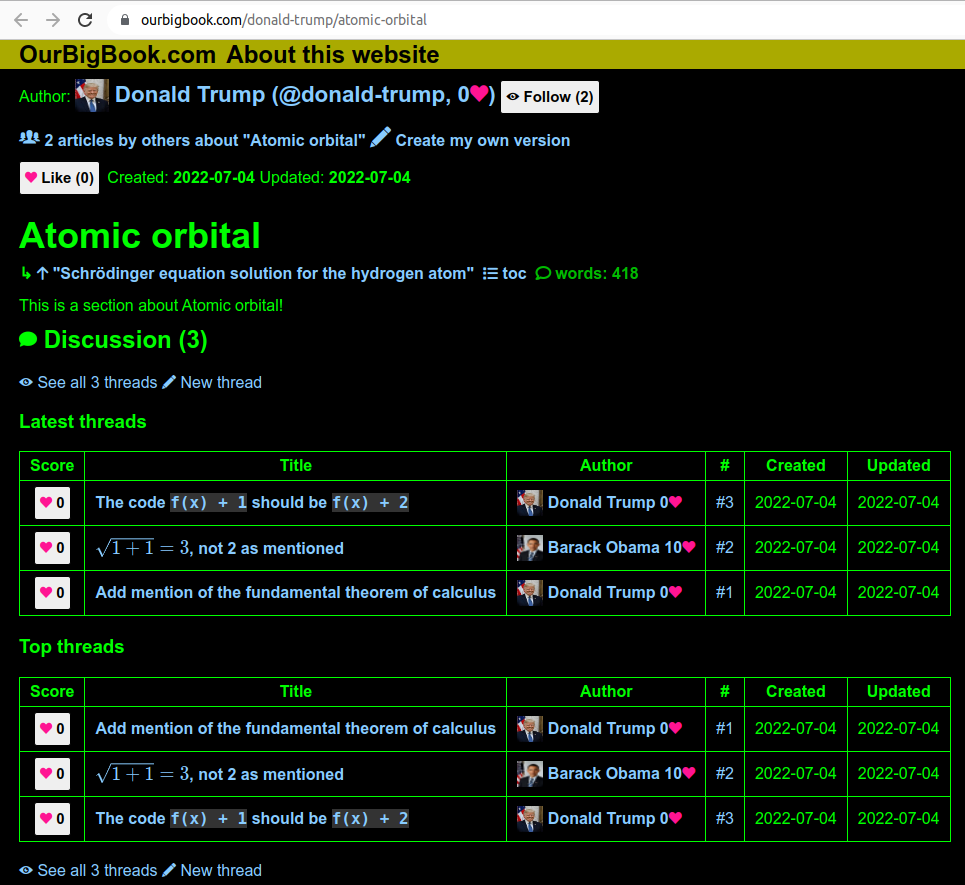
Every article now has a (very basic) GitHub-like issue tracker. Comments now go under issues, and issues go under articles. Issues themselves are very similar to articles, with a title and a body.
This was part of 1.0, but not the first priority, but I did it now anyways because I'm trying to do all the database changes ASAP as I'm not in the mood to write database migrations.
Here's an example:
- ourbigbook.com/go/issue/2/donald-trump/atomic-orbital a specific issue about the article "Atomic Orbital" by Donald Trump. Note the comments possibly by other users at the bottom.
- ourbigbook.com/go/issues/1/donald-trump/atomic-orbital list of issues about the article "Atomic Orbital" by Donald Trump
There are unlisted articles, also show them or only show them.