
youtube-dl Updated 2025-07-16
YouTube channel Updated 2025-07-16
Transcription (linguistics) Updated 2025-07-16
Logogram Updated 2025-07-16
Phonemic orthography Updated 2025-07-16
How to blackout your window without drilling Total Blackout Cassette Roller Blind from Order Blinds Online Updated 2025-07-16
This is my first working setup, done in a rental friendly way without drilling. I am sure that it is possible to do it cheaper, better and with less work, but it the first one that worked for me, so I will document it.
Cost: 150 Dollars for a relatively large 130 x 158 cm window. They do not sell for windows much larger than that.
Bought from www.orderblinds.co.uk on June 2019.
My window faces East, and in summer the sun rises at around 5AM here, and I am a bit light sensitive and was getting destroyed.
This setup, together with:is good enough to allow me to sleep properly, which is priceless.
- the existing sliding curtains which were not enough on their own
- a cheap and comfortable Figure 2. "GO Travel sleeping mask" from the Pharmacy


Demonstration if everything goes exceptionally well:
How to fit a Total Blackout Cassette Roller Blind by Order Blinds Online (2016)
Source. The actual product name appears to be Bloc Blinds or BlocOut, Order Blinds appears to whitelabel them.However, not all will necessarily be fun and games as in that YouTube video, especially if you are doing it for the first time, and the main point of this article is to make you aware of that.
The first problem is that you may have to remove existing useless "privacy blinds" from the way, which can mean putting effort into learning how they work and, has a risk of damaging the property. So be smart and get a chair and a second person to help you out!
Next, fitting the side rails is not going to be that easy. The thing has to be tight to block the light, right? Careful not to scratch the bottom sill!
Then you will notice that, like in the video at youtu.be/cTVVe7codw4?t=106, you are expected to screw the side rails to the bottom wood / plastic sill of the window, which is not rental acceptable! So I didn't to that, but together with the black tape that I will mention next, it held well enough.
The top part requires hammering nails as shown on the video: youtu.be/cTVVe7codw4?t=24 but this is generally rental acceptable, and you can fill the holes afterwards.
Once you have the setup in place, it is likely that there will be some light gaps still, because it is basically impossible to make such large objects fit perfectly. This was especially true for the top of the window, but also for the sides, so I just used some black tape
So I added some wide (50mm) Figure 4. "Diall PVC repairing black tape" between the blind and the wall to completely seal off the light.
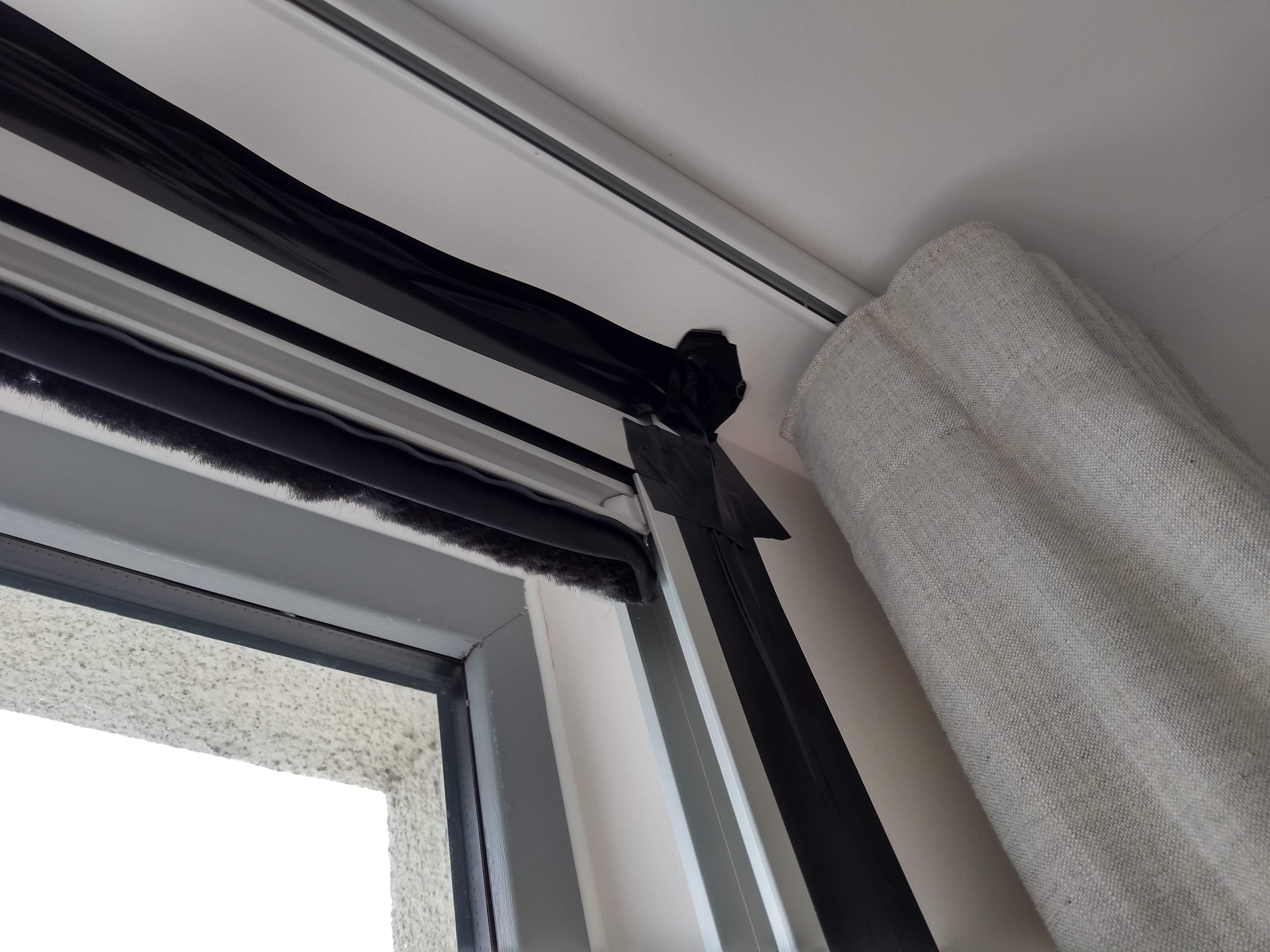


Diall PVC repairing black tape
. Source. This tape made things dark and was durable, but note at Section "Removal wall damage review" that it pulled bits of the plaster out with it during removal. I've since learnt about the existence of "painter’s tape"/masking tape, that might have been a better idea to protect the walls when pulling the tape off. It is worth noting that some of the painter's tape do come with a maximum number of days before you can pull them off, presumably after which wall damage becomes a possibility, e.g. Ciro saw one rateed 14 days. How to blackout your window without drilling Swimming goggles plus sleeping mask hack Updated 2025-07-16
The problem with virtually all sleeping masks on the market is that they leave a lot of room near your nose for light to come in.
Ciro Santilli discovered a useful workaround for that: make the mask tighter with a swimming goggles!
Just make the goggles as loose as possible to not put pressure on your eyes, and then strap them over the sleeping mask.
If you are a back sleeper, put the googles forward as normal. If you are a stomach sleeper, put the googles on the back of your head, and the straps over the mask. This way you wont get your head squished by the goggles and the bed.
Once Ciro understood the idea, Googling "swimming googles sleeping mask" led to: mantasleep.uk/ might be a good option.
How to blackout your window without drilling Previous failed attempts Updated 2025-07-16
Thick cardboard paper and Gorilla Tape: the intense Sun heat made the cardboard bend, and even the Gorilla tape could not hold it, leading to light leakage. Even worse, it started to smell a bit, and I got afraid that it could catch fire, so don't do this! Maybe I will try coating with aluminium foil next time, but I'm afraid it might stick to the glass. In any case, even if those setups work, your room may be permanently very dark depending on how far the window opens, which can lead to other problems such as mold. Another downside of this method is that the tape is extremely sticky, and especially difficult to remove if it touches the glass, where you can't use metallic items to scrape it off without scratching the glass. I had to get a solvent and use a lot of elbow grease to get rid of it.
I have tried a few sleeping masks, but none of them were enough on their own. There is always some light leakage around the nose, especially as you turn around in the night. And some of them are too hot. I have tried:
- Sleep Master (archive): www.amazon.co.uk/gp/product/B0015NZ6FK (archive). Also too hot.
- Muji Eye Mask
I also considered getting one of those "Perfect Fit Blinds" www.blindsdirect.co.uk/perfect-fit-roller-blinds (archive) which fit between the glass and the insulation. This looks like it could work. But I didn't go for it in the end because my window has 3 glass panels, so I would have to get three of those blinds separately.
DokuWiki Updated 2025-07-16
Know Your Meme Updated 2025-07-16
Mathematics wiki Updated 2025-07-16
Nature Scitable Updated 2025-07-16
As of 2022 visible at: www.nature.com/scitable
Apparently they had a separate URL as just scitable.com, so they were somewhat serious about it before shutting it down.
As of 2022 marked:RIP.
This page has been archived and is no longer updated
www.nature.com/scitable/blog/student-voices/ has last entry 2015, so presumably that's the shutdown year.
Self description:so quite related to OurBigBook.com.
Using our platform, you can customize your own eBooks for your students. Create an online classroom. Contribute and share content and connect with networks of colleagues.
Personal knowledge base Updated 2025-07-16
Trillium Notes Updated 2025-07-16
Originally at github.com/zadam/trilium, then after development stopped the community took it up at: github.com/TriliumNext/Notes.
Tree based organization at last. Infinitely deep.
Amazing WYSIWYG, including maths and tables, plus insane plugins like canvas mode, and specific file formats like code/mermaid diagrams/drawing mode.
Intentionally or not, they've basically made an open source Notion, with the possible exception that Notion historically started on web and moved to the desktop, while Trillium went the other way round.
Version history with automatic snapshots at intervals. TODO how is it implemented? Do they just ZIP multiple versions?
No multiuser features. Except for that, could have been a good starting point of an online multiuser thing such as OurBigBook.com!
With Book Notes it is possible possible to see more than one page at a time on the output, which his a major feature of OurBigBook. But does it show on HTML export as well?
You can static HTML export any subtree by right clicking on it in the navigation tree.
HTML export keeps all data as HTML is their native format. This may be inherited from CKEditor. The files are mostly visible, but there is some CSS missing, it is not 100% like editor, notably math is broken. There is also a hosted way of exposing: github.com/zadam/trilium/wiki/Sharing.
trilium.rocks however has a very good export, it is just a question of how much they had to hacked things, source at: github.com/zerebos/trilium.rocks
The default tHTML export uses frame navigation, with a toc fixed on the left frame. Efficient, but not of this century.
There is no concept of user created unique text IDs: you can have the same headers in the same folders in the UI. It's not even a matter of scopes. On exports they are differentiated as
1_name, 2_name, etc../Trilium Demo/Books/To read/1_HR.md
./Trilium Demo/Books/To read/2_HR.md
./Trilium Demo/Books/To read/HR.mdMarkdown export warns:
this preserves most of the formatting
Architecture: runs on local SQLite database via better-sqlite3. Data apparently stored in SQLite database at
~/.local/share/trilium-data, no raw files.Markup is stored as HTML as seen from:
sqlite3 document.db 'SELECT * from note_contents'. HTML is their native storage format, quite interesting. But this means it is not source centric, so any source editing would have to go via import/export. It can be done apparently: github.com/zadam/trilium/wiki/Markdown but involves shoving a ZIP around.WYSIWYG based on ckeditor.com/ which is a dependency. It is kind of cool that the view in which you view the output is exactly the same as the one you edit in, and there is no intermediate format, just the HTML.
Math is KaTeX based.
It also runs on the browser via a server: github.com/zadam/trilium/wiki/Server-installation. And they have a paid service for it at: trilium.cc/. Quite impressive.
They have server to from desktop sync: github.com/zadam/trilium/wiki/synchronization. There is no conflict resolution, one of them wins randomly. But they have revision history, and anything lost will be in the revision history. They have so many features it is mind blowing.
Maintainer announced he would be slowing down development since January 2024: github.com/zadam/trilium/issues/4620?ref=selfh.st
HyperCard Updated 2025-07-16
Wikipedia Updated 2025-07-16
Why Wikipedia sucks: Section "Wikipedia".
Best languages:
The most important page of Wikipedia is undoubtedly: en.wikipedia.org/wiki/Wikipedia:Reliable_sources/Perennial_sources which lists the accepted and non accepted sources. Basically, the decision of what is true in this world.
Wikipedia is incredibly picky about copyright. E.g.: en.wikipedia.org/wiki/Wikipedia:Deletion_of_all_fair_use_images_of_living_people because "such portrait could be created". Yes, with a time machine, no problem! This does more harm than good... excessive!
Citing in Wikipedia is painful. Partly because of they have a billion different templates that you have to navigate. They should really have a system where you can easily reuse existing sources across articles! Section "How to use a single source multiple times in a Wikipedia article?"
- youtu.be/_Rt0eAPLDkM?t=113 encyclopedia correction stickers. OMG!
- youtu.be/_Rt0eAPLDkM?t=201 Jimmy was a moderator on MUD games
Inside the Wikimedia Foundation offices by Wikimedia Foundation (2008)
Source. Scholarpedia Updated 2025-07-16
Wiki-binge Updated 2025-07-16
WikiWikiWeb Updated 2025-07-16
The pre-Eternal September feeling is palpable.
People could freely comment their thoughts and sign below, making it much closer to what Ciro Santilli wants OurBigBook.com to be. But with upvotes ;-)
What poor countries have to do to get richer Teach everyone English Updated 2025-07-16
This is obviously the most efficient investment any non-English speaking country must do, because you need to know English to be able to learn from rich countries and innovate.
Further discussion at: Section "Having more than one natural language is bad for the world".
There are unlisted articles, also show them or only show them.