Articles by others on the same topic

This is a section about Derivative!
For example, this sentence. And then another one.

The derivative measures the instantaneous rate at which a function changes. For a real function defined near , it exists when the difference quotient has a finite two-sided limit:The quotient is the slope of the straight line joining two nearby points of the graph. Its limit is the slope of the tangent line. Thus a derivative describes a local rate without choosing a particular finite measurement interval.
For , expanding the numerator givesAt , the increments , and give secant line slopes , and . The limit is , and the tangent line is . The picture makes the limiting process visible.
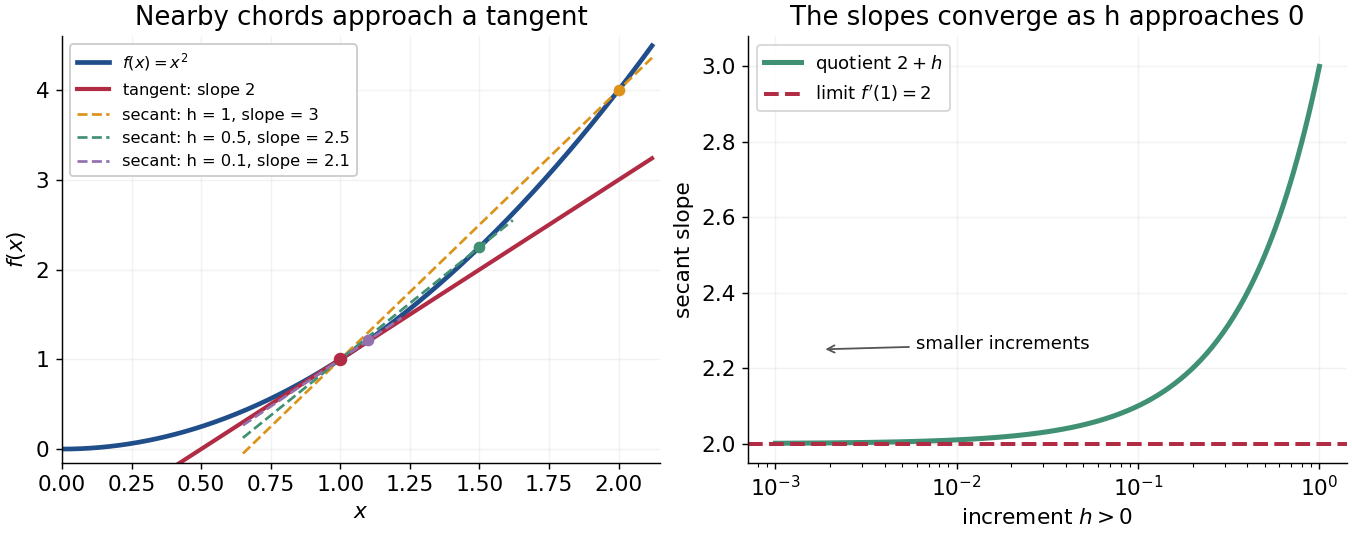
The same calculation shows why the derivative is useful for approximation:This is a local linear approximation. Near , replacing by makes the exact error , smaller than the leading change when is small. A curved graph can therefore be studied locally using a straight line.
If the function records position against time, its derivative is velocity. If it records an objective function, its derivative tests local changes that matter in optimization; in several variables, the gradient collects these directional rates and guides gradient descent. The interpretation comes from the function and its units, rather than from a new rule for each application.
Existence matters. For the absolute value function , the one-sided derivatives at zero are and , so there is no single tangent line described by a finite derivative there. Nor does a zero derivative alone identify a maximum or minimum: has but keeps increasing through zero.

This is a section about Derivative!
For example, this sentence. And then another one.



