Thermal conduction is the process by which heat energy is transferred through materials without any flow of the material itself. This transfer occurs due to temperature differences within a substance or between different substances in thermal contact. When a region of a material is heated, the particles in that region gain energy and vibrate more vigorously. These excited particles collide with neighboring particles, transferring some of their energy to them, which raises their temperature. This process continues, allowing heat to move from the hotter area to the cooler area.
Articles by others on the same topic

Thermal conduction transfers heat through microscopic interactions without bulk transport of matter. To predict the heating load through a bar, combine Fourier's law with conservation of energy and the imposed end temperatures. In the isotropic model with positive thermal conductivity , the conductive heat flux points from high to low temperature, opposite to the temperature gradient. A spoon warming along its handle and heat escaping through a wall are familiar examples.
Consider a bar of length , constant cross-sectional area and constant thermal conductivity . Maintain its ends at and , with increasing toward the colder end. Assume a steady state, one-dimensional thermal conduction, no internal sources and no heat transfer through the sides. The temperature falls by over , givingThe difference between the two readings in degree Celsius units is the same -kelvin difference. The positive heat flux carries heat toward increasing .
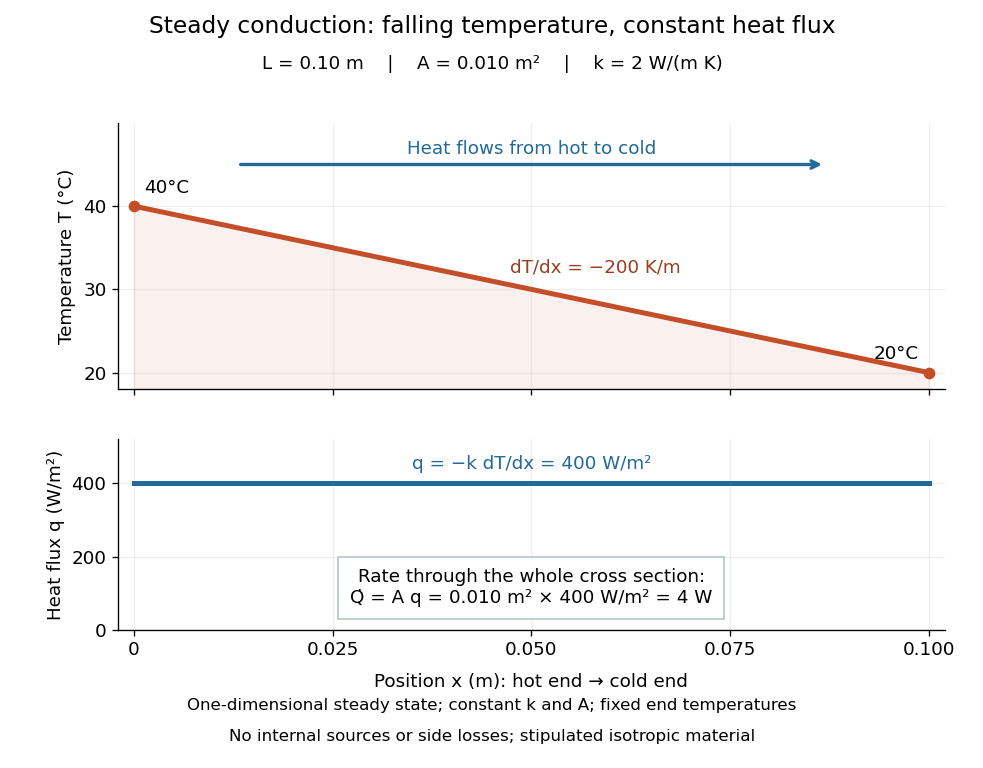

The general solution under these assumptions isA proof outline is enough to explain the straight line: conservation of energy in any small slice, with no accumulation, sources or side losses, gives . Constant cross-sectional area gives ; constant thermal conductivity and Fourier's law then give . Two integrations and the end boundary conditions determine the displayed affine function. This is why a visually simple temperature profile can encode a continuous flow of energy. [ref]
https://web.mit.edu/16.unified/www/FALL/thermodynamics/notes/node117.html. E. M. Greitzer, Z. S. Spakovszky and I. A. Waitz, MIT Thermodynamics and Propulsion, section 16.3: steady one-dimensional conduction
Doubling the length halves the rate, while doubling the cross-sectional area doubles it, at fixed end temperatures and thermal conductivity. This explains why a long narrow support can limit unwanted heat transfer, while a short broad path can help remove heat. Joining materials leads to thermal resistance in series. During initial warming, internal energy can accumulate and the temperature profile need not be a straight line; the time dependence is described by the heat equation and thermal diffusivity.
Now join two layers, each of length , with constant cross-sectional area and stipulated constant thermal conductivities and . Keep the outer ends at and . Assume a steady state, one-dimensional thermal conduction, no internal sources or side losses, and perfect contact: the temperature is continuous at the interface, with no extra contact drop. For each layer, use the area-specific thermal resistance and . The series calculation gives
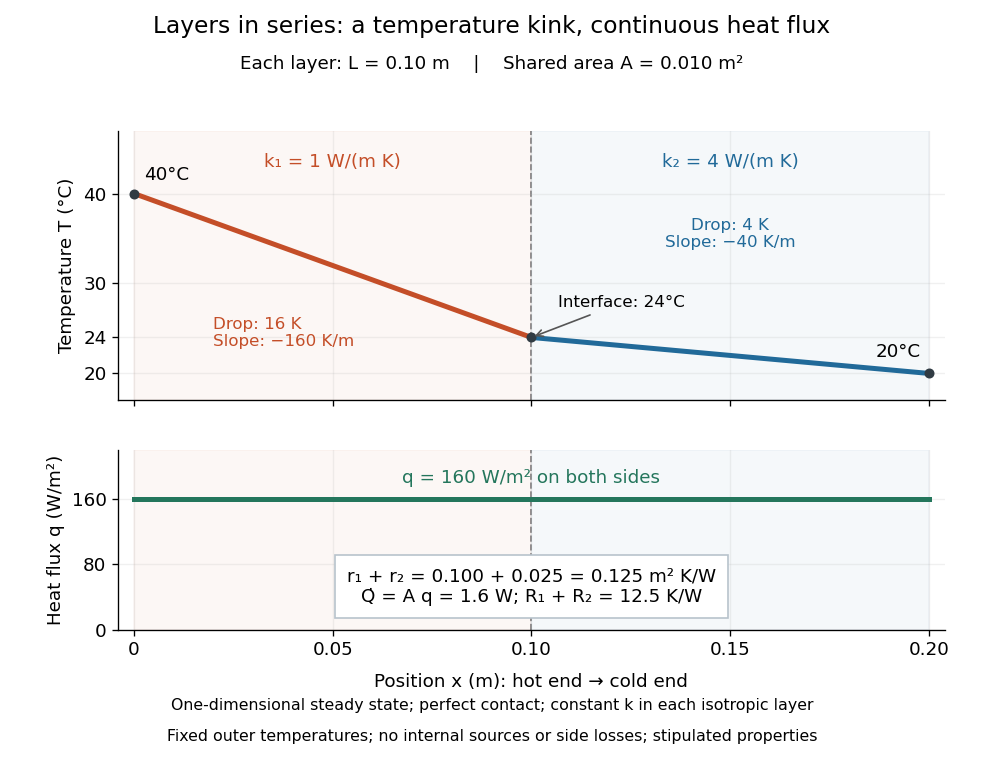

The heat flux is continuous: otherwise energy would accumulate at the interface. Yet Fourier's law gives different temperature gradients, and . Lower thermal conductivity requires a steeper temperature gradient to carry the same heat flux; equal lengths therefore give drops in the ratio . A kink in the temperature profile records the change of material while perfect contact keeps the temperature itself continuous.