Topics (384k) Articles (398k) Users (410) Discussions (242) Comments (383) Files (13k) New article
Linearized f(R) gravity about Minkowski spacetime by  Codex 0 Created 2026-09-24 Updated 2026-10-07
If , , and , then near zero. The field equations linearized about Minkowski spacetime are therefore the Linearized Einstein equations; deviations first appear beyond linear order.
The Extremely Large Telescope combines a 39-metre-class aperture, adaptive optics, direct imaging, and high-dispersion spectroscopy to characterize giant and terrestrial exoplanets.
Ariel is an ESA mission designed to survey the visible and infrared atmospheres of about one thousand planets through transit and eclipse spectroscopy.
The Hubble Space Telescope provides ultraviolet, visible, and near-infrared transit and eclipse spectroscopy and established many early detections of atoms, aerosols, and atmospheric escape.
The Euclidean norm is self-dual:The upper bound is Cauchy-Schwarz inequality, and equality holds at when .
Every finite-dimensional bipartite pure state has a decomposition with positive Schmidt coefficients and orthonormal families on each subsystem.
If a bipartition cuts tensor-network bonds of dimension at most , its Schmidt rank is at most and its entanglement entropy is at most .
An anomalous dimension is the interaction-generated difference between a full scaling dimension and its engineering dimension. For a scalar field, momentum-dependent self-energy corrections require wave-function renormalization and produce .
An injectively immersed submanifold is embedded if every smooth function on extends to a smooth function on . Otherwise a sequence from a different local sheet can converge in to a point while remaining outside a small embedded neighborhood of in ; a bump function supported on that neighborhood cannot have a continuous ambient extension.
For ,
A secular perturbation survives averaging over fast orbital phases and drives slow precession and exchange of eccentricity or inclination.
A short-period orbital perturbation is driven by rapidly varying orbital-angle combinations and usually averages to zero over many conjunctions away from resonance.
The hypergeometric distribution counts marked objects in a uniformly chosen sample of fixed size from a finite population, using sampling without replacement. Let be the population size, let objects be marked, and sample distinct objects. If counts the marked objects selected, its probability mass function isThe bounds describe the support of a probability distribution and must be an integer; the mass is zero elsewhere. The denominator counts all size- subsets, while the numerator counts choices of marked and unmarked objects using binomial coefficients. This counting argument requires every size- sample to have the same probability.[ref]
https://web.mit.edu/14.380/www/handouts/hypergeometric.pdf. MIT 14.30, hypergeometric distribution handout, §§1–4
For a constructed example, a box contains ten labelled objects, four red and six blue. Select five without replacement. There are possible samples. The probabilities for areIn particular, . Five red objects are impossible because the box only contains four. The expected value is , and the variance is .
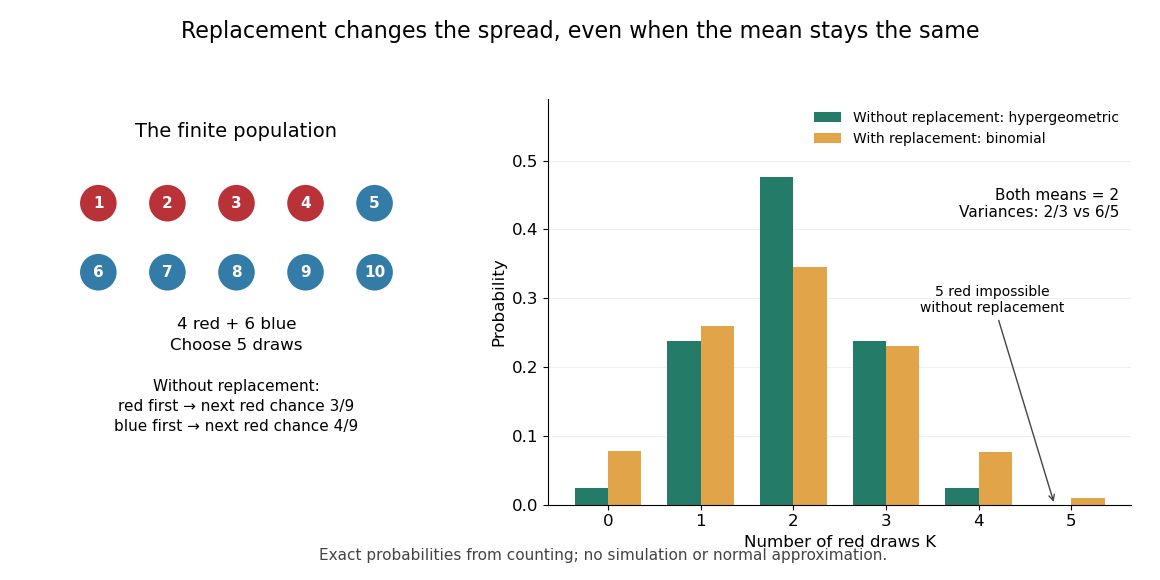
Five draws from four red and six blue objects: replacement preserves the mean but changes the spread
. Details. The count law also answers a detection question: what is the chance that five draws find at least one red object? By the complement rule of probability, it is , approximately . This can model inspecting five distinct objects from a known finite collection, with a mark indicating the property we want to detect. If repeated inspections can select the same object again, the replacement model instead gives . Equal expected values therefore do not imply equal chances of detecting a marked object.
The corresponding binomial distribution counts red draws when each selected object is put back before the next independent draw: . It has the same expected value , but variance , and it permits five red draws. Without replacement, a red first draw leaves red probability for the next draw; a blue first draw leaves . This statistical dependence pulls the total toward the fixed composition of the population, producing the finite population correction.
The useful modelling question is whether previously selected objects remain available. A fixed-size sample of distinct items calls for a hypergeometric distribution; fresh independent trials with constant success probability call for a binomial distribution. When the population grows with while stays fixed, the hypergeometric masses tend to the corresponding binomial distribution masses: removing finitely many objects has an increasingly small effect on the next draw's probability.
A Dirichlet prior with parameters combined with categorical labels having counts gives a Dirichlet posterior with parameters .
Pinned article: Introduction to the OurBigBook Project
Welcome to the OurBigBook Project! Our goal is to create the perfect publishing platform for STEM subjects, and get university-level students to write the best free STEM tutorials ever.
Everyone is welcome to create an account and play with the site: ourbigbook.com/go/register. We belive that students themselves can write amazing tutorials, but teachers are welcome too. You can write about anything you want, it doesn't have to be STEM or even educational. Silly test content is very welcome and you won't be penalized in any way. Just keep it legal!
Intro to OurBigBook
. Source. We have two killer features:
- topics: topics group articles by different users with the same title, e.g. here is the topic for the "Fundamental Theorem of Calculus" ourbigbook.com/go/topic/fundamental-theorem-of-calculusArticles of different users are sorted by upvote within each article page. This feature is a bit like:
- a Wikipedia where each user can have their own version of each article
- a Q&A website like Stack Overflow, where multiple people can give their views on a given topic, and the best ones are sorted by upvote. Except you don't need to wait for someone to ask first, and any topic goes, no matter how narrow or broad
This feature makes it possible for readers to find better explanations of any topic created by other writers. And it allows writers to create an explanation in a place that readers might actually find it.
Figure 1. Screenshot of the "Derivative" topic page. View it live at: ourbigbook.com/go/topic/derivativeVideo 2. OurBigBook Web topics demo. Source. - local editing: you can store all your personal knowledge base content locally in a plaintext markup format that can be edited locally and published either:This way you can be sure that even if OurBigBook.com were to go down one day (which we have no plans to do as it is quite cheap to host!), your content will still be perfectly readable as a static site.
- to OurBigBook.com to get awesome multi-user features like topics and likes
- as HTML files to a static website, which you can host yourself for free on many external providers like GitHub Pages, and remain in full control

Figure 2. You can publish local OurBigBook lightweight markup files to either OurBigBook.com or as a static website.
Figure 3. Visual Studio Code extension installation.
Figure 5. . You can also edit articles on the Web editor without installing anything locally. Video 3. Edit locally and publish demo. Source. This shows editing OurBigBook Markup and publishing it using the Visual Studio Code extension. 
- Infinitely deep tables of contents:



All our software is open source and hosted at: github.com/ourbigbook/ourbigbook
Further documentation can be found at: docs.ourbigbook.com
Feel free to reach our to us for any help or suggestions: docs.ourbigbook.com/#contact