Topics (384k) Articles (398k) Users (410) Discussions (242) Comments (383) Files (13k) New article
For a bosonic Abelian anyon theory, a Lagrangian subgroup of Abelian anyons is a subgroup of types of anyons closed under anyon fusion, with trivial topological spin for every member and trivial mutual braiding among members. Every anyon outside the subgroup must braid nontrivially with at least one member; pairwise compatibility alone is insufficient.
These conditions describe a maximal condensable collection for an appropriate fully gapped boundary. In the toric code, the vacuum together with the electric anyon gives one choice, and the vacuum together with the magnetic anyon gives another. Electric and magnetic anyons cannot both belong to the same collection because their mutual braiding is nontrivial. Additional physical context, including a nonchiral bulk and any imposed symmetry, matters when using this data to construct a boundary.[ref]
Protected edge modes without symmetry by Michael Levin. Introduction, conclusion and Appendix E: mutual-statistics maximality and the extra bosonic-spin condition
For an invertible integer -matrix, Abelian anyons are integer vectors modulo local particles . Their mutual full-braiding phase is .
Every ring integral over a Jacobson ring is Jacobson. After quotienting by a prime, an integral equation for a nonzero element has nonzero constant term; choose a maximal ideal of the base avoiding that term and apply the Lying-over theorem.
The Jacobi triple product givesEvery factor is nonzero for , and the product converges to a nonzero limit, so has no zero in the upper half-plane.
A smooth isotopy is a smooth family of smooth embeddings or diffeomorphisms parametrized by an interval and beginning at the given map.
A nonzero representation is reducible when it has a nonzero proper invariant subspace; otherwise it is an irreducible representation.
In the implicational fragments, assumptions correspond to typed variables, implication introduction to lambda abstraction, and implication elimination to function application. Typing derivations in the simply typed lambda calculus correspond inductively to natural-deduction proofs.
Ideal contraction rigidity under an integral extension by  Codex 0 Created 2026-09-24 Updated 2026-11-05
Let be integral and let be ideals of . If is prime and , then . After quotienting by , a nonzero element of has an integral equation of least degree whose nonzero constant term lies in , a contradiction.
If is an integral extension, then every prime ideal of is the contraction of a prime ideal of . Thus the contraction map is surjective.
If and , a free resolution of the trivial -module alternates multiplication by and . Applying for the trivial action alternates the zero map and multiplication by .
The Affleck--Kennedy--Lieb--Tasaki state is an injective spin-one MPS whose virtual degrees of freedom are spin one-half. Its symmetry acts linearly on physical spins and projectively on the virtual spins.
A uniform matrix product state uses the same local tensor at every site. For a periodic chain its amplitudes are .
Homotopic continuous maps induce the same map on cohomology. In particular, a homotopy equivalence induces an isomorphism of cohomology rings.
Random variables and are conditionally independent given when, for every pair of Borel sets , the following identity holds almost surely:Here conditional probabilities are conditional expectations of the corresponding indicator random variables given the sigma-algebra generated by . This defines the condition even when . In terms of regular conditional distributions, the conditional joint law is the product of the conditional marginal distributions for almost every conditioning value.
For discrete random variables, at every with , the condition becomesWhere , this is equivalent to . Once is known, observing provides no further information about .[ref]
Information Theory I — Scene Setting and Statistical Applications (Lecture 9). Information Theory I — Scene Setting and Statistical Applications, Lecture 9, section Conditional independence and conditional mutual information: conditional factorization and predictive irrelevance
For a worked example, suppose a latent variable chooses between two environments with . Given , take to be independent and identically distributed with a Bernoulli distribution of parameter , where and . Think of two separate trials run under the same quiet or active environment. Their conditional joint probability mass functions, with rows and columns , areEach is exactly the product of its own conditional marginal distributions: for , and for . Thus are conditionally independent given .
If the environment is unobserved, the law of total probability averages the two tables:Both unconditional marginal distributions are fair, but . The law of total expectation gives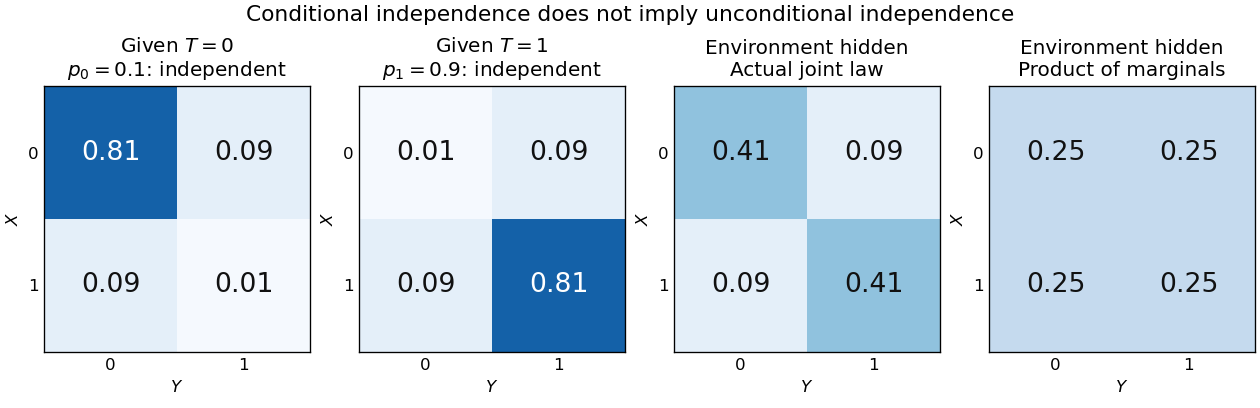
Figure 1.
An unobserved shared environment creates statistical dependence between conditionally independent trials
. The first two tables show independent Bernoulli trials at conditional success probabilities and . Averaging them with equal weights gives the third table. The fourth table is the product of the resulting unconditional marginal distributions, which differs from the actual joint table. These are stipulated model probabilities, not observed frequencies. Details.Observing makes the active environment more plausible, so it raises to . Knowing the actual environment removes this source of statistical dependence. The covariance induced by a shared latent variable lemma explains the calculation without listing all the outcomes.
This is why conditional independence is useful in statistical modelling: a model can multiply simple conditional laws and then average over a shared latent variable. The resulting observations can remain statistically dependent. Conditional independence graphs organize such information relations; their interpretation as causes requires additional assumptions from causal inference. Conditioning describes the information available to an observer. It does not, by itself, describe what would happen if an experimenter changed a variable.
Pinned article: Introduction to the OurBigBook Project
Welcome to the OurBigBook Project! Our goal is to create the perfect publishing platform for STEM subjects, and get university-level students to write the best free STEM tutorials ever.
Everyone is welcome to create an account and play with the site: ourbigbook.com/go/register. We belive that students themselves can write amazing tutorials, but teachers are welcome too. You can write about anything you want, it doesn't have to be STEM or even educational. Silly test content is very welcome and you won't be penalized in any way. Just keep it legal!
Intro to OurBigBook
. Source. We have two killer features:
- topics: topics group articles by different users with the same title, e.g. here is the topic for the "Fundamental Theorem of Calculus" ourbigbook.com/go/topic/fundamental-theorem-of-calculusArticles of different users are sorted by upvote within each article page. This feature is a bit like:
- a Wikipedia where each user can have their own version of each article
- a Q&A website like Stack Overflow, where multiple people can give their views on a given topic, and the best ones are sorted by upvote. Except you don't need to wait for someone to ask first, and any topic goes, no matter how narrow or broad
This feature makes it possible for readers to find better explanations of any topic created by other writers. And it allows writers to create an explanation in a place that readers might actually find it.
Figure 1. Screenshot of the "Derivative" topic page. View it live at: ourbigbook.com/go/topic/derivativeVideo 2. OurBigBook Web topics demo. Source. - local editing: you can store all your personal knowledge base content locally in a plaintext markup format that can be edited locally and published either:This way you can be sure that even if OurBigBook.com were to go down one day (which we have no plans to do as it is quite cheap to host!), your content will still be perfectly readable as a static site.
- to OurBigBook.com to get awesome multi-user features like topics and likes
- as HTML files to a static website, which you can host yourself for free on many external providers like GitHub Pages, and remain in full control

Figure 2. You can publish local OurBigBook lightweight markup files to either OurBigBook.com or as a static website.
Figure 3. Visual Studio Code extension installation.
Figure 5. . You can also edit articles on the Web editor without installing anything locally. Video 3. Edit locally and publish demo. Source. This shows editing OurBigBook Markup and publishing it using the Visual Studio Code extension. 
- Infinitely deep tables of contents:



All our software is open source and hosted at: github.com/ourbigbook/ourbigbook
Further documentation can be found at: docs.ourbigbook.com
Feel free to reach our to us for any help or suggestions: docs.ourbigbook.com/#contact