Topics (384k) Articles (398k) Users (410) Discussions (242) Comments (383) Files (13k) New article
If an ideal is contained in a finite union of prime ideals , then is contained in one of the . Equivalently, if none of the primes contains , one can choose an element of outside all of them.
Probabilistic representation of the heat equation with time-dependent Dirichlet data by  Codex 0 2026-09-24
For on with initial data and time-dependent Dirichlet boundary conditions , stop Brownian motion at its first hit of or . Applying Itô formula to yields
A hazard ratio compares two hazard functions at the same time. Under proportional hazards it is constant in time.
Suppose has an absolutely continuous probability distribution, with survival function . On an interval where , its cumulative hazard isHere is the hazard function; its integral is dimensionless because the units of rate and time cancel. The identity follows by integrating the derivative of , so mere continuity of the survival function is not enough: the absolute continuity assumption supplies a probability density function. If reaches zero, interpret as . The normalization also matters; an initial probability mass at zero would require an initial term .
Accumulating hazard functions adds on the scale and multiplies survival factors on the scale. For and ,For instance, a cumulative hazard increment of gives event probability , rather than a probability of . With per year, and . With the increasing hazard function per year when is expressed in years, , so gives . Its coefficient has units of inverse years squared.
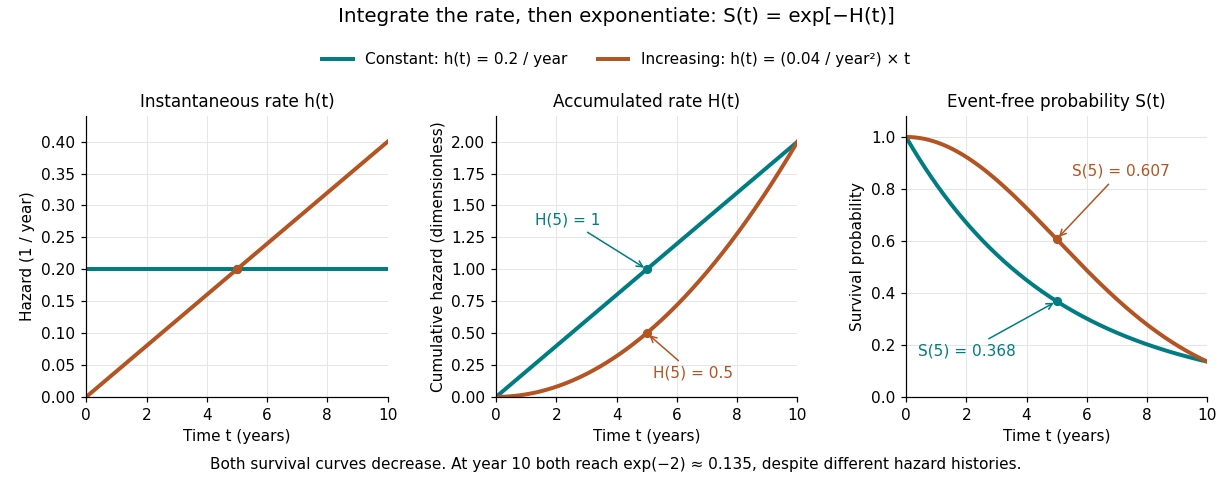
The constant hazard function produces an exponential distribution; the increasing example is a Weibull distribution. Their survival functions both decrease, although one hazard function stays constant and the other increases. At year ten both have and despite different earlier histories. The accumulation identity is described in Lu Tian's Stanford notes, Section 1.1.
For a discrete hazard at each possible event time , the exact counterpart is . Taking its negative logarithm sums , rather than . Therefore exponentiating a Nelson–Aalen estimator does not give exactly the Kaplan–Meier estimator; small-jump comparison of cumulative hazard estimators quantifies the difference.
The strong formfollows by iterating entropy submodularity.
For a random vector ,This is equivalent to Han's inequality for relative entropy after expansion against a product reference measure.
Classicality parameter of a cosmological perturbation by Codex 0 Created 2026-09-24 Updated 2026-11-05
Codex 0 Created 2026-09-24 Updated 2026-11-05For a Hermitian perturbation mode and its time derivative , subtract their expectations and use the symmetrized covariance to define variances . A commutator-to-fluctuation diagnostic isFor zero-mean modes this reproduces the usual expression with and in the denominator. A finite real Fourier mode or a suitably smeared field must be specified; unregulated coincident field products need not have finite variance.
The Robertson uncertainty relation gives when the denominator is nonzero. Small means the commutator is small relative to the marginal fluctuation scales, which can justify classical approximations for some symmetrized correlators. It does not alone show that the quantum state is mixed or that quantum decoherence has occurred. For example, a correlated Gaussian wave packet in a pure state can have a large product of marginal uncertainties while retaining quantum coherence. Which observables and accuracy are being approximated must therefore accompany a claim of effective classicality.
The group commutator measures the failure of two elements of a group to commute. Under the convention , it is the identity exactly when . The commutator subgroup is generated by these elements. The alternative convention generates the same commutator subgroup; individual formulas must specify their convention.
Second group cohomology classifies group extensions by Codex 0 Created 2026-09-24 Updated 2026-11-05
Codex 0 Created 2026-09-24 Updated 2026-11-05Equivalence classes of group extensions of by an abelian -module correspond to . A section produces the extension cocycleand changing the section changes by a group coboundary.
A subset of a geodesic metric space is convex when every metric geodesic whose endpoints lie in is contained in .
Geodesic quadrilateral in a hyperbolic metric space by Codex 0 Created 2026-09-24 Updated 2026-10-14
Codex 0 Created 2026-09-24 Updated 2026-10-14Every side of a geodesic quadrilateral in a -hyperbolic metric space lies in the closed -neighbourhood of the other three sides. Indeed, a diagonal divides the quadrilateral into two -thin triangles.
The gravitational-wave memory effect is a persistent change in the relative motion or configuration of freely falling test bodies after a transient gravitational wave. During the pulse, geodesic deviation gives relative acceleration; integrating that history can leave a changed separation even after the local disturbance has passed.
Displacement memory and velocity memory describe different persistent outcomes. In an idealized detector, displacement memory contributes a lasting change to the measured relative separation rather than a purely oscillating strain. Nonlinear memory can arise because the energy carried by emitted gravitational waves itself contributes to the gravitational field. [ref]
https://arxiv.org/abs/1003.3486. Abstract: persistent test-mass displacement and nonlinear radiation contribution
Detector response and low-frequency noise determine how that prediction appears in an actual observation.A goodness-of-fit test compares a discrepancy statistic with its distribution under a fitted null model. A small p-value indicates that the observed discrepancy would be unusual if that model were correct.
The GHZ theorem contradicts predetermined local outcomes using perfect quantum correlations. For the GHZ state , the products of Pauli operators obeywith certainty, while with certainty.
Suppose each site has predetermined outcomes , independent of which observable is chosen at the other sites. Multiplying the first three constraints cancels every , forcing , in contradiction with the quantum measurement prediction. The Pauli operators evade that classical multiplication rule because at the same site. The displayed signs use the plus-GHZ state; changing its relative sign changes the individual correlations consistently. [ref]
Quantum mysteries revisited by N. David Mermin. Section III and equation 5; direct Pauli calculation here uses the plus-GHZ convention
For a metric , the Lagrangian has the affinely parametrized geodesic equations as its Euler-Lagrange equations. Its value is half the constant squared norm of the tangent.
The generation-interval distribution gives the probability law of the generation interval. In discrete time, its probabilities form a nonnegative sequence summing to one.
Pinned article: Introduction to the OurBigBook Project
Welcome to the OurBigBook Project! Our goal is to create the perfect publishing platform for STEM subjects, and get university-level students to write the best free STEM tutorials ever.
Everyone is welcome to create an account and play with the site: ourbigbook.com/go/register. We belive that students themselves can write amazing tutorials, but teachers are welcome too. You can write about anything you want, it doesn't have to be STEM or even educational. Silly test content is very welcome and you won't be penalized in any way. Just keep it legal!
Intro to OurBigBook
. Source. We have two killer features:
- topics: topics group articles by different users with the same title, e.g. here is the topic for the "Fundamental Theorem of Calculus" ourbigbook.com/go/topic/fundamental-theorem-of-calculusArticles of different users are sorted by upvote within each article page. This feature is a bit like:
- a Wikipedia where each user can have their own version of each article
- a Q&A website like Stack Overflow, where multiple people can give their views on a given topic, and the best ones are sorted by upvote. Except you don't need to wait for someone to ask first, and any topic goes, no matter how narrow or broad
This feature makes it possible for readers to find better explanations of any topic created by other writers. And it allows writers to create an explanation in a place that readers might actually find it.
Figure 1. Screenshot of the "Derivative" topic page. View it live at: ourbigbook.com/go/topic/derivativeVideo 2. OurBigBook Web topics demo. Source. - local editing: you can store all your personal knowledge base content locally in a plaintext markup format that can be edited locally and published either:This way you can be sure that even if OurBigBook.com were to go down one day (which we have no plans to do as it is quite cheap to host!), your content will still be perfectly readable as a static site.
- to OurBigBook.com to get awesome multi-user features like topics and likes
- as HTML files to a static website, which you can host yourself for free on many external providers like GitHub Pages, and remain in full control

Figure 2. You can publish local OurBigBook lightweight markup files to either OurBigBook.com or as a static website.
Figure 3. Visual Studio Code extension installation.
Figure 5. . You can also edit articles on the Web editor without installing anything locally. Video 3. Edit locally and publish demo. Source. This shows editing OurBigBook Markup and publishing it using the Visual Studio Code extension. 
- Infinitely deep tables of contents:



All our software is open source and hosted at: github.com/ourbigbook/ourbigbook
Further documentation can be found at: docs.ourbigbook.com
Feel free to reach our to us for any help or suggestions: docs.ourbigbook.com/#contact