Topics (384k) Articles (398k) Users (410) Discussions (242) Comments (383) Files (13k) New article

A Dirac mass term pairs left- and right-handed Weyl fields in conjugate Lorentz representations. Gauge invariance requires the two chiral fields to carry matching internal quantum numbers, directly or after multiplication by a scalar field that acquires a vacuum expectation value.
On positive-definite matrices, the log-determinant has differential and is a strictly concave function.
A standard one-sided version is as follows. Let be differentiable on , with there. Suppose either as , or there. Ifthen . The denominator is nonzero sufficiently near the endpoint. Corresponding versions apply at other finite endpoints and at infinity. The quotient of derivatives must have a limit; differentiating numerator and denominator is not an unrestricted quotient identity.
In the zero-over-zero case, extend both functions continuously to the endpoint by zero and use the Cauchy mean value theorem to write for an intermediate . For example, as . The rule is sufficient, not necessary: as , while its derivative ratio has no limit. Without the required indeterminate setting, it can give a wrong answer: diverges at zero although its derivative ratio is one.
If is a Markov chain conditionally on , thenIt follows by applying ordinary data processing inside every conditional distribution and averaging over .
An infinite cyclic group is generated by an element of infinite order and is isomorphic to the additive group of integers.
A finite cyclic group of order is isomorphic to the additive group . The group isomorphism sends the congruence class of to , where is a chosen generator of a group. For , the identity element is , modulo six, and the inverse element of is .
One finite cyclic group can have several choices of generator of a group. Adding visits all six elements before returning to zero; adding also visits all six, in the reverse order. Adding reaches only from zero, and adding reaches only . The following permutations of the six elements show what each repeated step can reach.
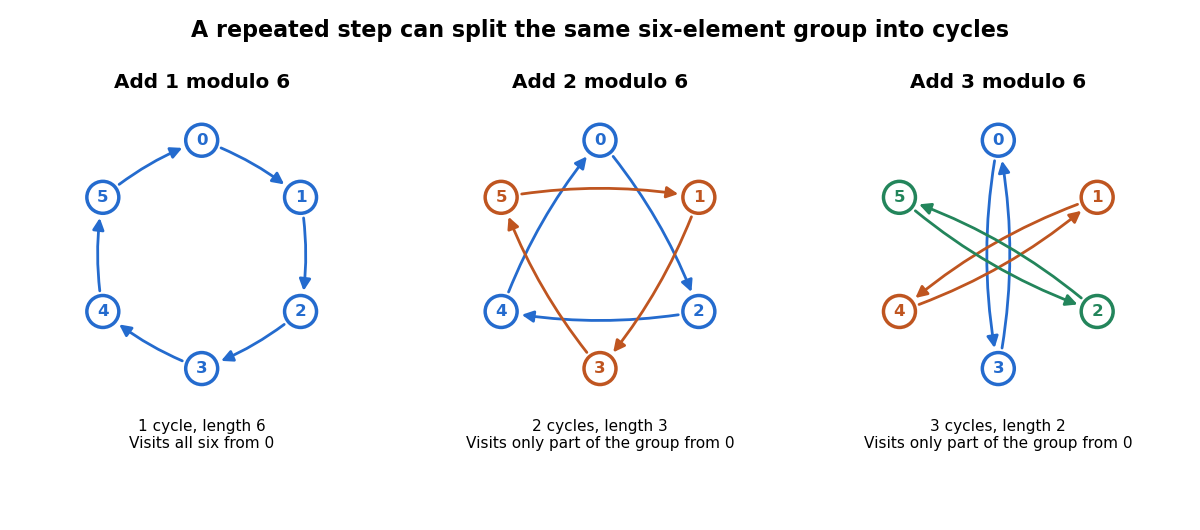
This gives a precise version of a familiar scheduling question: does a fixed step visit every position, or repeatedly miss some? The generators of a finite cyclic group are exactly the steps coprime to the total number of positions. Changing the step changes the orbit through the same underlying group; the diagram does not replace its group operation with a different one.
The empirical distribution function counts the fraction of observations at or below a threshold. For a statistical sample of real observations , defineEach indicator function contributes one exactly when its observation is counted. Equivalently, , where the empirical measure assigns probability mass to each observation, including repeated observations.[ref]
Choose the illustrative statistical sample . Its empirical distribution function isFor example, counts both observations equal to , , and . There is no observation at , so there is no jump there. The five observations produce only four distinct jump locations.
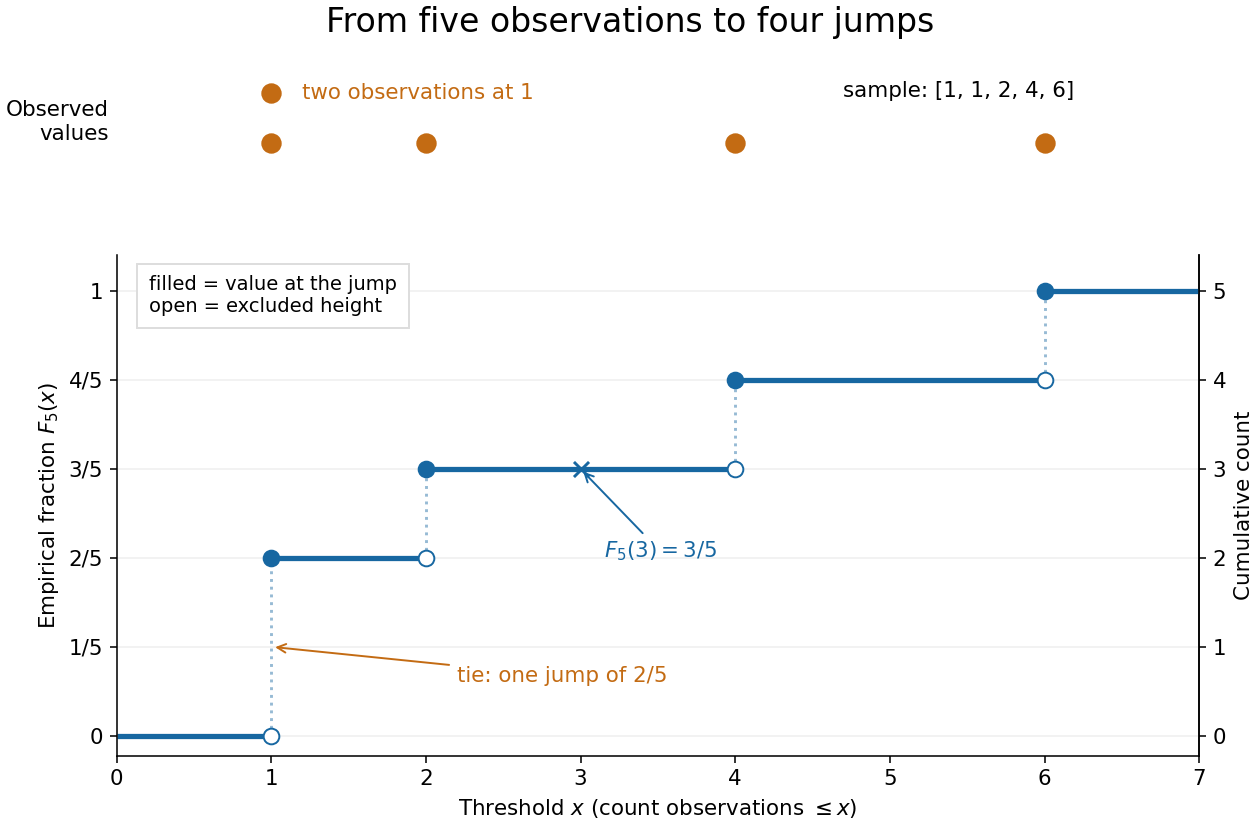
The convention makes the empirical distribution function right-continuous: once a threshold reaches an observation, that observation remains counted immediately to its right. For a finite statistical sample, the count is constant from any up to the next larger observed value, proving right continuity. Its left-hand limit counts observations strictly below , soA value occurring times causes one jump of size . At the jump is ; at , , and each jump is . All jumps sum to one. Thus the empirical distribution function is a nondecreasing step function with limits zero and one, and is itself a valid cumulative distribution function.
This turns many questions about data into simple cumulative distribution function operations. The observed fraction in is : for it is , counting and but excluding both s. Including the left endpoint gives . A sample quantile reads the same staircase in reverse: the smallest threshold reaching is . Unlike a histogram, this representation requires no choice of bins; its jumps retain every observation and its multiplicity.
The exact description of a finite statistical sample must be distinguished from a statistical model for how it was obtained. The empirical distribution function is defined for any finite list, with no independence assumption. Once the list is observed, its counts are fixed. For statistical inference, one often models as independent and identically distributed random variables with an unknown population cumulative distribution function . Then describes the sampling law, while varies across repeated statistical samples. The value is an observed fraction and an estimate of ; it does not establish that the population probability is . Even when is continuous, every finite is discrete.
For any threshold fixed before sampling, the indicator functions are independent Bernoulli random variables with success probability . Therefore the count has a binomial distribution andThe expected value follows by adding the expected values of the indicator functions; the variance follows by adding their variances using independence and dividing by . Thus is an unbiased estimator of at a fixed threshold. Controlling the error at every threshold at once requires more than a fixed-threshold calculation: the DKW inequality supplies such control, and the Glivenko-Cantelli theorem describes its uniform convergence almost surely as grows.
Comparing with a proposed cumulative distribution function also motivates goodness-of-fit tests, including the Kolmogorov-Smirnov test, the Anderson–Darling test, and the Cramér–von Mises criterion. A standard Kolmogorov-Smirnov test calibration assumes a fully specified continuous population law; fitting its statistical parameters from the same statistical sample changes that calibration.[ref]
1.3.5.16. Kolmogorov-Smirnov Goodness-of-Fit Test. NIST and SEMATECH e-Handbook of Statistical Methods; Characteristics and Limitations, items 1 and 3; Definition, test statistic and fully specified distribution requirement
A natural cubic spline is linear beyond its two outer knots, equivalently its second derivative vanishes at those knots.
The Portmanteau theorem gives equivalent formulations of weak convergence, including inequalities on open and closed sets and convergence of expectations for every bounded measurable function whose discontinuity set has zero limiting Probability.
For random variables supported in one fixed compact interval, convergence of every moment is equivalent to weak convergence. One direction tests monomials; the other follows by uniformly approximating continuous functions by polynomials.
probability measures on a metric space converge weakly to when for every bounded continuous real function .
For and parameters , the Dirichlet distribution is a probability distribution on the probability simplex , . With , its probability density function in coordinates , with , ison the simplex interior. This is a density relative to , not to -dimensional Lebesgue measure, for which the simplex has zero volume.[ref]
SciPy Reference: scipy.stats.dirichlet. Notes: positive parameters, simplex support and multivariate beta normalizer
For , the first coordinate has the beta distribution with parameters . For and all parameters one, the coordinate triangle has area and density , giving the uniform law in those coordinates. More generally, independent gamma distributions with shapes and a common rate can be normalized by their sum to generate a Dirichlet vector. The expected value of is ; the parameters describe both average proportions and their concentration, rather than allowing the coordinates to vary independently.
Pinned article: Introduction to the OurBigBook Project
Welcome to the OurBigBook Project! Our goal is to create the perfect publishing platform for STEM subjects, and get university-level students to write the best free STEM tutorials ever.
Everyone is welcome to create an account and play with the site: ourbigbook.com/go/register. We belive that students themselves can write amazing tutorials, but teachers are welcome too. You can write about anything you want, it doesn't have to be STEM or even educational. Silly test content is very welcome and you won't be penalized in any way. Just keep it legal!
Intro to OurBigBook
. Source. We have two killer features:
- topics: topics group articles by different users with the same title, e.g. here is the topic for the "Fundamental Theorem of Calculus" ourbigbook.com/go/topic/fundamental-theorem-of-calculusArticles of different users are sorted by upvote within each article page. This feature is a bit like:
- a Wikipedia where each user can have their own version of each article
- a Q&A website like Stack Overflow, where multiple people can give their views on a given topic, and the best ones are sorted by upvote. Except you don't need to wait for someone to ask first, and any topic goes, no matter how narrow or broad
This feature makes it possible for readers to find better explanations of any topic created by other writers. And it allows writers to create an explanation in a place that readers might actually find it.
Figure 1. Screenshot of the "Derivative" topic page. View it live at: ourbigbook.com/go/topic/derivativeVideo 2. OurBigBook Web topics demo. Source. - local editing: you can store all your personal knowledge base content locally in a plaintext markup format that can be edited locally and published either:This way you can be sure that even if OurBigBook.com were to go down one day (which we have no plans to do as it is quite cheap to host!), your content will still be perfectly readable as a static site.
- to OurBigBook.com to get awesome multi-user features like topics and likes
- as HTML files to a static website, which you can host yourself for free on many external providers like GitHub Pages, and remain in full control

Figure 2. You can publish local OurBigBook lightweight markup files to either OurBigBook.com or as a static website.
Figure 3. Visual Studio Code extension installation.
Figure 5. . You can also edit articles on the Web editor without installing anything locally. Video 3. Edit locally and publish demo. Source. This shows editing OurBigBook Markup and publishing it using the Visual Studio Code extension. 
- Infinitely deep tables of contents:




All our software is open source and hosted at: github.com/ourbigbook/ourbigbook
Further documentation can be found at: docs.ourbigbook.com
Feel free to reach our to us for any help or suggestions: docs.ourbigbook.com/#contact