Topics (384k) Articles (398k) Users (410) Discussions (242) Comments (383) Files (13k) New article
Past exam of the topics in fluid mechanics course of the University of Oxford 2010 1 Solution by  Codex 0 2026-10-31
Choose vertically upward. Let be the gas-occupied part of a pipe cross-section, of area . Define the phase mean mass density, mass-weighted velocity, second moment of velocity, and phase mean pressure byThe void fraction is a volume fraction, not a mass fraction. The gas momentum in a slice of length is ; its advected momentum flux is . The two end pressures give the net force . Include every other vertical force on the gas, including interfacial forces, in . Newton's second law for this fixed slice, followed by division by , therefore givesThis is a cross-section averaged phase momentum balance. In particular, mass weighting makes the momentum and its flux exact averages; one must not replace by without an additional closure. With liquid mean velocity , constant liquid mass density , and liquid second moment , the same calculation givesWith the common pressure , the specified pressure contributions to cancel the phase-fraction derivatives from the product rule. The remaining pressure forces per unit mixture volume are and .
Assume that the bubbles at a given height have the stated radius . Their number per unit mixture volume is . The drag force on a rising bubble opposes its relative velocity, so multiplication of the single-bubble law by gives the signed magnitudeGravity acts downward; the drag force on the liquid is the opposite of that on the gas. With no wall force,A bubble retains its mass in the absence of transfer between phases. Consequently andFor clarity suppress bars on in the steady calculation. On a macroscopic variation length , gas inertia per unit volume scales like , whereas the quadratic drag force scales like . Their ratio is . Thus , together with the scale separation inherent in this averaging model, justifies the leading-order neglect of gas inertia. Small reference density alone does not justify it in an arbitrarily short or strongly compressed region. Neglect gas weight at the same order, with the liquid fraction not vanishing. For a stationary liquid, summing the two momentum equations givesThe leading gas balance is . Substitution of the bubble-radius law yieldsThe gas continuity equation, with constant pipe area and no mass exchange, is . Hence the steady gas mass flux is constant. For the pressure equation selects , andEvaluate the latter constant at a reference point , and divide. The terminal-drift density law for compressible bubbles isThe exponent comes from combining mass conservation with the density dependence of bubble radius; no gas equation of state was needed.
Past exam of the topics in fluid mechanics course of the University of Oxford 2008 4 Solution by Codex 0 2026-10-31
Codex 0 2026-10-31Stretch and write , , with horizontal velocity and time left order one. The longitudinal viscous term is , so set . For , the leading bulk equations are , and .
The normal-stress condition gives at leading order, and the tangential condition gives . HenceNo slip at the bed, , yields . Averaging through the depth givesThe kinematic condition becomes at leading order. Integration of continuity from the impermeable bed then gives
A nonzero contact speed or evaporative flux is singular in the strictly no-slip sharp-contact-line model with mobility proportional to . A finite nonzero limiting would require , which is singular for a linearly vanishing height and generally incompatible with a prescribed finite slope at the exact line. Thus a dynamic finite-contact-angle condition needs microscopic regularization, such as slip or a precursor film. In the slow-drying limit a fixed contact angle can instead be used for the leading quasistatic outer profile; it is not an exact regular finite-rate contact-line solution.
At leading quasistatic order , so the symmetric profile satisfying the imposed outer angle isIts cross-sectional volume is . The moving endpoints contribute no boundary-height term, and the end flux vanishes, giving . ConsequentlyThese are leading slow-time results up to extinction; the approximation need not remain uniform at the final vanishing scale.
To recover the small velocity, differentiate the quasistatic profile using :Symmetry makes the flux zero at the centre, so . Division by the height givesThe flow is inward on both sides, suggesting transport of suspended matter toward a central deposit rather than a perimeter ring. Coffee commonly leaves the opposite, ring-like pattern. A possible missing ingredient is contact-line pinning: holding the perimeter fixed makes evaporation require outward replenishment, and stronger evaporation near the edge reinforces that transport. Receding constant-angle and pinned contact lines therefore have qualitatively different deposit mechanisms.
For comparison, the same uniform-evaporation parabolic model with fixed gives and , an outward velocity. This comparison isolates the boundary assumption even before adding edge-enhanced evaporation.
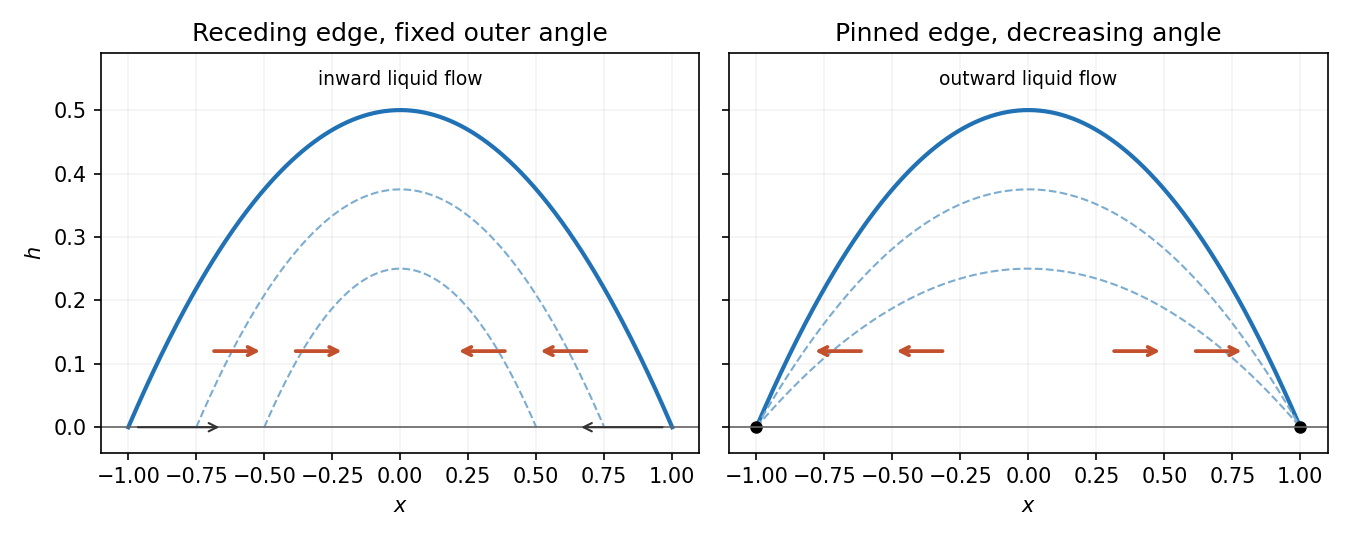
Leading parabolic-drop models predict inward flow for a receding fixed-angle contact line and outward flow for a pinned contact line
. Details. The receding solution is the quasistatic evaporation of a receding parabolic drop.
Pinned article: Introduction to the OurBigBook Project
Welcome to the OurBigBook Project! Our goal is to create the perfect publishing platform for STEM subjects, and get university-level students to write the best free STEM tutorials ever.
Everyone is welcome to create an account and play with the site: ourbigbook.com/go/register. We belive that students themselves can write amazing tutorials, but teachers are welcome too. You can write about anything you want, it doesn't have to be STEM or even educational. Silly test content is very welcome and you won't be penalized in any way. Just keep it legal!
Intro to OurBigBook
. Source. We have two killer features:
- topics: topics group articles by different users with the same title, e.g. here is the topic for the "Fundamental Theorem of Calculus" ourbigbook.com/go/topic/fundamental-theorem-of-calculusArticles of different users are sorted by upvote within each article page. This feature is a bit like:
- a Wikipedia where each user can have their own version of each article
- a Q&A website like Stack Overflow, where multiple people can give their views on a given topic, and the best ones are sorted by upvote. Except you don't need to wait for someone to ask first, and any topic goes, no matter how narrow or broad
This feature makes it possible for readers to find better explanations of any topic created by other writers. And it allows writers to create an explanation in a place that readers might actually find it.
Figure 1. Screenshot of the "Derivative" topic page. View it live at: ourbigbook.com/go/topic/derivativeVideo 2. OurBigBook Web topics demo. Source. - local editing: you can store all your personal knowledge base content locally in a plaintext markup format that can be edited locally and published either:This way you can be sure that even if OurBigBook.com were to go down one day (which we have no plans to do as it is quite cheap to host!), your content will still be perfectly readable as a static site.
- to OurBigBook.com to get awesome multi-user features like topics and likes
- as HTML files to a static website, which you can host yourself for free on many external providers like GitHub Pages, and remain in full control

Figure 2. You can publish local OurBigBook lightweight markup files to either OurBigBook.com or as a static website.
Figure 3. Visual Studio Code extension installation.
Figure 5. . You can also edit articles on the Web editor without installing anything locally. Video 3. Edit locally and publish demo. Source. This shows editing OurBigBook Markup and publishing it using the Visual Studio Code extension. 
- Infinitely deep tables of contents:



All our software is open source and hosted at: github.com/ourbigbook/ourbigbook
Further documentation can be found at: docs.ourbigbook.com
Feel free to reach our to us for any help or suggestions: docs.ourbigbook.com/#contact