Topics (384k) Articles (398k) Users (410) Discussions (242) Comments (383) Files (13k) New article
For a connected finite-dimensional Riemannian manifold, completeness of the Riemannian distance, geodesic completeness, and compactness of every closed bounded subset are equivalent. These conditions imply that any two points are joined by a minimizing geodesic. Pairwise existence of minimizing geodesics alone does not imply completeness: an open Euclidean ball is incomplete, yet the line segment between any two of its points stays in the ball and minimizes length.
The smoothness condition excludes the singular degree-four curves considered in the general plane-quartic family.
The generic derivative bound implies that at every rational ,The Cauchy-Hadamard theorem therefore gives radius zero to the Taylor series at every such . If a Taylor series represented on a neighborhood of any point, that neighborhood would contain a rational point at which was real analytic, a contradiction.
The 0-Hecke algebra is the specialization of a Generic Hecke algebra of a Coxeter system. Its generators obey .
Pinning a Gaussian free field at a vertex gives the field with value zero at and covarianceIt is independent of the removed scalar Gaussian mode at .
Total Gaussian curvature of a surface-of-revolution strip by  Codex 0 Created 2026-09-24 Updated 2026-09-24
 Nonnormal finite cover of a higher-genus orientable surface by Codex 0 Created 2026-09-24 Updated 2026-10-03
Codex 0 Created 2026-09-24 Updated 2026-10-03The vacuum equation with positive cosmological constant gives
. Its expanding flat-slicing solution is
. Its expanding flat-slicing solution is
The Chern connection is the unique connection on a Hermitian holomorphic bundle compatible with both its metric and holomorphic structure. Its curvature has type .
Two-mode variational bound for a linearly tilted square well by Codex 0 Created 2026-09-24 Updated 2026-11-05
Codex 0 Created 2026-09-24 Updated 2026-11-05For the first two sine modes in a width- infinite well with
, the Hamiltonian in units isIts lower eigenvalue gives the upper bound
, the Hamiltonian in units isIts lower eigenvalue gives the upper bound
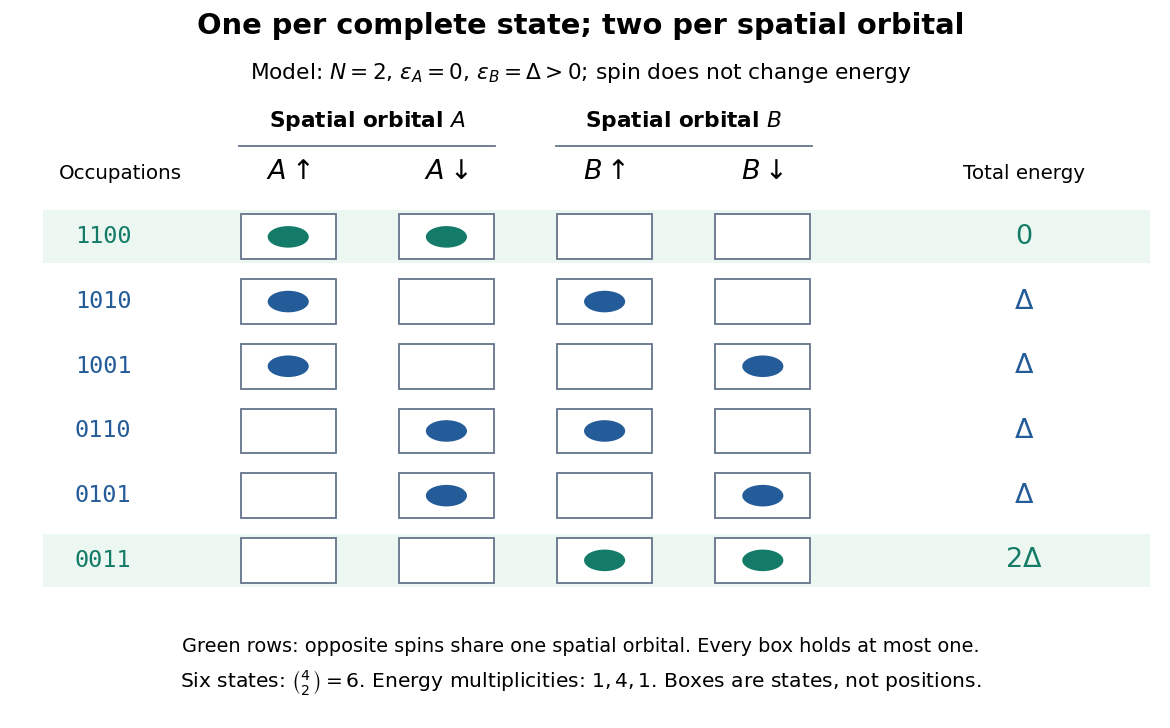
The Pauli exclusion principle says that each complete one-particle state can have fermionic occupation number zero or one. “Complete” includes spin and any other internal labels, as well as the spatial wavefunction. Thus two electrons can share a spatial orbital with opposite spin projections: these are two different spin orbitals. Equal energy alone does not mean equal quantum state, because degenerate energy levels contain several independent one-particle states.
This distinction explains how an electron shell can accommodate several electrons while exclusion still allows only one per complete one-particle state. It also makes a finite model of fermionic state counting surprisingly simple: two spatial orbitals with two spin choices each give four complete one-particle states, and exactly six two-electron basis states. The following diagram enumerates them; its boxes represent occupation numbers, not locations in space.
Pauli's Exclusion principle and quantum mechanics by Wolfgang Pauli is his retrospective account, delivered on 13 December 1946 for the 1945 Nobel Prize. On printed pp. 29–30, he describes proposing an extra two-valued electron property in autumn 1924 and formulating exclusion in 1925. The crucial clue linked counts of resolved energy eigenstates in alkali spectra under a magnetic field with the populations of closed electron shells. Resolving every label turned a complicated shell capacity into one electron per complete one-particle state. This historical route preceded the modern spin interpretation and the antisymmetric wavefunction formulation; it was not originally a deduction from a Slater determinant.
The alternating summands in the tensor square give . Since is self-dual and has trivial determinant,
A Gysin sequence of a sphere bundle is the long exact sequence induced by the Gysin homomorphism and the Euler class of a vector bundle.
Singleton equilibrium potential from the Green function by Codex 0 Created 2026-09-24 Updated 2026-09-24
Codex 0 Created 2026-09-24 Updated 2026-09-24A nonzero module is a brick when every endomorphism is either zero or an isomorphism. Equivalently, its endomorphism ring is a division ring.
Pinned article: Introduction to the OurBigBook Project
Welcome to the OurBigBook Project! Our goal is to create the perfect publishing platform for STEM subjects, and get university-level students to write the best free STEM tutorials ever.
Everyone is welcome to create an account and play with the site: ourbigbook.com/go/register. We belive that students themselves can write amazing tutorials, but teachers are welcome too. You can write about anything you want, it doesn't have to be STEM or even educational. Silly test content is very welcome and you won't be penalized in any way. Just keep it legal!
Intro to OurBigBook
. Source. We have two killer features:
- topics: topics group articles by different users with the same title, e.g. here is the topic for the "Fundamental Theorem of Calculus" ourbigbook.com/go/topic/fundamental-theorem-of-calculusArticles of different users are sorted by upvote within each article page. This feature is a bit like:
- a Wikipedia where each user can have their own version of each article
- a Q&A website like Stack Overflow, where multiple people can give their views on a given topic, and the best ones are sorted by upvote. Except you don't need to wait for someone to ask first, and any topic goes, no matter how narrow or broad
This feature makes it possible for readers to find better explanations of any topic created by other writers. And it allows writers to create an explanation in a place that readers might actually find it.
Figure 1. Screenshot of the "Derivative" topic page. View it live at: ourbigbook.com/go/topic/derivativeVideo 2. OurBigBook Web topics demo. Source. - local editing: you can store all your personal knowledge base content locally in a plaintext markup format that can be edited locally and published either:This way you can be sure that even if OurBigBook.com were to go down one day (which we have no plans to do as it is quite cheap to host!), your content will still be perfectly readable as a static site.
- to OurBigBook.com to get awesome multi-user features like topics and likes
- as HTML files to a static website, which you can host yourself for free on many external providers like GitHub Pages, and remain in full control

Figure 2. You can publish local OurBigBook lightweight markup files to either OurBigBook.com or as a static website.
Figure 3. Visual Studio Code extension installation.
Figure 5. . You can also edit articles on the Web editor without installing anything locally. Video 3. Edit locally and publish demo. Source. This shows editing OurBigBook Markup and publishing it using the Visual Studio Code extension. 
- Infinitely deep tables of contents:



All our software is open source and hosted at: github.com/ourbigbook/ourbigbook
Further documentation can be found at: docs.ourbigbook.com
Feel free to reach our to us for any help or suggestions: docs.ourbigbook.com/#contact