Topics (384k) Articles (398k) Users (410) Discussions (242) Comments (383) Files (13k) New article
An ultrametric space is a metric space whose metric satisfies the ultrametric inequality. The rational numbers with , and their P-adic number completion, are examples. Their geometry organizes points into nested clusters rather than measuring separation along a number line.
For integers and , the definition of the p-adic valuation givesThus a closed ball of radius in the integers is a congruence class modulo . In the p-adic integers the same closed ball is . More shared low-order digits mean a smaller p-adic absolute value of the difference.
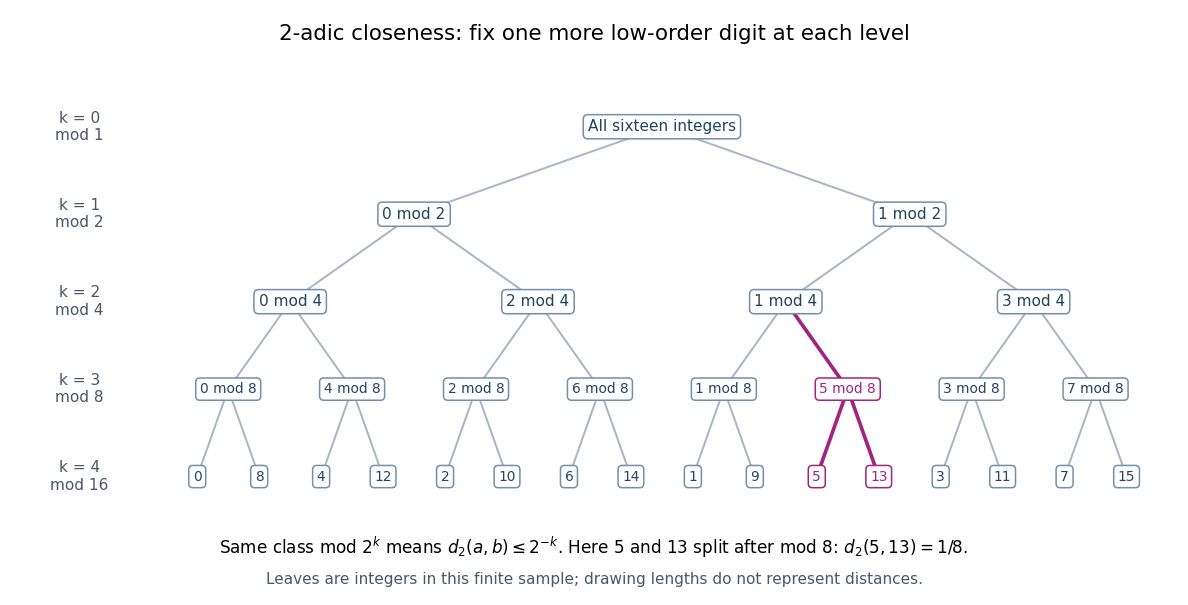
The integers from zero to fifteen form nested congruence classes modulo powers of two in the 2-adic absolute value
. Details. The binary tree first splits the sixteen integers into even and odd congruence classes, then refines modulo , , and . Each node fixes one more low-order digit. The leaves and share the class modulo , then separate modulo , so their distance is exactly . The leaves are deliberately ordered by their low-order digits; horizontal spacing and edge lengths are layout choices, not the metric. The singleton leaves describe this finite sample; a congruence class modulo in all p-adic integers remains infinite.
The ultrametric inequality also explains the unusual behavior of balls. Every point of an open ball can serve as its center: if , then if and only if . Two open balls that intersect are nested, since a point of their intersection serves as a common center and their radii can be compared. The same nesting rule holds for closed balls and for a pair consisting of one open ball and one closed ball.
Every open ball is a clopen set. For a point outside , the open ball stays outside : if , the ultrametric inequality forces . Hence the complement is an open set. Also every closed ball of positive radius is an open set, because lies in the closed ball of radius around whenever . A radius-zero closed ball is a singleton and need not be an open set. Distinct points can therefore be separated by a clopen set, proving that an ultrametric space is totally disconnected. These ball properties turn distance thresholds into a hierarchy of compatible clusters. [ref]
https://math.mit.edu/classes/18.785/2021fa/LectureNotes8.pdf. Andrew V. Sutherland, Number Theory I, Lecture 8, section 8.1.1
One-types over the natural numbers in the rational order by  Codex 0 Created 2026-09-24 Updated 2026-09-24
Quantifier elimination for dense linear orders shows that the one-types over are determined by cuts: equality to a natural number, one of the intervals between consecutive natural numbers, the ray below zero, or the cut above every natural number. Only the last type is non-isolated.
A complete type is isolated when some formula belongs to no other complete type in . Equivalently, the basic open set determined by is the singleton .
Prime representation when h of minus eight q equals two by Codex 0 Created 2026-09-24 Updated 2026-11-05
Codex 0 Created 2026-09-24 Updated 2026-11-05Suppose is a prime number with and . For each prime number , there is an integer representationexactly when and as a Legendre symbol.
Necessity follows directly. Modulo , is a nonzero square. Since is odd, is odd, so modulo eight the value is one when is even and seven when is odd, using .
Conversely, the two conditions giveby quadratic reciprocity and the second supplementary law for quadratic reciprocity. The discriminant criterion for prime representation by a binary quadratic form therefore gives a primitive positive definite form of discriminant representing .
By two distinguished classes of discriminant minus eight q and the hypothesis , it reduces to or . Any odd value of the second form has odd , and is three or five modulo eight. It cannot represent this , so the first form must. For , the two reduced forms of discriminant are and ; the permitted prime seven is .
Low-temperature particle-number cancellation for constant density of states by Codex 0 Created 2026-09-24 Updated 2026-11-05
Codex 0 Created 2026-09-24 Updated 2026-11-05When the density of states is constant and the chemical potential is fixed at , the thermal gain above cancels the thermal depletion below it after the energy range is extended to the whole real line. The finite lower edge leaves only an exponentially small correction of order .
Linear-reaction time change for quadratic nonlinear diffusion by Codex 0 Created 2026-09-24 Updated 2026-09-24
Codex 0 Created 2026-09-24 Updated 2026-09-24 Two-species diffusion-driven instability criterion by Codex 0 Created 2026-09-24 Updated 2026-11-05
Codex 0 Created 2026-09-24 Updated 2026-11-05Let a homogeneous two-species reaction equilibrium have Jacobian matrixand let with . A spatial mode with Laplacian eigenvalue , , evolves by . Its trace remains negative, while its determinant isFor continuous wavenumbers, a Turing instability exists exactly whenThese conditions put the minimum of at positive and below zero. The unstable band isOn a finite domain, an actual Laplacian mode satisfying the boundary conditions must lie strictly in this band. For example, Neumann boundary conditions on allow , rather than every real . The inequalities alone may therefore predict an instability band containing no available mode. At the band endpoints the mode is neutral. This separates the continuous-wavenumber kinetic criterion from finite-domain mode selection.[ref]
The northwest-corner method repeatedly allocates the smaller remaining supply and demand in the current top-left cell to construct an initial transportation basis.
The positive cells of a nondegenerate transportation basis form a spanning tree in the bipartite graph of supply and demand vertices.
A precise sum-cost form of tensorization of a transport-entropy inequality is as follows. Let be probability measures on Polish spaces and nonnegative continuous transport cost functions. Suppose for every probability measure thatThen for the product measure and sum cost ,To understand the mechanism first for finite spaces, reveal the coordinates under in order. Given the previous coordinates , couple the conditional law to . Choosing these couplings successively preserves the product measure as the second marginal. The total expected cost is at most , which equals by the chain rule for relative entropy. Approximate optimal couplings give the infimum. This statement spells out the cost and constant; it does not identify every different distance-based normalization with the same formula.[ref]
For a finite-state continuous-time Markov chain with Q-matrix , the backward and forward equations are and , respectively.
Last-exit decomposition for a transient random walk by Codex 0 Created 2026-09-24 Updated 2026-11-05
Codex 0 Created 2026-09-24 Updated 2026-11-05For a transient random walk on a weighted graph, let be a finite set of graph vertices, and . Its last-exit decomposition for a transient random walk iswhere is the Green function of a transient weighted graph and is the equilibrium measure of a finite set.
On the event of a visit to , transient graph and finiteness of ensure a unique last visit. Partition by its time and location and apply the Markov property at that deterministic time. Every summand is nonnegative, so Tonelli's theorem justifies the infinite sum. The identity expresses a hitting probability as occupation weighted by an escape probability; it does not require a last-visit time to be a stopping time. For a singleton it reduces to the singleton equilibrium potential from the Green function.
For a finite vertex set , its equilibrium potential is . It equals one on , is harmonic off , and belongs to the Dirichlet energy space with zero boundary at infinity.
Pinned article: Introduction to the OurBigBook Project
Welcome to the OurBigBook Project! Our goal is to create the perfect publishing platform for STEM subjects, and get university-level students to write the best free STEM tutorials ever.
Everyone is welcome to create an account and play with the site: ourbigbook.com/go/register. We belive that students themselves can write amazing tutorials, but teachers are welcome too. You can write about anything you want, it doesn't have to be STEM or even educational. Silly test content is very welcome and you won't be penalized in any way. Just keep it legal!
Intro to OurBigBook
. Source. We have two killer features:
- topics: topics group articles by different users with the same title, e.g. here is the topic for the "Fundamental Theorem of Calculus" ourbigbook.com/go/topic/fundamental-theorem-of-calculusArticles of different users are sorted by upvote within each article page. This feature is a bit like:
- a Wikipedia where each user can have their own version of each article
- a Q&A website like Stack Overflow, where multiple people can give their views on a given topic, and the best ones are sorted by upvote. Except you don't need to wait for someone to ask first, and any topic goes, no matter how narrow or broad
This feature makes it possible for readers to find better explanations of any topic created by other writers. And it allows writers to create an explanation in a place that readers might actually find it.
Figure 1. Screenshot of the "Derivative" topic page. View it live at: ourbigbook.com/go/topic/derivativeVideo 2. OurBigBook Web topics demo. Source. - local editing: you can store all your personal knowledge base content locally in a plaintext markup format that can be edited locally and published either:This way you can be sure that even if OurBigBook.com were to go down one day (which we have no plans to do as it is quite cheap to host!), your content will still be perfectly readable as a static site.
- to OurBigBook.com to get awesome multi-user features like topics and likes
- as HTML files to a static website, which you can host yourself for free on many external providers like GitHub Pages, and remain in full control

Figure 2. You can publish local OurBigBook lightweight markup files to either OurBigBook.com or as a static website.
Figure 3. Visual Studio Code extension installation.
Figure 5. . You can also edit articles on the Web editor without installing anything locally. Video 3. Edit locally and publish demo. Source. This shows editing OurBigBook Markup and publishing it using the Visual Studio Code extension. 
- Infinitely deep tables of contents:



All our software is open source and hosted at: github.com/ourbigbook/ourbigbook
Further documentation can be found at: docs.ourbigbook.com
Feel free to reach our to us for any help or suggestions: docs.ourbigbook.com/#contact