Topics (384k) Articles (398k) Users (410) Discussions (242) Comments (383) Files (13k) New article

The -torsion subgroup is the kernel of multiplication by . When the characteristic does not divide , it is isomorphic over an algebraic closure to .
An isogeny between elliptic curves is a nonconstant morphism preserving their group identities; it is finite and surjective with finite kernel.
An isogeny is a nonconstant morphism of elliptic curves preserving their identity points. It is a finite surjective group homomorphism.
A one-dimensional commutative formal group law over a ring is a series satisfying the identity, commutativity, and associativity axioms. A homomorphism from to is a series satisfying .
A flex of a smooth plane cubic is a point whose tangent line has intersection multiplicity three with the cubic. Over an algebraically closed field, choose a flex as the elliptic curve identity. A line cuts out a divisor linearly equivalent to , so is a flex exactly when : the tangent divisor is then . Thus the flexes are precisely the geometric 3-torsion points.
If the characteristic is not three, prime-to-characteristic geometric torsion gives nine distinct flexes. In characteristic three, the scheme-theoretic fibre still has length nine, but need not have nine distinct points: an ordinary elliptic curve has three geometric 3-torsion points, and a supersingular elliptic curve has only the identity. A flex chosen over the algebraic closure need not be rational over the original field.
A Weierstrass equation presents an elliptic curve aswith nonzero discriminant, together with the point at infinity .
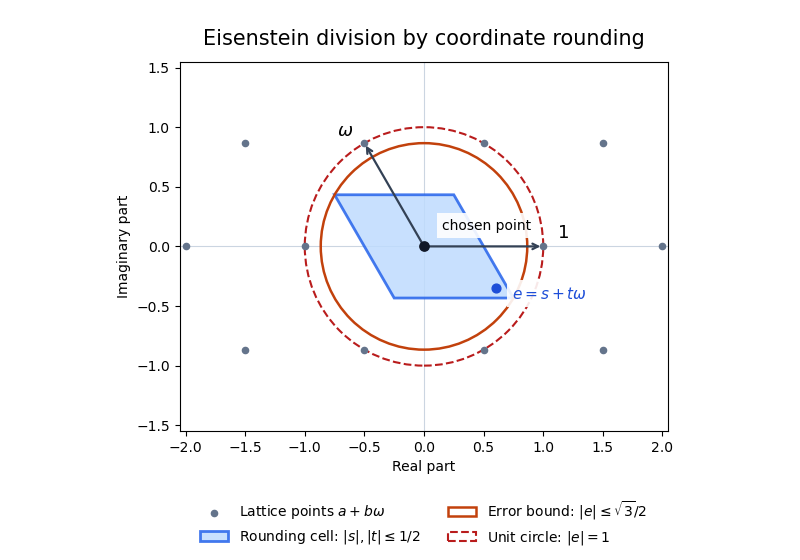
Every complex number can be written uniquely as with real , where . Round separately to integers . The error is with , andFor Eisenstein integers with , apply this to to choose . The remainder is an Eisenstein integer and if nonzero. Thus the Eisenstein norm is a Euclidean function and these integers form a Euclidean domain. Coordinate rounding suffices; no closest-point theorem is needed.
If and is a differentiable function defining a simple eigenvalue, thenThe Cauchy-Schwarz inequality and the operator norm give
A common envelope is a phase of binary interaction in which the two stellar cores orbit within shared gas. It can arise when Roche-lobe overflow becomes unstable or when a companion is engulfed by an expanding giant. Motion through the gas transfers orbital energy and angular momentum to the envelope, causing the orbit to shrink.
If enough energy and momentum reach gas that can escape, envelope ejection can leave a much closer binary star; otherwise the cores can merge. The common-envelope energy formalism estimates the final separation by comparing released orbital energy with envelope binding energy, but its efficiency parameters compress complicated gas dynamics and energy transport. The outcome therefore depends on the donor's structure and the actual coupling to escaping material, rather than orbital energy being automatically available with unit efficiency.
The value group of a valued field is the ordered abelian group formed by the values of its nonzero elements. A valuation is discrete when its value group is infinite cyclic with the order inherited from .
For the -valued convention on the unbiased Boolean hypercube, the influence of coordinate is , where is the discrete derivative of a Boolean function. It equals the probability that flipping coordinate changes . For the -valued convention, the same flip probability is instead , since a nonzero discrete derivative has magnitude .
For a probability density on the whole real line, if the density and its derivatives decay sufficiently fast that all boundary terms vanish, two integrations by parts givewhile the diffusion term contributes zero to the first moment.
The linear noise approximation replaces small fluctuations around a deterministic solution by a linear stochastic differential equation. For a stable equilibrium of drift , write . In one dimension with and local increment variance , the approximation is the Ornstein-Uhlenbeck processIts mean decays as . Applying Itô formula to gives , so its stationary Normal distribution has variance .
For constant immigration rate and linear death rate , the equilibrium is , , and . The stationary variance is therefore , matching the exact stationary Poisson distribution's mean and variance. The Normal distribution is a useful approximation when that mean is large; for small means it misses discreteness and assigns probability to negative populations. In several dimensions the drift is the Jacobian matrix at the equilibrium and the stationary covariance solves , a Continuous Lyapunov equation. Stability and sufficiently small fluctuations are essential: a zero restoring eigenvalue with nonzero noise has no finite stationary variance.
The Debye temperature is the vibrational cutoff energy of a Debye model expressed in temperature units, . It compares a characteristic lattice excitation scale with thermal energy.
For temperatures much below , only low-frequency modes are significantly occupied and the three-dimensional model predicts a heat capacity. Well above that scale, most modes approach their classical thermal contribution. Different fitting observables or temperature ranges can yield different effective Debye temperatures in a real material because its spectrum is not an exact cutoff continuum. The parameter is therefore useful for organizing thermal regimes, without being an independently sharp thermodynamic phase-transition temperature.
exponential tilting reweights a probability law in favour of larger or smaller values. Let be finite at the chosen parameter. Define the tilted law by its Radon-Nikodym derivativeIts total mass is one by construction. Positive favours larger , while negative favours smaller ; it changes probabilities without creating values outside the original support.
For in the interior of the finite moment-generating-function domain, differentiation under the integral givesThe interior-domain condition supplies the integrable exponential bounds needed for these derivatives. Endpoint tilts can exist without a finite tilted mean, so existence of a normalized tilt alone is insufficient for the mean formula.
For a Bernoulli distribution with success probability , the tilted success probability is : tilting adds to its log odds. A Normal distribution tilts to by completing the square. These calculations explain why exponential tilting is useful for making a rare Sample mean typical while retaining an explicit Likelihood ratio.
The Coxeter graph has vertex set , joins and when , and labels the edge by when . A Coxeter system is irreducible exactly when this graph is connected.
Pinned article: Introduction to the OurBigBook Project
Welcome to the OurBigBook Project! Our goal is to create the perfect publishing platform for STEM subjects, and get university-level students to write the best free STEM tutorials ever.
Everyone is welcome to create an account and play with the site: ourbigbook.com/go/register. We belive that students themselves can write amazing tutorials, but teachers are welcome too. You can write about anything you want, it doesn't have to be STEM or even educational. Silly test content is very welcome and you won't be penalized in any way. Just keep it legal!
Intro to OurBigBook
. Source. We have two killer features:
- topics: topics group articles by different users with the same title, e.g. here is the topic for the "Fundamental Theorem of Calculus" ourbigbook.com/go/topic/fundamental-theorem-of-calculusArticles of different users are sorted by upvote within each article page. This feature is a bit like:
- a Wikipedia where each user can have their own version of each article
- a Q&A website like Stack Overflow, where multiple people can give their views on a given topic, and the best ones are sorted by upvote. Except you don't need to wait for someone to ask first, and any topic goes, no matter how narrow or broad
This feature makes it possible for readers to find better explanations of any topic created by other writers. And it allows writers to create an explanation in a place that readers might actually find it.
Figure 1. Screenshot of the "Derivative" topic page. View it live at: ourbigbook.com/go/topic/derivativeVideo 2. OurBigBook Web topics demo. Source. - local editing: you can store all your personal knowledge base content locally in a plaintext markup format that can be edited locally and published either:This way you can be sure that even if OurBigBook.com were to go down one day (which we have no plans to do as it is quite cheap to host!), your content will still be perfectly readable as a static site.
- to OurBigBook.com to get awesome multi-user features like topics and likes
- as HTML files to a static website, which you can host yourself for free on many external providers like GitHub Pages, and remain in full control

Figure 2. You can publish local OurBigBook lightweight markup files to either OurBigBook.com or as a static website.
Figure 3. Visual Studio Code extension installation.
Figure 5. . You can also edit articles on the Web editor without installing anything locally. Video 3. Edit locally and publish demo. Source. This shows editing OurBigBook Markup and publishing it using the Visual Studio Code extension. 
- Infinitely deep tables of contents:



All our software is open source and hosted at: github.com/ourbigbook/ourbigbook
Further documentation can be found at: docs.ourbigbook.com
Feel free to reach our to us for any help or suggestions: docs.ourbigbook.com/#contact