Topics (384k) Articles (398k) Users (410) Discussions (242) Comments (383) Files (13k) New article
For a continuously differentiable function and a piecewise smooth parametric curve from to ,The chain rule converts the integrand into , then the fundamental theorem of calculus supplies the endpoint difference. This is why a conservative vector field has a path independent line integral. For , every path from to gives , provided it lies in the domain where the potential is defined.
Let be a bounded region in Euclidean space with piecewise smooth boundary and outward unit normal vector . For a continuously differentiable vector field on a neighborhood of its closure,The total outward flux equals the accumulated divergence inside. Contributions across shared internal faces cancel when a region is divided into small pieces.
For on a ball of radius , the divergence is , giving . On the boundary, , so the surface integral is also . This agreement turns the derivative into a geometric flux measurement. The required regularity matters: a singular field at the center cannot be included without checking its contribution separately.
A vector field is conservative when for a potential of a conservative vector field . On a simply connected open subset of , every continuously differentiable curl-free vector field is conservative. Locally this follows from the Poincaré lemma applied to the differential one-form ; globally, simple connectivity makes its line integral independent of the path. The fundamental theorem for line integrals expresses that path independence as the difference of the potential at the endpoints.
Let be linearly independent unit vectors in a real Hilbert space, and write , so . Given desired inner products and , the unique least-norm solution lies in and isSolve the two-by-two Gram matrix system to obtain these coefficients. Every solution is with orthogonal to both , so the Pythagorean theorem gives .
If the orthogonal complement of their span contains a nonzero vector, a unit solution exists exactly when : choose with length . In a two-dimensional ambient space the complement is zero, so a unit solution instead requires equality. For example, satisfies the inequality but cannot be attained by a unit vector in the plane spanned by . For a solution of norm at most1, the inequality is the criterion in either dimension.
For smooth vector fields ,andBoth follow by contracting two Levi-Civita symbols and applying the product rule.
The Laplacian takes the divergence of a scalar field's gradient. For a real-valued function on an open region of Euclidean space, with continuous partial derivatives through order two, its expression in a Cartesian coordinate system isThus the Laplacian, also called the Laplace operator, adds the coordinate second derivatives; equivalently it is the matrix trace of the Hessian matrix. Its output is another scalar field.[ref]
The Feynman Lectures on Physics, Volume II by Richard Feynman and others. Volume II, §2–7, equations 2.52–2.54: divergence of a gradient and the Cartesian Laplacian
Three original examples distinguish shape from this sum. The bowl has . The saddle instead has : opposite second derivatives cancel. It is a harmonic function, although its graph of a function is not a plane. For the Gaussian function , with , differentiation givesIts Laplacian is negative inside the circle of radius one, zero on that circle, and positive outside it. The Gaussian function itself is positive throughout: its value and its Laplacian describe different properties.
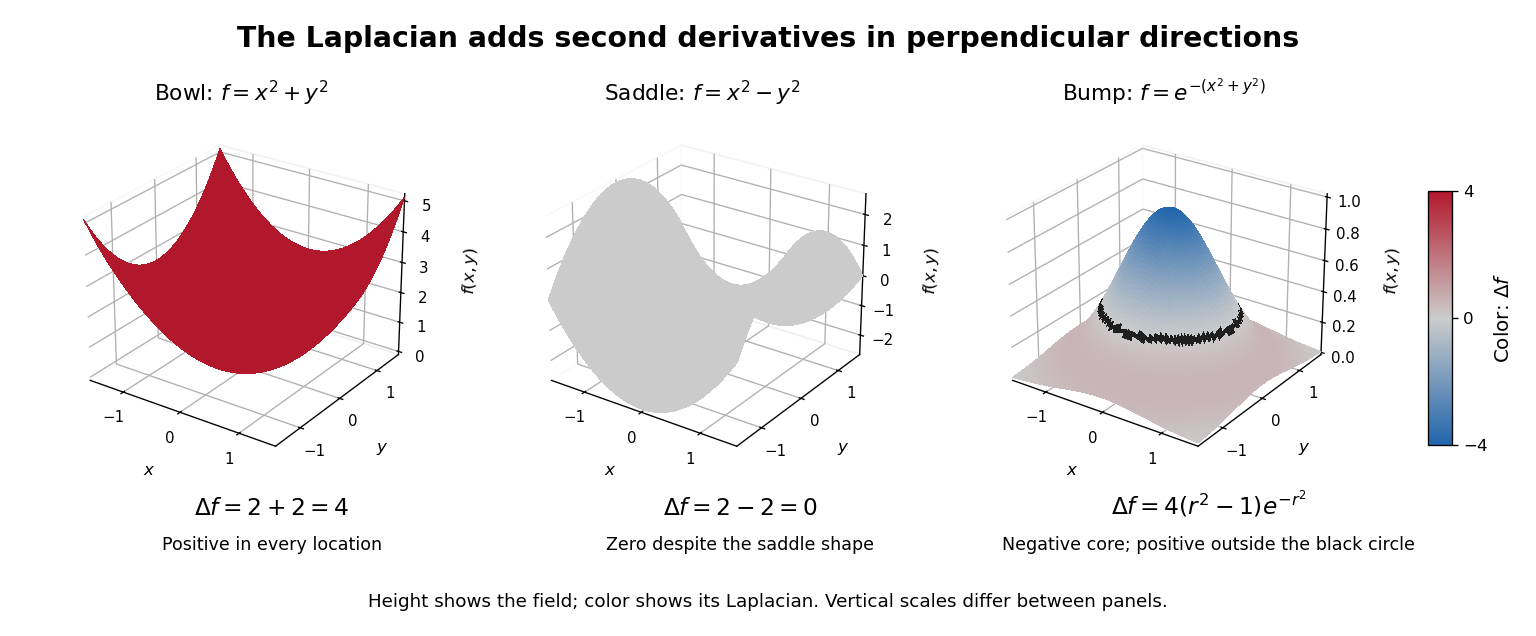
The sum does not favor a particular orientation. Under a change of Cartesian coordinate system represented by an orthogonal matrix , the Hessian matrix becomes . The cyclic property of the trace and preserve its matrix trace. This makes the Laplacian useful when the behavior depends on spatial differences equally in every direction, rather than on the arbitrary choice of axes.
For a vector field, the Euclidean Laplacian acts separately on components expressed in a fixed Cartesian coordinate system. Components in a position-dependent basis require differentiating that basis too; applying a scalar formula separately to polar components omits those terms.[ref]
The Feynman Lectures on Physics, Volume II by Richard Feynman and others. Volume II, component formula following equation 2.54 and final paragraph of §2–8: fixed rectangular components
The scalar formula in Laplacian in polar coordinates is valid away from ; smoothness at the origin must be handled in coordinates that remain regular there.For a continuously differentiable vector field in three-dimensional Euclidean space, the component of its curl along a unit normal vector is the limiting circulation per unit area around a small loop in the perpendicular plane. The loop direction and the normal obey the right-hand rule. Stokes theorem gives the corresponding relation for a finite surface.
For the rigidly rotating velocity field , direct differentiation gives . A circle of radius has tangential speed and circumference , so its circulation is , twice the angular velocity times the enclosed area. The factor of two distinguishes vorticity from rigid-body angular velocity.
Curved integral curves alone do not demonstrate nonzero curl. The field has zero curl, yet its trajectories satisfy , and hence : away from the axes they are hyperbolas. The curl measures local circulation of the field, not the curvature of an individual trajectory.
For in Cartesian coordinates,
For a continuously differentiable vector field, the divergence is the limiting outward flux per unit volume through a small closed surface. Opposite faces of a small rectangular box almost cancel; the remaining differences in the three components give the sum of partial derivatives above. The divergence theorem extends this local balance to a whole region.
For , the divergence is . In a planar unit square, the right edge contributes outward flux and the top contributes , while the left and bottom contribute zero. The total equals the integral of the planar divergence over area .
If is a velocity field, positive divergence means local volume expansion, not automatically creation of mass. The continuity equation gives , where is the material derivative. For this field, a uniform initial density evolves as while material volumes grow as . Their product stays constant.
Helicity conservation by tangent boundary conditions by  Codex 0 Created 2026-09-24 Updated 2026-09-29
If a helicity density evolves as a sum of directional derivatives along divergence-free fields tangent to the boundary, its volume integral is conserved because both terms become vanishing boundary fluxes.
On an open set , a vector field assigns a vector to each point . Its components are scalar functions. For a smooth manifold , the corresponding definition requires : the vector belongs to the tangent space at its base point. A smooth vector field is a smooth section of the tangent bundle.[ref]
Calculus Volume 3 by Gilbert Strang and others. section6.1, Vector Fields, planar and spatial definitions
For example, is tangent to circles centred at the origin. Its integral curves solve , , so is constant. This distinguishes the field, which assigns a direction and magnitude at every point, from any one trajectory following it. A fluid velocity is a physical vector field; its divergence measures local expansion, while its curl measures local rotation in three dimensions.
A finite forbidden relational pattern can be excluded by a universal sentence. If a finite structure has distinct vertices , let say that the variables are distinct and have the required relations. Thenforbids that pattern. Taking one sentence for each forbidden finite pattern gives a universal first-order theory.
For a triangle-free graph, the forbidden diagram asserts that three distinct vertices are pairwise adjacent. To forbid an induced pattern, the diagram must specify absent relations as well as present ones. Forbidding an ordinary path on three vertices allows extra edges between its vertices; forbidding an induced path on three vertices does not. Thus the meaning of pattern determines the exact diagram. The construction explains why many local graph constraints are preserved under taking substructures.
For an ordered basis of a Lie algebra , the ordered monomials form a basis of . In particular, a triangular decomposition gives as vector spaces.
A time-reversal operator intertwines forward and backward evolution:It must be antiunitary in ordinary quantum mechanics. Its conjugate linearity sends to , allowing it to commute with a time-reversal-invariant Hamiltonian rather than reversing the sign of its energy.
The Heisenberg picture assigns a closed system's unitary time evolution to its observables while keeping the state fixed at a reference time. If is the evolution operator, a Schrödinger-picture linear operator becomesThe transformation preserves expectation values:It is a change of description, not a different physical evolution.
For a possibly time-dependent Hamiltonian operator , let . Differentiating the transformation givesIf is time independent and has no explicit time dependence, this reduces to . Using an untransformed time-dependent Hamiltonian without checking the picture would generally be incorrect.
For a spin one-half with , a fixed Schrödinger-picture becomesThe Pauli matrix commutator identity verify its initial derivative , illustrating uniform-field spin precession with a fixed Heisenberg-picture state.
For , the right adjoint is full and faithful exactly when the counit is an isomorphism. Dually, is full and faithful exactly when the unit is an isomorphism.
Every unipotent algebraic subgroup of is conjugate to a subgroup of the upper unitriangular group. The filtration by vanishing initial superdiagonals then proves that every unipotent algebraic group is a nilpotent group.
Let be a finite union-closed family whose union is nonempty. Some ground element belongs to at least a proportionof its members. Requiring a nonempty union excludes both the empty set family and , for which no element can be chosen.
Here is the entropy mechanism. Choose independent uniform random members of . Then and , because the union still belongs to . If every element had probability at most of belonging to , Will Sawin's binary entropy estimate would givea contradiction when . A singleton set family with nonempty union satisfies the conclusion directly.[ref]
An improved lower bound for the union-closed sets conjecture by Will Sawin. Theorems1–2 and proof of Theorem1
Pinned article: Introduction to the OurBigBook Project
Welcome to the OurBigBook Project! Our goal is to create the perfect publishing platform for STEM subjects, and get university-level students to write the best free STEM tutorials ever.
Everyone is welcome to create an account and play with the site: ourbigbook.com/go/register. We belive that students themselves can write amazing tutorials, but teachers are welcome too. You can write about anything you want, it doesn't have to be STEM or even educational. Silly test content is very welcome and you won't be penalized in any way. Just keep it legal!
Intro to OurBigBook
. Source. We have two killer features:
- topics: topics group articles by different users with the same title, e.g. here is the topic for the "Fundamental Theorem of Calculus" ourbigbook.com/go/topic/fundamental-theorem-of-calculusArticles of different users are sorted by upvote within each article page. This feature is a bit like:
- a Wikipedia where each user can have their own version of each article
- a Q&A website like Stack Overflow, where multiple people can give their views on a given topic, and the best ones are sorted by upvote. Except you don't need to wait for someone to ask first, and any topic goes, no matter how narrow or broad
This feature makes it possible for readers to find better explanations of any topic created by other writers. And it allows writers to create an explanation in a place that readers might actually find it.
Figure 1. Screenshot of the "Derivative" topic page. View it live at: ourbigbook.com/go/topic/derivativeVideo 2. OurBigBook Web topics demo. Source. - local editing: you can store all your personal knowledge base content locally in a plaintext markup format that can be edited locally and published either:This way you can be sure that even if OurBigBook.com were to go down one day (which we have no plans to do as it is quite cheap to host!), your content will still be perfectly readable as a static site.
- to OurBigBook.com to get awesome multi-user features like topics and likes
- as HTML files to a static website, which you can host yourself for free on many external providers like GitHub Pages, and remain in full control

Figure 2. You can publish local OurBigBook lightweight markup files to either OurBigBook.com or as a static website.
Figure 3. Visual Studio Code extension installation.
Figure 5. . You can also edit articles on the Web editor without installing anything locally. Video 3. Edit locally and publish demo. Source. This shows editing OurBigBook Markup and publishing it using the Visual Studio Code extension. 
- Infinitely deep tables of contents:



All our software is open source and hosted at: github.com/ourbigbook/ourbigbook
Further documentation can be found at: docs.ourbigbook.com
Feel free to reach our to us for any help or suggestions: docs.ourbigbook.com/#contact