Topics (384k) Articles (398k) Users (410) Discussions (242) Comments (383) Files (13k) New article
Contracting two Levi-Civita symbols gives
Contracting one index gives
For a random field on a countable locally finite graph, declare open when . Increasing can only remove open vertices, so the event that an infinite percolation cluster exists is decreasing in . One convention for the critical threshold for level-set percolation isThe value may be infinite, and the definition does not decide what happens at . On a general graph, a specified-root threshold can differ from a global existence threshold, so the convention matters.
For independent and identically distributed random variables with uniform distribution on , the open probability is for . The resulting model is site percolation, and reversing the parameter gives , where is its percolation critical probability. This example separates the direction of the level threshold from the usual increasing opening-density parameter.
For a symmetric bandwidth- averaging kernel and a density with bounded first derivative, the interior pointwise bias is at most a constant times . Near a support boundary, an uncorrected symmetric kernel can instead have nonvanishing bias.
Uniformly most powerful upper-tail test for a logistic location by  Codex 0 Created 2026-09-24 Updated 2026-09-24
 Hodge decomposition theorem for compact Kähler manifolds by Codex 0 Created 2026-09-24 Updated 2026-10-14
Codex 0 Created 2026-09-24 Updated 2026-10-14This is the compact Kähler specialization of Hodge theory.
The Fubini-Study form is the standard Kähler form on complex projective space. With the integral normalization, .
The two-form is associated with the Fubini-Study metric.
The Lefschetz operator of a Kähler manifold is exterior multiplication by its Kähler form,Its formal adjoint is denoted by and lowers the bidegree of a differential form by .
This wedge operator participates in the Kähler identities; the theorem on integral classes is a different result.
For a representative , the Hecke parameter isThe Iwahori-Hecke algebra of a BN-pair is obtained from the generic algebra by .
An equation can define a function without giving an explicit formula for it. The implicit function theorem tells us when the constraint determines uniquely from nearby , and makes the resulting function continuously differentiable. It is useful when solving an equation explicitly is cumbersome or impossible: the partial derivatives already reveal whether local recovery is possible.
Let be a continuously differentiable map from an open subset of to . Suppose and the partial derivative is an invertible linear map. There are open neighbourhoods of and of and a unique continuously differentiable function such that, for ,Thus the nearby level set is a graph of a function. The derivative of this graph isThe matrix inverse acts on the left; the order matters in several dimensions.
For example, take the unit circle, written as the level set . At , , so the local upper branch is . Implicit differentiation givesThis tangent line slope is available directly from the constraint. The negative square root branch is elsewhere on the same circle; it does not destroy uniqueness near the selected upper point.
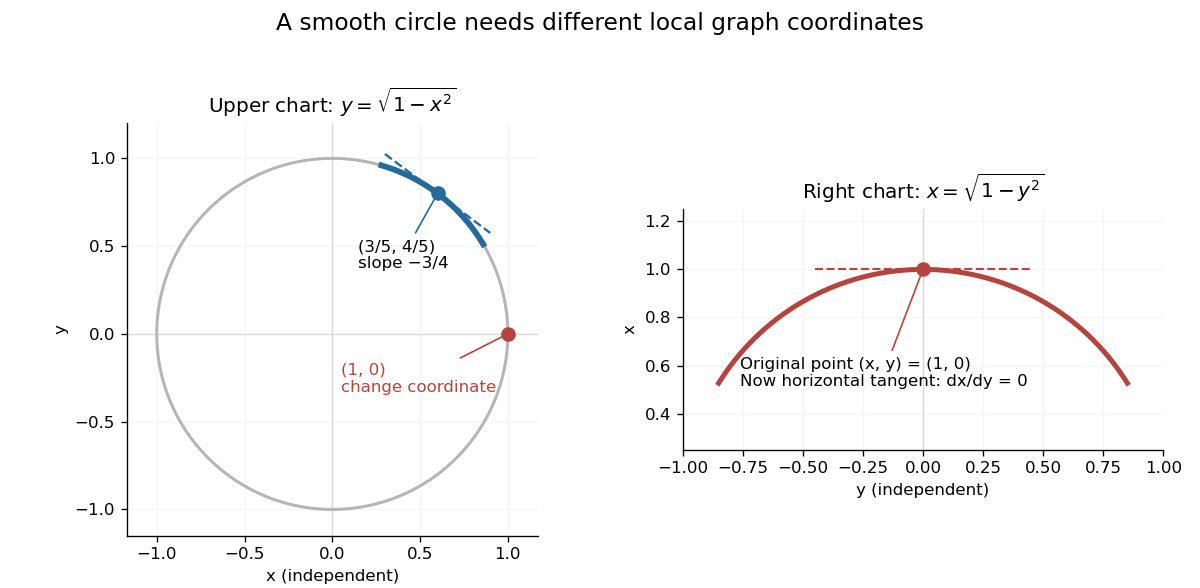
The same circle uses y as a function of x near its upper arc and x as a function of y near its rightmost point
. Details. At , however, and the circle cannot be represented locally as one function : just to the left of there are two nearby values of . The circle is still smooth there. Since , use the other coordinate instead: , with . A failed coordinate choice is different from a geometric singularity.
The derivative condition is sufficient, not necessary for every possible implicit graph. For , the entire zero set is the smooth graph , even though vanishes there. In this case the defining equation itself has a degenerate derivative; the theorem's test gives no conclusion.
The connection to the inverse function theorem is particularly elegant. Augment the constraint to the map , whose Jacobian matrix isIts determinant is . When this is nonzero, locally invert and set its second output to zero. The recovered second input is . In this way an implicit constraint becomes an ordinary inverse function problem. [ref]
https://www.math.utoronto.ca/courses/mat237y1/20199/notes/Chapter3/S3.3.html. University of Toronto MAT237: the implicit theorem as a corollary of the inverse theorem
A local diffeomorphism is a differentiable map that restricts near every point to a diffeomorphism onto an open subset of its target. The local inverse functions need not combine into a single global inverse function: different parts of the domain of a function can map onto the same output region.
For continuously differentiable maps between open subsets of , being a local diffeomorphism is equivalent to having an invertible derivative at every point. The inverse function theorem proves one direction. For the other, the chain rule for each local inverse function gives two inverse linear maps. The periodic angle example under the inverse function theorem has this property everywhere, even though it has infinitely many inputs for every point of the punctured plane. The noninjective map with constant Jacobian determinant gives another useful distinction: even a constant nonzero Jacobian determinant need not give global injectivity.
Every local diffeomorphism is an open map. To see this, take an open subset of the source and intersect it with the neighbourhoods where the map is a diffeomorphism. Each local image is open, and their union is the full image. Thus nearby outputs remain available locally, despite the possible global ambiguity.
Fast holding rates create continuous-time positive recurrence by Codex 0 Created 2026-09-24 Updated 2026-11-05
Codex 0 Created 2026-09-24 Updated 2026-11-05A recurrent jump chain with infinite invariant measure can yield a positive-recurrent continuous-time chain when .
Even when the jump chain has invariant probability , the continuous-time invariant measure may have infinite mass if holding rates become too small, producing infinite mean return time.
Continuous bijection of the real line is monotone by Codex 0 Created 2026-09-24 Updated 2026-09-24
Codex 0 Created 2026-09-24 Updated 2026-09-24Every continuous injective function from a real interval to the real line is strictly monotone. A continuous bijection therefore has a continuous inverse.
If a continuous real-valued function on a real or complex vector space has opposite signs at two points, restricting it to the line segment between them and applying the intermediate value theorem gives a zero.
Pinned article: Introduction to the OurBigBook Project
Welcome to the OurBigBook Project! Our goal is to create the perfect publishing platform for STEM subjects, and get university-level students to write the best free STEM tutorials ever.
Everyone is welcome to create an account and play with the site: ourbigbook.com/go/register. We belive that students themselves can write amazing tutorials, but teachers are welcome too. You can write about anything you want, it doesn't have to be STEM or even educational. Silly test content is very welcome and you won't be penalized in any way. Just keep it legal!
Intro to OurBigBook
. Source. We have two killer features:
- topics: topics group articles by different users with the same title, e.g. here is the topic for the "Fundamental Theorem of Calculus" ourbigbook.com/go/topic/fundamental-theorem-of-calculusArticles of different users are sorted by upvote within each article page. This feature is a bit like:
- a Wikipedia where each user can have their own version of each article
- a Q&A website like Stack Overflow, where multiple people can give their views on a given topic, and the best ones are sorted by upvote. Except you don't need to wait for someone to ask first, and any topic goes, no matter how narrow or broad
This feature makes it possible for readers to find better explanations of any topic created by other writers. And it allows writers to create an explanation in a place that readers might actually find it.
Figure 1. Screenshot of the "Derivative" topic page. View it live at: ourbigbook.com/go/topic/derivativeVideo 2. OurBigBook Web topics demo. Source. - local editing: you can store all your personal knowledge base content locally in a plaintext markup format that can be edited locally and published either:This way you can be sure that even if OurBigBook.com were to go down one day (which we have no plans to do as it is quite cheap to host!), your content will still be perfectly readable as a static site.
- to OurBigBook.com to get awesome multi-user features like topics and likes
- as HTML files to a static website, which you can host yourself for free on many external providers like GitHub Pages, and remain in full control

Figure 2. You can publish local OurBigBook lightweight markup files to either OurBigBook.com or as a static website.
Figure 3. Visual Studio Code extension installation.
Figure 5. . You can also edit articles on the Web editor without installing anything locally. Video 3. Edit locally and publish demo. Source. This shows editing OurBigBook Markup and publishing it using the Visual Studio Code extension. 
- Infinitely deep tables of contents:



All our software is open source and hosted at: github.com/ourbigbook/ourbigbook
Further documentation can be found at: docs.ourbigbook.com
Feel free to reach our to us for any help or suggestions: docs.ourbigbook.com/#contact