Topics (384k) Articles (398k) Users (410) Discussions (242) Comments (383) Files (13k) New article

A family of sets is intersecting when every two of its members have nonempty intersection.
Let be random subsets of a common ground set. If every pairwise union takes values in a fixed family of sets of cardinality at most , then Shearer's inequality and the fact that a pair of bits with prescribed OR has at most three possibilities give
A total order is a reflexive, antisymmetric, transitive relation in which every two elements are comparable.
A partially ordered set, or poset, is a set equipped with a reflexive, antisymmetric and transitive binary relation.
A pair records two objects. An ordered pair has a distinguished first and second position, so and can differ; an unordered pair does not record their order. Repeated entries are permitted in an ordered pair, while is a singleton.
The intersection keeps exactly the set elements common to both sets:Membership in an intersection therefore uses logical conjunction (AND). For and , the only shared member is , so . The Venn diagram in set union shades only the overlap for this operation.
An intersection is useful when every requirement must hold. If and are the sets of database records passing two separate conditions, their intersection gives the records passing both. Similarly, satisfying two equations requires belonging to the intersection of their solution sets. The same membership rule applies even when the objects have entirely different meanings.
For a family of sets, the intersection contains exactly the set elements belonging to every set :Here universal quantification expresses “every”. If all the sets lie within a fixed universal set , the intersection over no indexing members is defined to be : there are no requirements to fail. This convention depends on specifying . By contrast, intersecting with the empty set always gives .
The union collects the set elements belonging to either set, including those belonging to both:Thus membership in a union uses logical disjunction (OR). For and , the union is : the shared member occurs only once, because a set records membership without repeated entries.
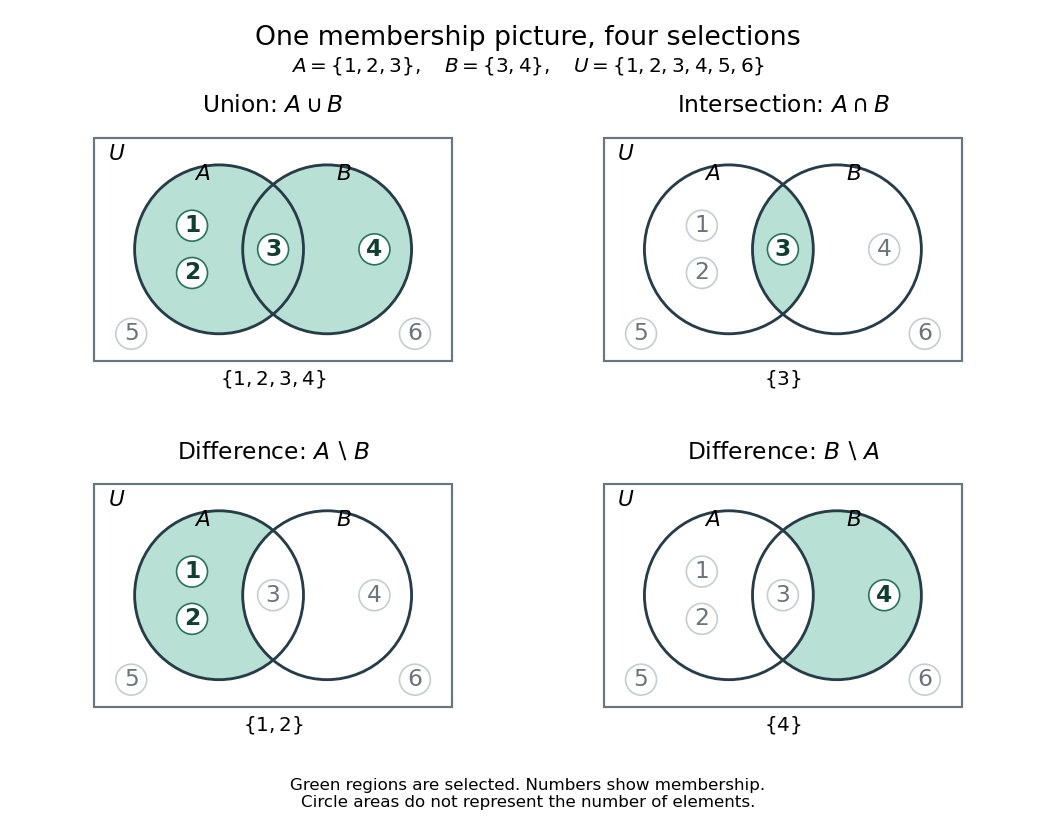
In this Venn diagram, belong only to , belongs to both sets, belongs only to , and belong to neither. The surrounding universal set is . Numbers are placed by membership; circle areas do not represent cardinalities. Each panel shades the region selected by its operation.
For a database illustration, let collect records matching one condition and collect records matching another. Their union selects records matching at least one condition, with a record satisfying both still appearing once. This interpretation turns an abstract operation into a reusable rule for combining selections. For an authored treatment of union, intersection, set difference, and complement, see Lehman, Leighton and Meyer, Mathematics for Computer Science (2015), Definition 4.1.1, pp. 82–83.
More generally, the union contains exactly the set elements belonging to at least one set :The existential quantification expresses “at least one”. With no indexing members, the union is the empty set. Combining a set with the empty set leaves it unchanged: .
Elements are distinct when they are unequal.
The empty set has no elements.
A finite set is a set admitting a bijection with for some nonnegative integer , including the empty set at . The number is uniquely determined and is its cardinality.
Every injective map from a finite set to itself is surjective, and conversely. This follows by counting image elements: an injection cannot omit an element without reducing the size of its image. For infinite sets the property can fail, as is an injection of the natural numbers into themselves that omits zero. The bijection definition gives a precise meaning to finite without reusing the word in its own definition.
A Hermitian form is a sesquilinear form on a complex vector space satisfying conjugate symmetry,Hence is a real number for every vector. In a basis, the matrix of a Hermitian form has and obeys , equivalently : it is a Hermitian matrix. The coordinate rule remains . Conjugate symmetry does not imply positivity.[ref]
https://sites.math.washington.edu/~burke/crs/554/lectures/b-lecture4.pdf. Burke, Linear Analysis, Lecture 4, Hermitian symmetry
The diagonal contains more information than might be expected. For any complex sesquilinear form , put . Expanding four expressions gives the complex polarization identity in the linear-first convention:This is an algebraic identity, with no positivity assumption. If every is real, interchanging preserves the first difference and negates the second: use for . The identity then gives . Thus a complex sesquilinear form is a Hermitian form if and only if all its diagonal values are real. Testing only the basis vectors is insufficient: the off-diagonal example in sesquilinear form has zero diagonal entries in its matrix but a nonreal value at .
Consider the indefinite Hermitian formIts values at are . Moreover and are nonzero isotropic vectors: , yet . These vectors do not belong to the radical of a Hermitian form, and the usual Cauchy-Schwarz inequality would incorrectly require . An indefinite Hermitian form records signed geometry rather than defining a norm by .
There is a separate boundary case: is a positive semidefinite Hermitian form, since , but . Its radical of a Hermitian form is the entire second coordinate line. Positive definiteness is exactly the additional condition in a Hermitian inner product. The three examples below show why these distinctions matter: on the real slice , has an ellipse as its unit level, has hyperbolas, and has two parallel lines. These are slices of the complex examples, not drawings of their full four-dimensional domains.
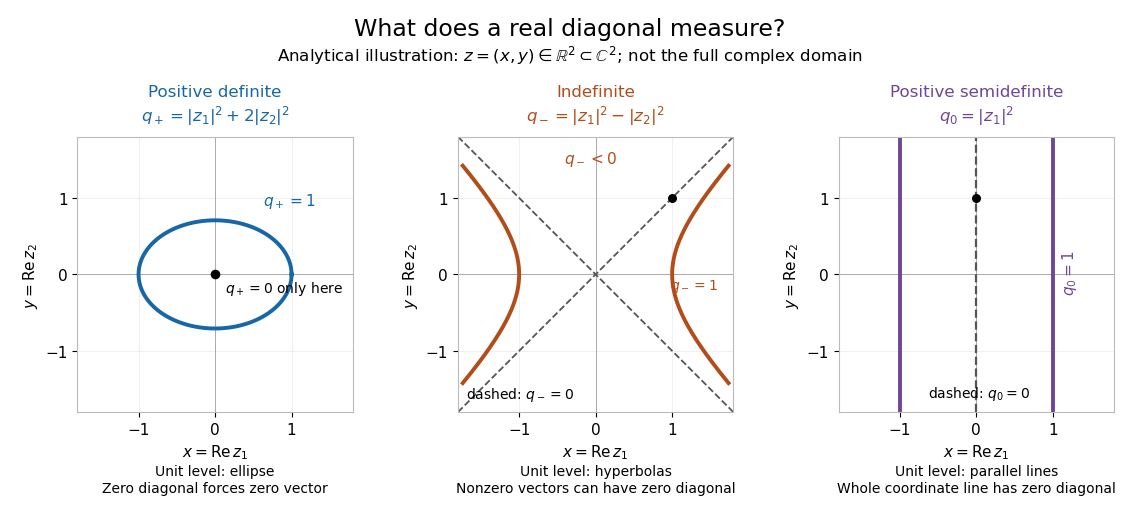
Analytical illustration: real slices of positive definite, indefinite, and positive semidefinite Hermitian forms
. Details. A function is the uniform limit of a sequence of functions whenEquivalently the supremum error tends to zero. The same index works for all inputs, including inputs chosen differently for each . A uniform limit of continuous functions is continuous, by approximating both endpoint values with one common approximant.
For on , , the zero function is a uniform limit because the supremum error is . On , the pointwise limit instead equals zero below one and one at one. Its supremum error remains one for every , so there is no uniform limit there. The open supremum below the endpoint need not be attained to obstruct uniform convergence.
Pinned article: Introduction to the OurBigBook Project
Welcome to the OurBigBook Project! Our goal is to create the perfect publishing platform for STEM subjects, and get university-level students to write the best free STEM tutorials ever.
Everyone is welcome to create an account and play with the site: ourbigbook.com/go/register. We belive that students themselves can write amazing tutorials, but teachers are welcome too. You can write about anything you want, it doesn't have to be STEM or even educational. Silly test content is very welcome and you won't be penalized in any way. Just keep it legal!
Intro to OurBigBook
. Source. We have two killer features:
- topics: topics group articles by different users with the same title, e.g. here is the topic for the "Fundamental Theorem of Calculus" ourbigbook.com/go/topic/fundamental-theorem-of-calculusArticles of different users are sorted by upvote within each article page. This feature is a bit like:
- a Wikipedia where each user can have their own version of each article
- a Q&A website like Stack Overflow, where multiple people can give their views on a given topic, and the best ones are sorted by upvote. Except you don't need to wait for someone to ask first, and any topic goes, no matter how narrow or broad
This feature makes it possible for readers to find better explanations of any topic created by other writers. And it allows writers to create an explanation in a place that readers might actually find it.
Figure 1. Screenshot of the "Derivative" topic page. View it live at: ourbigbook.com/go/topic/derivativeVideo 2. OurBigBook Web topics demo. Source. - local editing: you can store all your personal knowledge base content locally in a plaintext markup format that can be edited locally and published either:This way you can be sure that even if OurBigBook.com were to go down one day (which we have no plans to do as it is quite cheap to host!), your content will still be perfectly readable as a static site.
- to OurBigBook.com to get awesome multi-user features like topics and likes
- as HTML files to a static website, which you can host yourself for free on many external providers like GitHub Pages, and remain in full control

Figure 2. You can publish local OurBigBook lightweight markup files to either OurBigBook.com or as a static website.
Figure 3. Visual Studio Code extension installation.
Figure 5. . You can also edit articles on the Web editor without installing anything locally. Video 3. Edit locally and publish demo. Source. This shows editing OurBigBook Markup and publishing it using the Visual Studio Code extension. 
- Infinitely deep tables of contents:




All our software is open source and hosted at: github.com/ourbigbook/ourbigbook
Further documentation can be found at: docs.ourbigbook.com
Feel free to reach our to us for any help or suggestions: docs.ourbigbook.com/#contact