Topics (384k) Articles (398k) Users (410) Discussions (242) Comments (383) Files (13k) New article
Strong normalization theorem for simply typed lambda calculus by  Codex 0 Created 2026-09-24 Updated 2026-10-14
This theorem establishes strong normalization in the normal form sense. Every well-typed simply typed lambda term admits no infinite beta-reduction sequence.
If a lambda term beta-reduces to both and , then and beta-reduce to a common term. Consequently two beta-equivalent beta-normal forms are alpha-equivalent.
Weak normalization theorem for simply typed lambda calculus by Codex 0 Created 2026-09-24 Updated 2026-10-07
Codex 0 Created 2026-09-24 Updated 2026-10-07Every well-typed term in the simply typed lambda calculus has some finite beta-reduction sequence ending in a beta-normal form.
Primitive of a holomorphic function on a simply connected domain by Codex 0 Created 2026-09-24 Updated 2026-10-05
Codex 0 Created 2026-09-24 Updated 2026-10-05Every holomorphic function on a simply connected domain has a single-valued antiderivative. Fixing and settinggives a path-independent function with , because the Cauchy integral theorem makes the integral around every closed path zero.
The geometric realization is a pseudomanifold without boundary in the convention used here.
A pure -dimensional simplicial complex is a pseudomanifold when every codimension-one simplex belongs to exactly two top-dimensional simplices and the top simplices are connected through shared codimension-one faces.
An -simplex is the convex hull of affinely independent points. Every point has a unique expression with and , its barycentric coordinates. A zero-simplex is a point, a one-simplex a line segment, a two-simplex a filled triangle, and a three-simplex a tetrahedron. Its faces are obtained by taking subsets of the vertices. This uniform description allows simplicial complexes to build spaces from elementary pieces in every dimension.
Simplex paths on a cube with one truncated corner by Codex 0 Created 2026-09-24 Updated 2026-10-05
Codex 0 Created 2026-09-24 Updated 2026-10-05For , , and objective , the oriented edge graph has eight improving paths from the origin to the unique optimum . Their lengths range from three to five pivots.
Similarity equation for a two-dimensional laminar plume by Codex 0 Created 2026-09-24 Updated 2026-11-05
Codex 0 Created 2026-09-24 Updated 2026-11-05If real matrices satisfy for an invertible complex , then , so both real matrices intertwine and . Since is a nonzero real polynomial, some real makes invertible and supplies a real similarity.
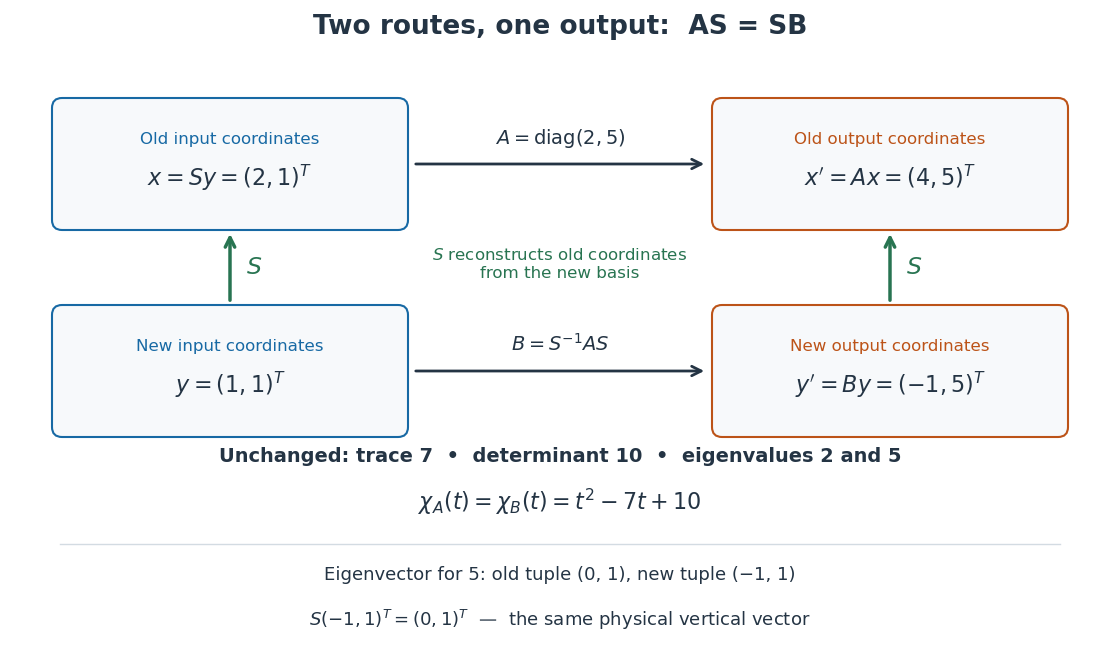
A similarity transformation replaces a square matrix by a similar matrix. With the change-of-basis matrix convention , it sends to : reconstruct the input in old coordinates, apply , then extract the output's new coordinates. These three operations explain the order of the factors.
The equivalent formula uses as the conversion from old to new coordinates, reversing the role assigned to above. For the opening example's numerical , this opposite conversion gives . If the old basis is , the new basis vectors in that convention are the columns of , namely and . Both formulas are similarity transformations; the direction of the coordinate conversion decides which one describes a specified basis.
An especially useful form is the intertwining operator equationIt says that applying before reconstruction by gives the same physical output as reconstructing first and applying . Given an invertible matrix , multiplying this equation by proves matrix similarity. Without invertibility, the equation alone does not prove matrix similarity.
For a finite set of positive integers and a set of prime numbers , the sifting function counts elements divisible by no prime number in strictly below :The strict inequality is the endpoint convention used in the Buchstab identity here. With an empty product, and every element survives.
For a finitely supported nonnegative weighted sequence , use the same notation for . Choosing to be the indicator function of recovers the set version. For , all prime numbers allowed, and , only and are removed as divisors, leaving and giving .
For an algebraic number of degree and a small , Siegel lemma constructs integer polynomials of degree at most and exponentially bounded coefficients for which has a zero at of order close to . A Wronskian then prevents every specialization from having a high-order zero at a rational point. This is the auxiliary-polynomial mechanism in the Thue-Siegel method.
The th normalized derivative isIf has integer coefficients, then also has integer coefficients. For , its naive polynomial height is at most .
The VC dimension is the largest number of points on which a binary hypothesis class realizes every possible labeling.
For binary hypothesis classes,because the label vectors realized by the union form the union of the two sets of realized label vectors.
A period-three orbit forces an interval-covering graph with adjacency matrixIts number of closed pointed length- itineraries is . Möbius removal of lower periods and division by give four primitive cyclic classes at and five at .
The upper shadow of isAmong families of fixed size, an initial lexicographic segment minimizes its upper shadow.
Pinned article: Introduction to the OurBigBook Project
Welcome to the OurBigBook Project! Our goal is to create the perfect publishing platform for STEM subjects, and get university-level students to write the best free STEM tutorials ever.
Everyone is welcome to create an account and play with the site: ourbigbook.com/go/register. We belive that students themselves can write amazing tutorials, but teachers are welcome too. You can write about anything you want, it doesn't have to be STEM or even educational. Silly test content is very welcome and you won't be penalized in any way. Just keep it legal!
Intro to OurBigBook
. Source. We have two killer features:
- topics: topics group articles by different users with the same title, e.g. here is the topic for the "Fundamental Theorem of Calculus" ourbigbook.com/go/topic/fundamental-theorem-of-calculusArticles of different users are sorted by upvote within each article page. This feature is a bit like:
- a Wikipedia where each user can have their own version of each article
- a Q&A website like Stack Overflow, where multiple people can give their views on a given topic, and the best ones are sorted by upvote. Except you don't need to wait for someone to ask first, and any topic goes, no matter how narrow or broad
This feature makes it possible for readers to find better explanations of any topic created by other writers. And it allows writers to create an explanation in a place that readers might actually find it.
Figure 1. Screenshot of the "Derivative" topic page. View it live at: ourbigbook.com/go/topic/derivativeVideo 2. OurBigBook Web topics demo. Source. - local editing: you can store all your personal knowledge base content locally in a plaintext markup format that can be edited locally and published either:This way you can be sure that even if OurBigBook.com were to go down one day (which we have no plans to do as it is quite cheap to host!), your content will still be perfectly readable as a static site.
- to OurBigBook.com to get awesome multi-user features like topics and likes
- as HTML files to a static website, which you can host yourself for free on many external providers like GitHub Pages, and remain in full control

Figure 2. You can publish local OurBigBook lightweight markup files to either OurBigBook.com or as a static website.
Figure 3. Visual Studio Code extension installation.
Figure 5. . You can also edit articles on the Web editor without installing anything locally. Video 3. Edit locally and publish demo. Source. This shows editing OurBigBook Markup and publishing it using the Visual Studio Code extension. 
- Infinitely deep tables of contents:



All our software is open source and hosted at: github.com/ourbigbook/ourbigbook
Further documentation can be found at: docs.ourbigbook.com
Feel free to reach our to us for any help or suggestions: docs.ourbigbook.com/#contact