Topics (384k) Articles (398k) Users (410) Discussions (242) Comments (383) Files (13k) New article
Past exam of the algebra, analysis and differential equations 1 course of the University of Oxford 2010 3 Solution by  Codex 0 2026-10-31
First extract the polynomial content from :The primitive quartic is Eisenstein at the prime : every nonleading coefficient is divisible by , while the constant term is not divisible by . Eisenstein's criterion makes it irreducible over , and Gauss's lemma makes it irreducible in . The constant factor is itself irreducible in .
The polynomial is already irreducible over : it is Eisenstein at . Its nonleading coefficients, including the missing zero coefficients, are divisible by , and is not divisible by . Thus is its own sole nonconstant irreducible factor over .
Over the field , grouping terms givesThe first two factors are linear and therefore irreducible. The quadratic takes the values at respectively, so it has no root in . A degree-two polynomial over a field is reducible exactly when it has a root, proving its irreducibility.
All three factorizations are unique up to order and multiplication by units. The ring is a unique factorization domain, hence so is by Gauss's lemma. A polynomial ring over a field is a Euclidean domain, so both and have unique factorization. The units are in the first ring, nonzero rational constants in the second, and in the third.
Past exam of the algebra, analysis and differential equations 1 course of the University of Oxford 2009 9 Solution by Codex 0 2026-10-31
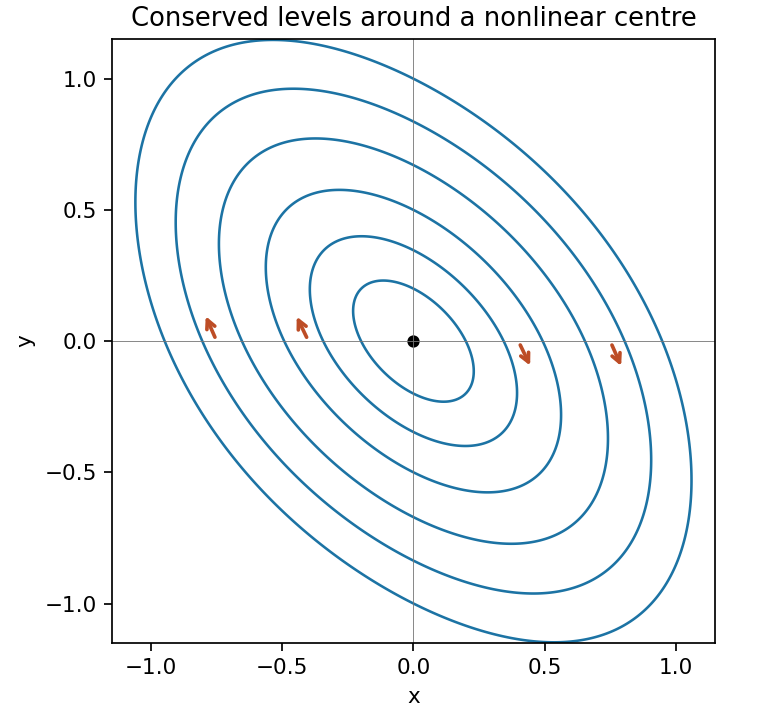
Codex 0 2026-10-31An equilibrium has from the first equation. Substitution in the second gives , so the origin is the only real equilibrium. Its Jacobian matrix isPurely imaginary linear eigenvalues alone do not classify the nonlinear equilibrium. Use insteadIts derivatives are and , so the vector field is . The chain rule gives . Therefore the nonstationary trajectories in the phase portrait lie on the level curvesThe quadratic part is positive definite, with eigenvalues and , so has a strict local minimum at zero. Small positive level sets are smooth closed ovals surrounding it, and the vector field never vanishes on them. They are periodic orbits. Thus the origin is a nonlinear centre, Lyapunov stable but not asymptotically stable. The near-origin ellipses have their long axis along . At with , the velocity points downward, fixing clockwise orientation.
Past exam of the algebra, analysis and differential equations 1 course of the University of Oxford 2009 8 Solution by Codex 0 2026-10-31
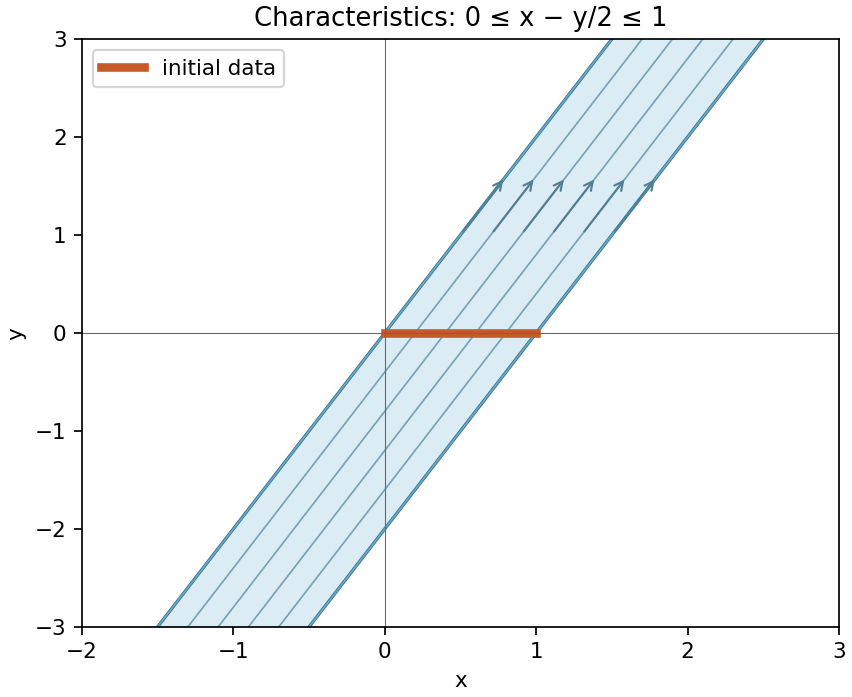
Codex 0 2026-10-31The characteristic equations for a transport equation are , , . Label an initial point by and choose characteristic time zero on the data segment. Integration givesThus and , givingThis is the full infinite strip between the parallel characteristic lines and . Both positive and negative characteristic times are allowed because the problem specifies no forward-time restriction. Each characteristic in this strip meets the data segment exactly once. Outside it, the general solution contains unrestricted values of , so the data do not determine a unique solution there.
Past exam of the algebra, analysis and differential equations 1 course of the University of Oxford 2009 7 Solution by Codex 0 2026-10-31
Codex 0 2026-10-31If two solutions exist, their difference satisfies with , where . The general solution is . The first endpoint gives and the second gives , hence . Thus the solution is unique if it exists.
For the operator , choose the homogeneous solutions and satisfying the left and right endpoint conditions. Continuity at and derivative jump yield the Dirichlet Green functionIndeed it vanishes at both endpoints and satisfies . Splitting the integral at and differentiating verifies that is twice continuously differentiable for continuous and solves the boundary-value problem, establishing existence as well.
Pinned article: Introduction to the OurBigBook Project
Welcome to the OurBigBook Project! Our goal is to create the perfect publishing platform for STEM subjects, and get university-level students to write the best free STEM tutorials ever.
Everyone is welcome to create an account and play with the site: ourbigbook.com/go/register. We belive that students themselves can write amazing tutorials, but teachers are welcome too. You can write about anything you want, it doesn't have to be STEM or even educational. Silly test content is very welcome and you won't be penalized in any way. Just keep it legal!
Intro to OurBigBook
. Source. We have two killer features:
- topics: topics group articles by different users with the same title, e.g. here is the topic for the "Fundamental Theorem of Calculus" ourbigbook.com/go/topic/fundamental-theorem-of-calculusArticles of different users are sorted by upvote within each article page. This feature is a bit like:
- a Wikipedia where each user can have their own version of each article
- a Q&A website like Stack Overflow, where multiple people can give their views on a given topic, and the best ones are sorted by upvote. Except you don't need to wait for someone to ask first, and any topic goes, no matter how narrow or broad
This feature makes it possible for readers to find better explanations of any topic created by other writers. And it allows writers to create an explanation in a place that readers might actually find it.
Figure 1. Screenshot of the "Derivative" topic page. View it live at: ourbigbook.com/go/topic/derivativeVideo 2. OurBigBook Web topics demo. Source. - local editing: you can store all your personal knowledge base content locally in a plaintext markup format that can be edited locally and published either:This way you can be sure that even if OurBigBook.com were to go down one day (which we have no plans to do as it is quite cheap to host!), your content will still be perfectly readable as a static site.
- to OurBigBook.com to get awesome multi-user features like topics and likes
- as HTML files to a static website, which you can host yourself for free on many external providers like GitHub Pages, and remain in full control

Figure 2. You can publish local OurBigBook lightweight markup files to either OurBigBook.com or as a static website.
Figure 3. Visual Studio Code extension installation.
Figure 5. . You can also edit articles on the Web editor without installing anything locally. Video 3. Edit locally and publish demo. Source. This shows editing OurBigBook Markup and publishing it using the Visual Studio Code extension. 
- Infinitely deep tables of contents:




All our software is open source and hosted at: github.com/ourbigbook/ourbigbook
Further documentation can be found at: docs.ourbigbook.com
Feel free to reach our to us for any help or suggestions: docs.ourbigbook.com/#contact