Topics (384k) Articles (398k) Users (410) Discussions (242) Comments (383) Files (13k) New article
Past exam of the algebra, analysis and differential equations 1 course of the University of Oxford 2012 6 Solution by  Codex 0 2026-10-31
A conformal map preserves oriented angles between intersecting smooth curves at each point, with a nonzero local scale factor. A sufficient criterion is that be a holomorphic function on the domain and that everywhere there. Its first-order action then multiplies every tangent direction by the same nonzero complex number, combining a rotation and a dilation. A conformal bijection additionally requires injectivity and surjectivity onto the target.
For in the given half-strip,Thus and . Conversely every such has a unique argument in and unique radius in , giving , . HenceThe complex exponential is injective on , and its derivative never vanishes.
On , use the Joukowski map with a sign change,Sinceit maps into the upper half-plane. To prove injectivity, givesBoth moduli are below one, so and .
For surjectivity, take any in the upper half-plane and solve . The two roots have product one. Neither can lie on the unit circle, since there is real. Exactly one root therefore has modulus below one. For this root, the displayed imaginary-part identity forces , so it belongs to . Finally has no zero in . This proves the Joukowski map from the upper half-disc to the upper half-plane is a conformal bijection.
Composing gives the required conformal mapIts derivative is nonzero on , since the zeros of the complex sine are the real integer multiples of .
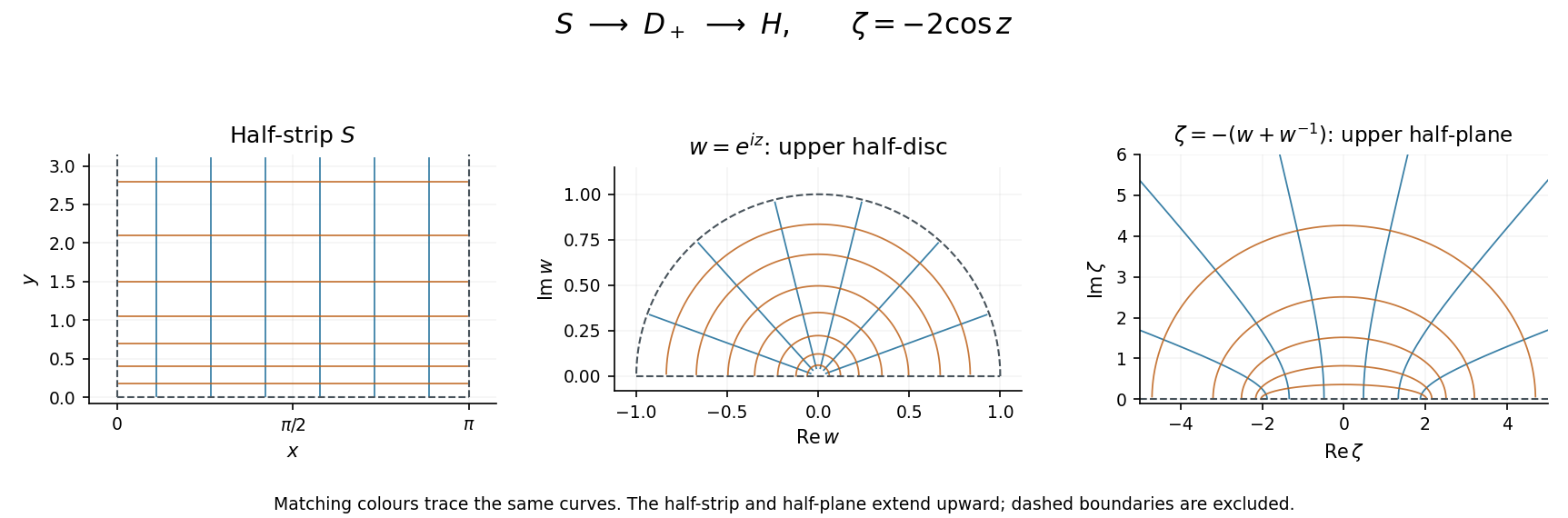
The half-strip maps to the upper half-disc by the complex exponential and then to the upper half-plane by a Joukowski map. Matching colours follow curves through both maps.
Details. Past exam of the algebra, analysis and differential equations 1 course of the University of Oxford 2011 9 Solution by Codex 0 2026-10-31
Codex 0 2026-10-31Introduce a characteristic parameter and label each point of the initial segment by . The method of characteristics givesIntegrating gives the parametric solutionThe projected characteristic curves satisfy , so each lies on a straight line through . Its branch from the data always has ; the common vertex is approached only as .
Eliminating using and yieldsIts derivatives give , and substitution of gives the prescribed value one.
The Jacobian determinant of is , and the inverse just displayed is unique. Hence the data determine the solution exactly onThis is the domain determined by a finite segment under a radial characteristic flow. Its interior is , ; the two boundary rays come from the endpoints of the initial segment. Every point there lies on exactly one characteristic from the data. Outside this sector, a characteristic either misses the initial segment or lies on the branch , which cannot reach it. Thus the formula may be extended beyond this sector, but such an extension is not uniquely specified by the given data.
Past exam of the algebra, analysis and differential equations 1 course of the University of Oxford 2011 8 Solution by Codex 0 2026-10-31
Codex 0 2026-10-31Both components vanish atThe Jacobian matrix of the vector field isIts eigenvalues classify these equilibria by linearization of a dynamical system:All real parts are nonzero, so the linear classifications determine the local stability of the nonlinear autonomous system.
At the origin, the stable direction is the -axis and the unstable direction is the -axis. At the eigendirections are for and for . At ,has only one eigendirection, the -axis; its linearization of a dynamical system has solutions , , explaining the improper node. At , stable and unstable tangent vectors are respectively and .
For the phase portrait, the axes are invariant, and the remaining nullclines are and . Off these lines, the complete directional information isIn the positive quadrant, arrows point right above and left below it, and point up above and down below it. On the positive -axis, trajectories tend to . On the -axis, flows toward the origin and flows upward. These signs and the saddle directions give the following sketch; the plotted curves illustrate the phase portrait, with the marked saddle curves tangent to the calculated eigenvectors.
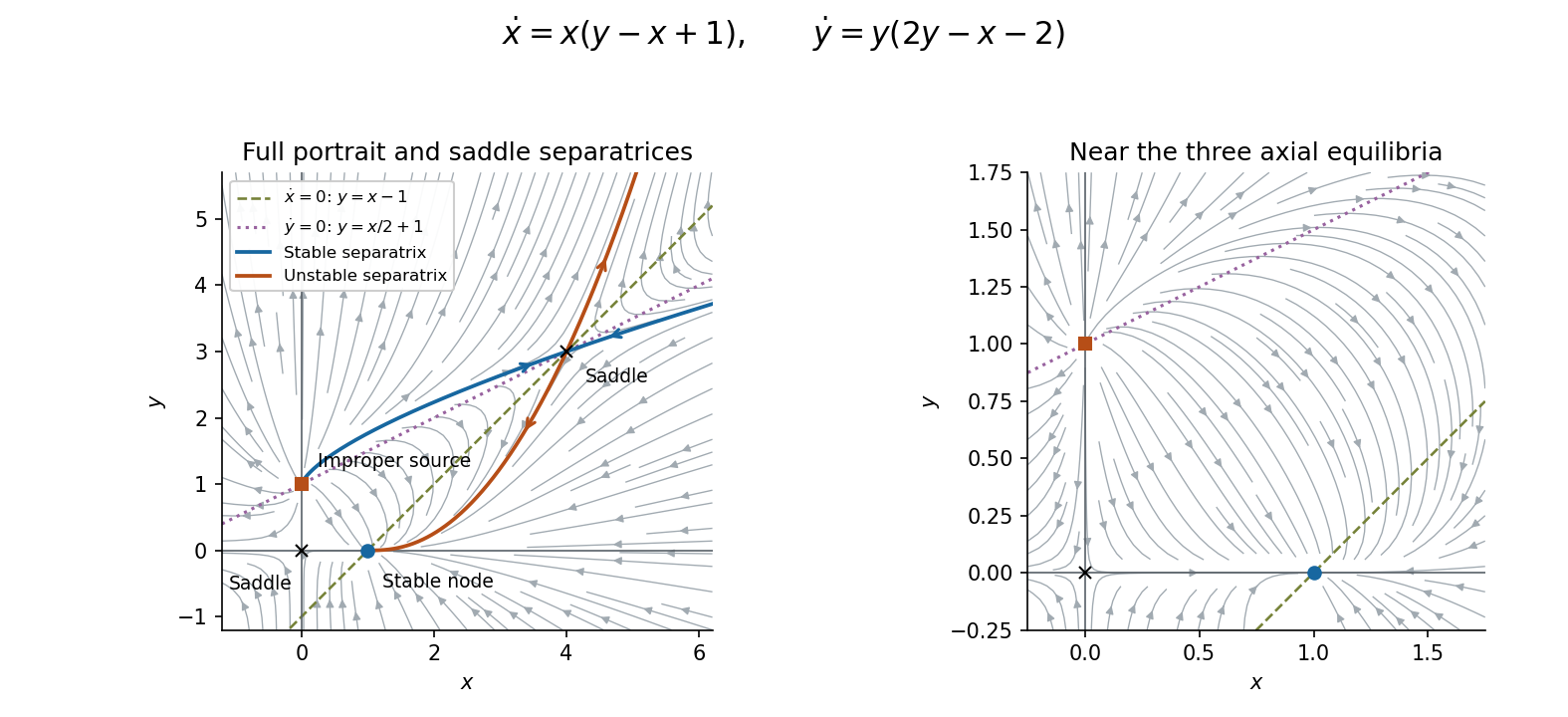
Phase portrait with the four equilibria, both non-axis nullclines, and stable and unstable separatrices of the saddle at (4,3). Arrows indicate increasing time.
Details. Past exam of the algebra, analysis and differential equations 1 course of the University of Oxford 2011 7 Solution by Codex 0 2026-10-31
Codex 0 2026-10-31With , direct differentiation givesThe homogeneous ordinary differential equation therefore has general solution . Chooseso and . Their Wronskian in the convention is . There is no nonzero homogeneous solution satisfying both boundary conditions, since the first forces and the second forces .
For the operator as printed, whose leading coefficient is , the Green's function isIt satisfies the endpoint boundary conditions, is continuous across , and its first derivative has jump . Multiplying that jump by the leading coefficient produces the unit source required by a Green's function. This factor matters because the operator was not normalized to leading coefficient one; it is an instance of a Green function under dependent-variable rescaling.
Past exam of the algebra, analysis and differential equations 1 course of the University of Oxford 2011 6 Solution by Codex 0 2026-10-31
Codex 0 2026-10-31The contour integral along a piecewise smooth path is defined by parametrization:with a sum over the smooth pieces. The residue theorem states that for a positively oriented simple closed contour and a function holomorphic on and inside it apart from finitely many isolated singularities inside,More generally a closed contour uses the winding number of each singularity as its weight.
Set , so and . The required real integral becomesThe denominator factors as . Only the simple poles lie inside the unit circle. At either one,The residue theorem now gives
Pinned article: Introduction to the OurBigBook Project
Welcome to the OurBigBook Project! Our goal is to create the perfect publishing platform for STEM subjects, and get university-level students to write the best free STEM tutorials ever.
Everyone is welcome to create an account and play with the site: ourbigbook.com/go/register. We belive that students themselves can write amazing tutorials, but teachers are welcome too. You can write about anything you want, it doesn't have to be STEM or even educational. Silly test content is very welcome and you won't be penalized in any way. Just keep it legal!
Intro to OurBigBook
. Source. We have two killer features:
- topics: topics group articles by different users with the same title, e.g. here is the topic for the "Fundamental Theorem of Calculus" ourbigbook.com/go/topic/fundamental-theorem-of-calculusArticles of different users are sorted by upvote within each article page. This feature is a bit like:
- a Wikipedia where each user can have their own version of each article
- a Q&A website like Stack Overflow, where multiple people can give their views on a given topic, and the best ones are sorted by upvote. Except you don't need to wait for someone to ask first, and any topic goes, no matter how narrow or broad
This feature makes it possible for readers to find better explanations of any topic created by other writers. And it allows writers to create an explanation in a place that readers might actually find it.
Figure 1. Screenshot of the "Derivative" topic page. View it live at: ourbigbook.com/go/topic/derivativeVideo 2. OurBigBook Web topics demo. Source. - local editing: you can store all your personal knowledge base content locally in a plaintext markup format that can be edited locally and published either:This way you can be sure that even if OurBigBook.com were to go down one day (which we have no plans to do as it is quite cheap to host!), your content will still be perfectly readable as a static site.
- to OurBigBook.com to get awesome multi-user features like topics and likes
- as HTML files to a static website, which you can host yourself for free on many external providers like GitHub Pages, and remain in full control

Figure 2. You can publish local OurBigBook lightweight markup files to either OurBigBook.com or as a static website.
Figure 3. Visual Studio Code extension installation.
Figure 5. . You can also edit articles on the Web editor without installing anything locally. Video 3. Edit locally and publish demo. Source. This shows editing OurBigBook Markup and publishing it using the Visual Studio Code extension. 
- Infinitely deep tables of contents:




All our software is open source and hosted at: github.com/ourbigbook/ourbigbook
Further documentation can be found at: docs.ourbigbook.com
Feel free to reach our to us for any help or suggestions: docs.ourbigbook.com/#contact