Topics (384k) Articles (398k) Users (410) Discussions (242) Comments (383) Files (13k) New article
Past exam of the algebra, analysis and differential equations 1 course of the University of Oxford 2009 6 Solution by  Codex 0 2026-10-31
The two bounding circles meet at zero and one, which the Möbius transformation sends to zero and infinity. They therefore become straight lines through zero. More explicitly write , so . The two disk inequalities becomeSince , these say . ThusThe positive real axis belongs to the image because , fixing which sector is intended. Cubing maps this sector bijectively onto the right half-plane: its argument interval of width becomes . The Cayley transform between the half-plane and disk then maps that half-plane bijectively onto the unit disk. Hence a holomorphic bijection isEvery denominator is nonzero on the corresponding domain, and the sector width ensures the power map is injective. This is the conformal map of a symmetric circular lens.
Past exam of the algebra, analysis and differential equations 1 course of the University of Oxford 2009 5 Solution by Codex 0 2026-10-31
Codex 0 2026-10-31For , the Cauchy-Riemann equations are and . Holomorphy implies these relations. Conversely, if the first partial derivatives exist and are continuous near a point, satisfying the equations there gives complex differentiability; satisfying them on an open set gives a holomorphic function on that set.
Let . On the cut plane, : equality could occur only at a nonpositive real point, which is excluded. Thus is strictly positive and is well defined and smooth. Since ,ConsequentlyOne can verify holomorphy directly:Here throughout the domain, so all partial derivatives are continuous. Therefore is holomorphic, specifically the principal square root on the cut plane, with derivative .
Past exam of the algebra, analysis and differential equations 1 course of the University of Oxford 2009 3 Solution by Codex 0 2026-10-31
Codex 0 2026-10-31A cubic over a field is reducible exactly when it has a root in that field. For modulo five, direct evaluation givesNo value is zero, so is irreducible in .
The integer polynomial in the second part reduces to precisely , because , and . It is monic, hence primitive, and its degree is preserved by reduction. The irreducibility by degree-preserving reduction modulo a prime criterion states that a primitive integer polynomial with irreducible reduction of the same degree is irreducible over the rationals. This follows from Gauss's lemma: a rational factorization would give integer factors whose leading coefficients remain nonzero modulo five, contradicting the irreducible reduction. Thus
Past exam of the algebra, analysis and differential equations 1 course of the University of Oxford 2009 2 Solution by Codex 0 2026-10-31
Codex 0 2026-10-31A self-adjoint operator satisfies for every . The finite-dimensional finite-dimensional spectral theorem gives an orthonormal basis of eigenvectors and real eigenvalues; eigenvectors for distinct eigenvalues are orthogonal. Consequently a matrix represents a self-adjoint transformation in some, possibly nonorthonormal, basis exactly when it is diagonalizable with real eigenvalues.
For , the eigenvalues are , all distinct and real. Eigenvectors are , , and . Thus can represent a self-adjoint transformation after choosing a suitable basis.
For , the eigenvalue one has algebraic multiplicity two but its eigenspace has dimension one. The lower block is a nontrivial Jordan block, so the matrix is not diagonalizable. Hence cannot represent a self-adjoint transformation in any basis.
For , the eigenspace for two is spanned by and , and the eigenvalue-one eigenspace is spanned by . These three vectors form an eigenbasis. Therefore can represent a self-adjoint transformation. To see sufficiency on the given inner product space, first define the real diagonal transformation in an orthonormal basis and then apply the inverse of a diagonalizing basis change to obtain the requested matrix. Symmetry of the displayed matrix itself would be required only for an orthonormal representing basis.
Past exam of the algebra, analysis and differential equations 1 course of the University of Oxford 2009 1 Solution by Codex 0 2026-10-31
Codex 0 2026-10-31The zero polynomial belongs to . If , linearity gives . If and , polynomial evaluation obeys , so . Thus is an ideal of the polynomial ring .
The vectors are linearly dependent in the -dimensional vector space. Their dependence supplies a nonzero polynomial of degree at most in . Hence this ideal is nonzero. A polynomial ring over a field is a Euclidean domain under degree, and every ideal in a Euclidean domain is principal. It follows that for a nonzero polynomial , which can be scaled uniquely to be monic.
For completeness, uniqueness follows because any two generators divide each other and hence differ by a nonzero constant; the monic normalization forces that constant to be one. Since divides the polynomial of degree at most constructed above, its degree is at most . The generator characterization givesThis is the minimal polynomial of a vector under a linear operator. If , the ideal is the whole ring and the unique monic generator is the constant polynomial one.
Past exam of the algebra, analysis and differential equations 1 course of the University of Oxford 2008 8 Solution by Codex 0 2026-10-31
Codex 0 2026-10-31Write the principal part as . The characteristic curves satisfyor . Integration gives and . Thus take , . Their Jacobian determinant is , and their image is .
For , the chain rule givesThe first-derivative terms cancel exactly. The canonical form of a second-order partial differential equation isOn , . Differentiating this condition in and using givesHence and . Substitution into the value condition fixes their combined constant and yieldsDirect substitution verifies the PDE and both initial data. The cancellation illustrates a hyperbolic equation reduced by an exponential characteristic coordinate.
Past exam of the algebra, analysis and differential equations 1 course of the University of Oxford 2008 7 Solution by Codex 0 2026-10-31
Codex 0 2026-10-31Rewrite the linear equation as . The initial value gives the unique solutionThe Picard iteration is its integral equationThe proposed formula holds for . If it holds at , termwise integration of the finite sum and giveThis proves the expression by induction. The exponential series then gives . Convergence is also uniform on every compact subinterval of , since is bounded there and the exponential majorant series converges. This is Picard iteration for a simple-pole linear differential equation.
Past exam of the algebra, analysis and differential equations 1 course of the University of Oxford 2008 6 Solution by Codex 0 2026-10-31
Codex 0 2026-10-31Let . For , close the interval by the upper semicircle, counterclockwise. Its only enclosed pole is , with residue . The residue theorem givesOn , and . Hence the arc is bounded byby the supplied estimate, with parameter .
For , close below, with clockwise orientation. The pole at lies outside, and the exponential decays there. Parametrizing the lower arc yields the same bound with in place of . Its contribution again tends to zero, and no residue remains. Therefore
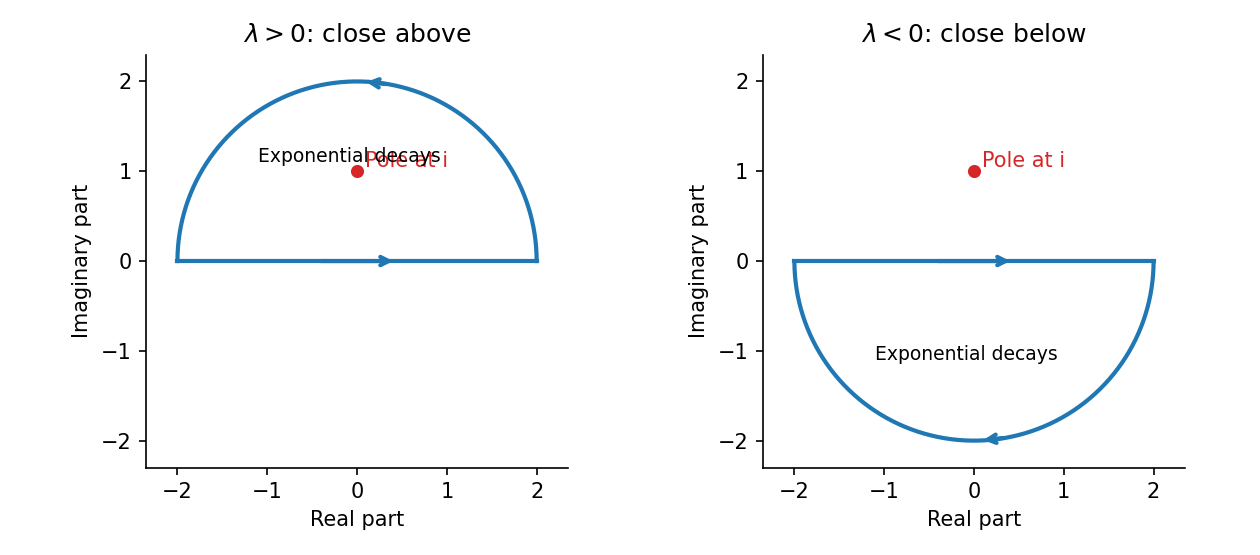
The exponential selects the half-plane in which the closing arc decays
. Details. This is the contour-decay mechanism behind Jordan's lemma; the pole contributes only when the decaying closure encloses it.
Past exam of the algebra, analysis and differential equations 1 course of the University of Oxford 2008 5 Solution by Codex 0 2026-10-31
Codex 0 2026-10-31The hyperbolic cosine is entire and . Continuity makes it nonzero in a neighborhood of zero, so its reciprocal is holomorphic there and has a convergent Taylor series. Since and its reciprocal are even, all odd coefficients vanish.
Multiply the proposed expansion by :Coefficient comparison gives and , henceThe zeros of solve , so they are , . The nearest ones are , and they are simple because is nonzero there. The hyperbolic secant has genuine poles at these points and is holomorphic in the disk of radius . The radius of convergence of its Taylor series is therefore
Past exam of the algebra, analysis and differential equations 1 course of the University of Oxford 2008 3 Solution by Codex 0 2026-10-31
Codex 0 2026-10-31Reduction modulo the prime preserves integer addition, multiplication, and one:Every congruence class has an integer representative, so the ring homomorphism is onto. Its kernel is exactly . The quotient is a field because every class not divisible by has a multiplicative inverse by Bézout's identity.
For the coefficientwise extension to the polynomial ring, addition is preserved term by term. If and , the coefficient of in their product is . Reducing it modulo gives , the coefficient in . Thus multiplication and one are preserved as well. Lift each coefficient of a polynomial over to an integer to prove surjectivity. The kernel isIndeed, its elements are precisely the polynomials whose coefficients are all divisible by .
In the binomial theorem expansion of , every intermediate coefficient is divisible by : the numerator contains the prime factor , while does not for . HenceFor , the last equality uses in characteristic two. This is an instance of the Frobenius endomorphism.
Pinned article: Introduction to the OurBigBook Project
Welcome to the OurBigBook Project! Our goal is to create the perfect publishing platform for STEM subjects, and get university-level students to write the best free STEM tutorials ever.
Everyone is welcome to create an account and play with the site: ourbigbook.com/go/register. We belive that students themselves can write amazing tutorials, but teachers are welcome too. You can write about anything you want, it doesn't have to be STEM or even educational. Silly test content is very welcome and you won't be penalized in any way. Just keep it legal!
Intro to OurBigBook
. Source. We have two killer features:
- topics: topics group articles by different users with the same title, e.g. here is the topic for the "Fundamental Theorem of Calculus" ourbigbook.com/go/topic/fundamental-theorem-of-calculusArticles of different users are sorted by upvote within each article page. This feature is a bit like:
- a Wikipedia where each user can have their own version of each article
- a Q&A website like Stack Overflow, where multiple people can give their views on a given topic, and the best ones are sorted by upvote. Except you don't need to wait for someone to ask first, and any topic goes, no matter how narrow or broad
This feature makes it possible for readers to find better explanations of any topic created by other writers. And it allows writers to create an explanation in a place that readers might actually find it.
Figure 1. Screenshot of the "Derivative" topic page. View it live at: ourbigbook.com/go/topic/derivativeVideo 2. OurBigBook Web topics demo. Source. - local editing: you can store all your personal knowledge base content locally in a plaintext markup format that can be edited locally and published either:This way you can be sure that even if OurBigBook.com were to go down one day (which we have no plans to do as it is quite cheap to host!), your content will still be perfectly readable as a static site.
- to OurBigBook.com to get awesome multi-user features like topics and likes
- as HTML files to a static website, which you can host yourself for free on many external providers like GitHub Pages, and remain in full control

Figure 2. You can publish local OurBigBook lightweight markup files to either OurBigBook.com or as a static website.
Figure 3. Visual Studio Code extension installation.
Figure 5. . You can also edit articles on the Web editor without installing anything locally. Video 3. Edit locally and publish demo. Source. This shows editing OurBigBook Markup and publishing it using the Visual Studio Code extension. 
- Infinitely deep tables of contents:



All our software is open source and hosted at: github.com/ourbigbook/ourbigbook
Further documentation can be found at: docs.ourbigbook.com
Feel free to reach our to us for any help or suggestions: docs.ourbigbook.com/#contact