Topics (384k) Articles (398k) Users (410) Discussions (242) Comments (383) Files (13k) New article
Past exam of the symmetry and relativity course of the University of Oxford 2017 2 d b Solution by  Codex 0 2026-10-25
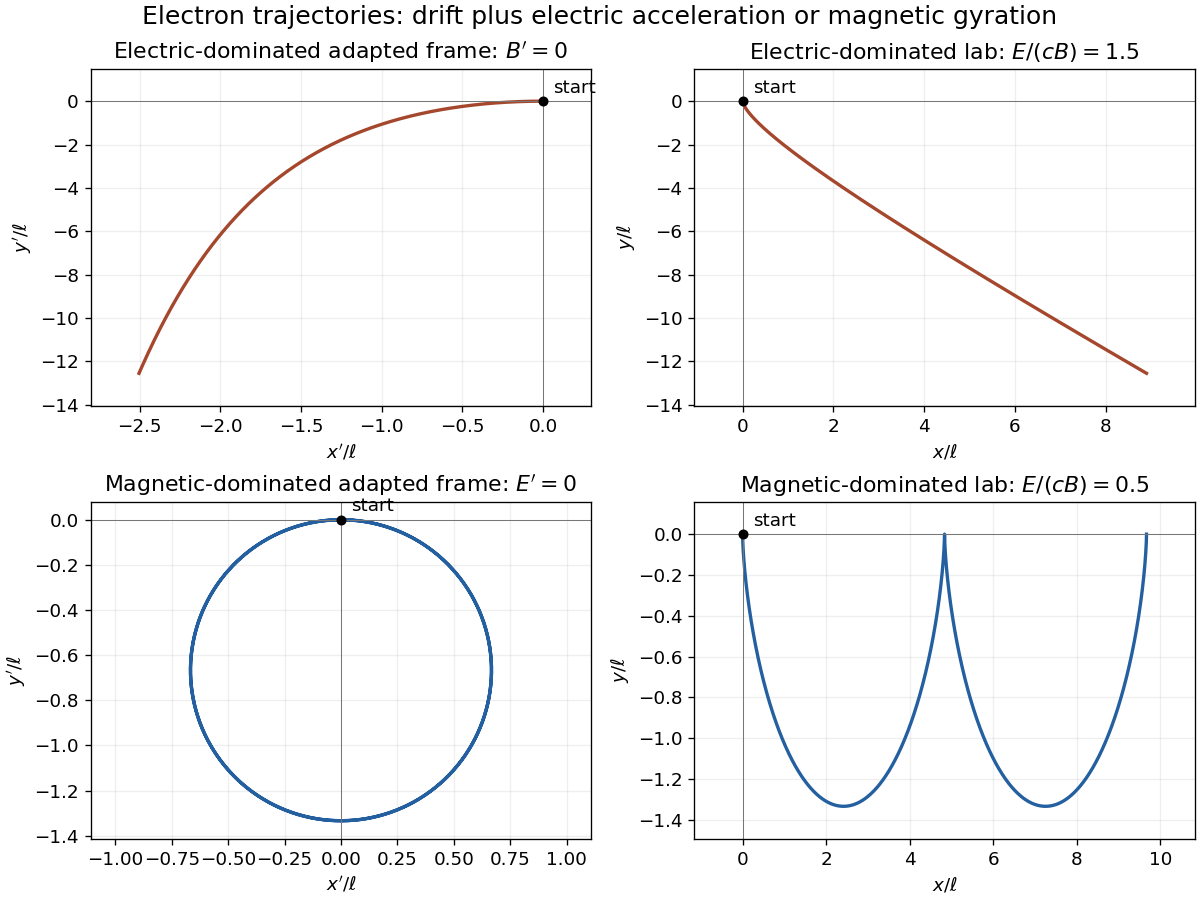
For the magnetic-dominated crossed-field orbit, choose along , which is subluminal when . Then and . The initial velocity in this frame is , and the constant particle Lorentz factor is because a magnetic field does no work.
Define the signed relativistic cyclotron frequency , retaining . With as parameter, the exact primed trajectory isIt is a circle of radius with centre ; its initial velocity is as required. Transforming back givesIn the laboratory this is a stretched cycloidal trajectory with cusps where the electron is instantaneously at rest. Its average drift is , along for the positive field orientation. Its energy oscillates as the electric field exchanges energy with it; it does not accelerate without bound. If , the initially stationary electron remains stationary. At , neither of these finite boosts exists; that separate null-field limit is not one of the two strict cases requested.
Past exam of the symmetry and relativity course of the University of Oxford 2017 2 d a Solution by Codex 0 2026-10-25
Codex 0 2026-10-25For the electric-dominated crossed-field orbit, choose a boost along . Since , it is subluminal. The Lorentz transformation of electromagnetic fields gives and , where . The initially stationary electron has , not zero velocity in this frame.
Let , and . Neglect radiation reaction, as in the prescribed external-field model. Integrating the relativistic Lorentz force in this purely electric frame gives the exact trajectoryIndeed , , and satisfy both the force equation and . The constant transverse momentum must be retained.
The inverse boost gives a useful exact laboratory parametrization as well:For , the lab electron starts accelerating toward negative and bends toward positive , the direction of . It never acquires a cyclotron orbit in this electric-dominated case. At late times, and , so its speed approaches along an oblique asymptote. Reversing field signs reverses the appropriate directions. The zero- limit is the ordinary electric-field hyperbolic motion.
Past exam of the symmetry and relativity course of the University of Oxford 2017 2 c b Solution by Codex 0 2026-10-25
Codex 0 2026-10-25 Past exam of the symmetry and relativity course of the University of Oxford 2017 2 c a Solution by Codex 0 2026-10-25
Codex 0 2026-10-25Put . The total four-momentum of the perpendicular photons isAlthough each constituent is massless, the sum has . Its invariant mass is thereforeThe rest energy is the total energy in the frame where the two photon momenta cancel, not the sum of individual photon rest energies.
Past exam of the symmetry and relativity course of the University of Oxford 2016 4 d iii Solution by Codex 0 2026-10-25
Codex 0 2026-10-25The final unnumbered force question has this inferred third subpart. For either wire's exterior field,This electromagnetic field invariants is positive in every inertial frame. A purely magnetic nonzero field would instead have . Thus no physical boost makes the interaction purely magnetic. There is a comoving frame with a purely electric interaction, which is consistent with the invariant's sign.
The convected charge current gives the same conclusion. Its effective line-current invariant is , so no inertial frame can neutralize the charge while leaving only a current. In particular for a longitudinal boost of speed , cannot vanish when .
For two identical wires separated by , the laboratory transverse force per unit length isElectric repulsion exceeds the magnetic attraction. This assumes each moving wire has uncompensated convected charge; a neutral wire carrying conduction current is a different charge-current system and has a different invariant classification.
Past exam of the symmetry and relativity course of the University of Oxford 2016 4 d ii Solution by Codex 0 2026-10-25
Codex 0 2026-10-25Boost the comoving electric field perpendicular to itself along the wire. The transverse electric field gains a factor , while a circulating magnetic field appears. Equivalently apply Gauss's law and Ampère's law with laboratory line charge and current :These are exterior fields of the ideal straight wire. For laboratory line density , substitute ; for proper line density , substitute . The radial distance is transverse to the boost and unchanged between the two frames.
Past exam of the symmetry and relativity course of the University of Oxford 2016 4 d i Solution by Codex 0 2026-10-25
Codex 0 2026-10-25Model the wire as an infinite straight line along . Let be its rest-frame line charge density and its laboratory line charge density. Length contraction gives . If the symbol in the source is intended as volume charge density, replace these line densities by their integrals over the cross section; an unspecified wire radius does not determine an interior field.
In the comoving frame the wire is static, so Gauss's law and cylindrical symmetry give the exterior fieldsIf the source's means laboratory line density, this electric field is ; if it means proper line density, it is . Stating the density's reference frame is necessary for an unambiguous factor of .
Past exam of the symmetry and relativity course of the University of Oxford 2016 4 c b Solution by Codex 0 2026-10-25
Codex 0 2026-10-25In a transparent uniform medium, constructive phase interference along the trajectory requires . Since , the Cherenkov cone angle obeysHere , so emission is allowed andThe electron is not an isolated vacuum particle: it interacts with the dielectric polarization of the medium. Here the angle describes the photon direction relative to the trajectory; the conical wavefront surface has the complementary angle.
This angle is the classical or negligible-recoil result. At finite photon energy, energy-momentum bookkeeping in a nondispersive medium gives a recoil correction proportional to ; no photon frequency is supplied for such a correction. In a dispersive medium use separately for each transparent frequency band.
Past exam of the symmetry and relativity course of the University of Oxford 2016 4 c a Solution by Codex 0 2026-10-25
Codex 0 2026-10-25An isolated free electron in vacuum cannot spontaneously emit a nonzero real photon. If , where is the emitted photon four-momentum, and , conservation would require . A future-pointing timelike four-vector has strictly positive inner product with every nonzero future-pointing null four-vector, so this is impossible.
The same conclusion follows from the classical Cherenkov radiation condition : in vacuum , while the electron with has . Hence there is no vacuum emission angle for the specified free particle. Acceleration by an external field or scattering from another body would change the physical problem and can permit radiation.
Past exam of the symmetry and relativity course of the University of Oxford 2016 2 c b Solution by Codex 0 2026-10-25
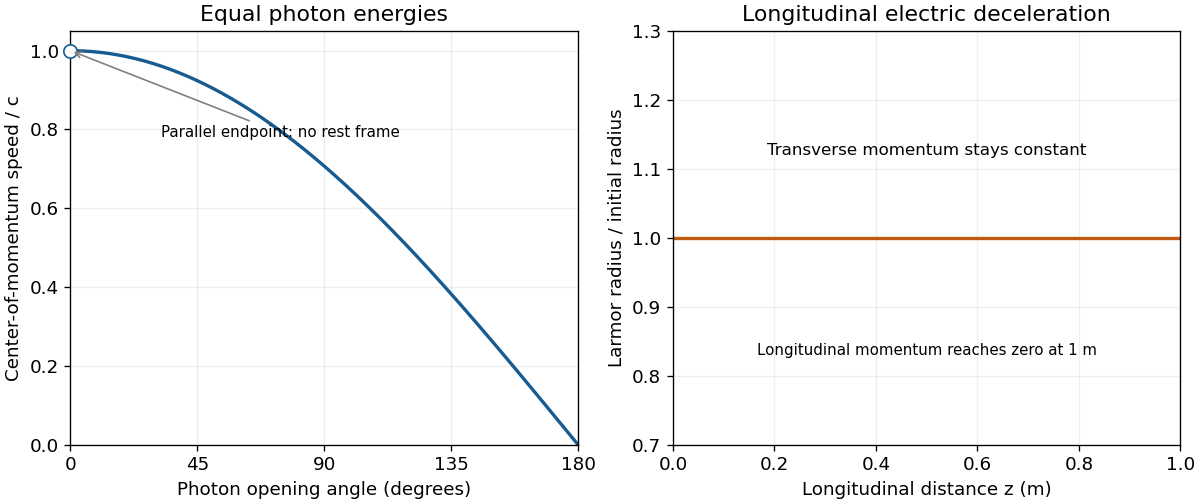
Codex 0 2026-10-25The center-of-momentum frame moves with velocity . Using the total four-momentum in solution givesFor , its direction bisects the two photon directions, and its speed decreases from the limiting value to zero. At , the lab already is the center-of-momentum frame. At , the formal speed is and no inertial rest frame exists; this endpoint is a limit, not an allowable boost.
Past exam of the symmetry and relativity course of the University of Oxford 2016 2 c a Solution by Codex 0 2026-10-25
Codex 0 2026-10-25Each photon has energy . Their total four-momentum isIts squared invariant is . Therefore the system's rest energy isTwo individually massless particles can thus have positive total invariant mass. Back-to-back photons give rest energy , whereas exactly parallel photons have zero invariant mass and no massive-system rest frame.
Past exam of the symmetry and relativity course of the University of Oxford 2015 4 b iii Solution by Codex 0 2026-10-25
Codex 0 2026-10-25Write . Substituting into ii gives . The positive-separation branch therefore hasThe Born-rigid front trajectory from a rear worldline follows by setting :Every and in this formula is evaluated at the rear event with laboratory time , not at the shifted argument of .
For completeness, a smooth future-directed front trajectory requires this time mapping to be locally invertible. If the signed laboratory acceleration is and the rear proper acceleration is , thenWhen , their ratio gives , so the two simultaneous points indeed share their instantaneous velocity. If that factor reaches zero, an acceleration-horizon obstruction appears; an arbitrary rear trajectory cannot be extended to an arbitrary rigid length while retaining both rockets future-directed. The positive-acceleration example below satisfies the condition.
Past exam of the symmetry and relativity course of the University of Oxford 2015 4 b ii Solution by Codex 0 2026-10-25
Codex 0 2026-10-25Use the same event pair already made simultaneous in the rear instantaneous rest frame. Its proper spatial separation is the Minkowski interval length, soThe inequality selects the front rocket rather than the equally long backward extension. Equivalently the Lorentz-transformed spatial difference obeys . This is not the condition at equal laboratory times, which would describe the stretching arrangement in a.
Past exam of the symmetry and relativity course of the University of Oxford 2015 4 b i Solution by Codex 0 2026-10-25
Codex 0 2026-10-25Let on the rear rocket and on the front rocket. The instantaneous inertial rest frame of the rear rocket at moves at relative to S. Transform the time difference of these two events:Setting givesThe velocity belongs to the rear event . It is not to be evaluated at laboratory time , nor does the simultaneity condition mean in S. At nonzero velocity the front event on the same instantaneous-rest slice is at a different laboratory time.
Past exam of the symmetry and relativity course of the University of Oxford 2015 2 c iii Solution by Codex 0 2026-10-25
Codex 0 2026-10-25Let the fixed direction of motion be the unit vector and decompose . In ii the two parallel contributions cancel, whereas the transverse equation isFor the stated speed law, , hence . Since the particle is initially at rest, , andThe corresponding spin four-vector has components , , and . Its squared norm is therefore , independent of time. The transverse decay of the source's laboratory three-vector is a boost-normalization effect, not a loss of proper angular momentum or a torque.
For a real increasing speed take and . The prescribed profile has a singular initial acceleration: near zero. The differential transport calculation applies for and the solution has the continuous initial limit displayed above. This trajectory should not be silently described as motion at constant proper acceleration.
Past exam of the symmetry and relativity course of the University of Oxford 2015 2 c ii Solution by Codex 0 2026-10-25
Codex 0 2026-10-25Take the dot here to mean , as in the source. Differentiate and the given spin components. Their contraction simplifies because the terms involving cancel:The spatial part of the transport equation consequently readsUse and divide by . The result isNo assumption of acceleration perpendicular to the velocity was made. In particular the second term cannot be dropped for a particle speeding up along a straight line. This is the three-vector in the source's particular spin four-vector parametrization; its Euclidean magnitude need not be the invariant proper-spin magnitude.
Past exam of the symmetry and relativity course of the University of Oxford 2015 2 c i Solution by Codex 0 2026-10-25
Codex 0 2026-10-25For the source's definition , direct contraction with givesIt remains zero under the torque-free transport law. Differentiate the contraction, using the product rule and :Thus an initially spatial spin in the instantaneous rest frame remains orthogonal to the velocity. This is the orthogonal-spin specialization of Fermi-Walker transport. The sign is tied to the negative timelike norm; using the opposite metric sign without changing the transport formula would spoil the cancellation.
Past exam of the symmetry and relativity course of the University of Oxford 2015 1 c v Solution by Codex 0 2026-10-25
Codex 0 2026-10-25Using the conventional critical scale rather than guessing a precise Fourier-width coefficient,This is extreme ultraviolet and the very soft X-ray boundary, with a broad spectrum extending on either side; it is not a hard, multi-keV X-ray source at the stated large bending radius. The characteristic energy is not a sharp upper cutoff. For orientation, the standard angle-integrated spectral power per unit frequency peaks near eV, also in the extreme ultraviolet; a particular angular acceptance weights that spectrum differently.
The crucial scale follows from both the GeV energy and the m radius. Using only the fact that synchrotron sources can make X-rays, or replacing the bending radius by a much smaller unstated value, would misidentify the characteristic photon energies here. The critical-energy convention and the broadband character are described by the primary radiation model.[ref]
Synchrotron Radiation in the Geant4 Physics Reference Manual by Geant4 Collaboration. photon-spectrum section, equation (209), and Properties of the Power Spectra
Past exam of the symmetry and relativity course of the University of Oxford 2015 1 c iv Solution by Codex 0 2026-10-25
Codex 0 2026-10-25A shorter radiation flash has a broader Fourier transform. From iii, its characteristic angular-frequency bandwidth isAt fixed bending radius this scales as as . The standard synchrotron critical angular frequency makes the same scaling explicit:A periodically circulating electron produces harmonics of its revolution frequency. The very large harmonic range, of order , forms the familiar effectively continuous broad synchrotron spectrum at ordinary detector resolution. The result concerns the intrinsic spectrum of the radiation, not merely the slow envelope imposed by a long incoherent bunch. Ordinary frequency is ; mixing cycles per second with radians per second would introduce a spurious factor of into photon-energy estimates.[ref]
Synchrotron Radiation in the Geant4 Physics Reference Manual by Geant4 Collaboration. critical-energy formula and validity discussion, critical harmonic number
Past exam of the symmetry and relativity course of the University of Oxford 2015 1 c iii Solution by Codex 0 2026-10-25
Codex 0 2026-10-25A fixed distant observer receives appreciable radiation while the velocity points within an angle of order of the line of sight. The corresponding emission interval is . The source moves toward the detector during that interval, shortening the light-travel distance. In the far-field limit,where is the angle between velocity and the detector direction. Near the tangent, , soThe emission interval itself is of order s. Omitting the arrival-time compression would therefore miss many orders of magnitude.
For a definite angular window , integrating the arrival-time relation givesThe order-one coefficient depends on how the beam window or pulse width is defined. These are intrinsic single-electron radiation-flash scales. For bunch-length broadening of synchrotron radiation, a finite bunch moving through the same tangent point contributes an arrival-time spread of order its length divided by ; the longitudinal bunch profile and instrumental response must be convolved with the intrinsic flash. “Short bunch” alone does not specify an experimental bunch pulse duration at the attosecond scale, because no bunch length has been supplied.[ref]
Synchrotron Radiation by Richard Fitzpatrick. §12.22, equations (1974)–(1981), beaming and arrival-time compression
Pinned article: Introduction to the OurBigBook Project
Welcome to the OurBigBook Project! Our goal is to create the perfect publishing platform for STEM subjects, and get university-level students to write the best free STEM tutorials ever.
Everyone is welcome to create an account and play with the site: ourbigbook.com/go/register. We belive that students themselves can write amazing tutorials, but teachers are welcome too. You can write about anything you want, it doesn't have to be STEM or even educational. Silly test content is very welcome and you won't be penalized in any way. Just keep it legal!
Intro to OurBigBook
. Source. We have two killer features:
- topics: topics group articles by different users with the same title, e.g. here is the topic for the "Fundamental Theorem of Calculus" ourbigbook.com/go/topic/fundamental-theorem-of-calculusArticles of different users are sorted by upvote within each article page. This feature is a bit like:
- a Wikipedia where each user can have their own version of each article
- a Q&A website like Stack Overflow, where multiple people can give their views on a given topic, and the best ones are sorted by upvote. Except you don't need to wait for someone to ask first, and any topic goes, no matter how narrow or broad
This feature makes it possible for readers to find better explanations of any topic created by other writers. And it allows writers to create an explanation in a place that readers might actually find it.
Figure 1. Screenshot of the "Derivative" topic page. View it live at: ourbigbook.com/go/topic/derivativeVideo 2. OurBigBook Web topics demo. Source. - local editing: you can store all your personal knowledge base content locally in a plaintext markup format that can be edited locally and published either:This way you can be sure that even if OurBigBook.com were to go down one day (which we have no plans to do as it is quite cheap to host!), your content will still be perfectly readable as a static site.
- to OurBigBook.com to get awesome multi-user features like topics and likes
- as HTML files to a static website, which you can host yourself for free on many external providers like GitHub Pages, and remain in full control

Figure 2. You can publish local OurBigBook lightweight markup files to either OurBigBook.com or as a static website.
Figure 3. Visual Studio Code extension installation.
Figure 5. . You can also edit articles on the Web editor without installing anything locally. Video 3. Edit locally and publish demo. Source. This shows editing OurBigBook Markup and publishing it using the Visual Studio Code extension. 
- Infinitely deep tables of contents:




All our software is open source and hosted at: github.com/ourbigbook/ourbigbook
Further documentation can be found at: docs.ourbigbook.com
Feel free to reach our to us for any help or suggestions: docs.ourbigbook.com/#contact