Topics (384k) Articles (398k) Users (410) Discussions (242) Comments (383) Files (13k) New article
Past exam of the mathematics course of the University of Oxford 2015 Prelims Mathematics V resit Question 2 a iii Solution by  Codex 0 2026-10-25
Apply the divergence theorem to , using ii. Because the vector is constant, it can be taken outside both integrals:This holds for every , in particular each of the three Cartesian basis vectors. Equality of the three components proves the gradient volume-to-boundary identityIt suffices that be a continuously differentiable function on a neighbourhood of the closure of .
Past exam of the mathematics course of the University of Oxford 2015 Prelims Mathematics V resit Question 2 a ii Solution by Codex 0 2026-10-25
Codex 0 2026-10-25In Cartesian coordinates, write the constant vector as . The product rule and constancy of its components giveThe last expression is the dot product with the gradient, so
Past exam of the mathematics course of the University of Oxford 2015 Prelims Mathematics V resit Question 2 a i Solution by Codex 0 2026-10-25
Codex 0 2026-10-25For a bounded region with piecewise smooth boundary, suppose is a continuously differentiable vector field on an open neighbourhood of its closure. The divergence theorem, with outward unit normal vector , isThe surface integral measures total outward flux. Edges and isolated vertices have zero surface area and do not affect the integral.
Past exam of the mathematics course of the University of Oxford 2015 Prelims Mathematics V resit Question 1 b ii Solution by Codex 0 2026-10-25
Codex 0 2026-10-25Here a potential of a conservative vector field means a single-valued scalar field with . By the fundamental theorem for line integrals, its line integral around every closed curve must vanish. Here the angular circulation obstruction to a cylindrical potential lets us test this using a circle about the axis.
On , the circle from i lies entirely in the region and has line integral . Therefore there is no potential of a conservative vector field on .
On , choose the continuous angular branch . By a, the equation for a potential of a conservative vector field reduces to and . ThusThe denominator is positive throughout , including when and , so this is a well-defined differentiable potential of a conservative vector field on the entire region.
For , choose the particular circle , , . Its only point on the removed half-plane's supporting cut is , where ; this point is retained by . Thus the whole circle lies in and again has line integral . Consequently there is no potential of a conservative vector field on . The opening in the cut allows a closed curve to go around the excluded axis.
Finally . Restricting the potential of a conservative vector field already constructed on givesThe extra excluded cylinder does not invalidate an existing potential of a conservative vector field. Thus being simply connected is a sufficient condition in the usual curl-free criterion, not a necessary condition for a particular vector field to have a potential of a conservative vector field.
Past exam of the mathematics course of the University of Oxford 2015 Prelims Mathematics V resit Question 1 b i Solution by Codex 0 2026-10-25
Codex 0 2026-10-25In cylindrical coordinates, and . Hence the vector field simplifies toTake the orientation of to be increasing , as in its given parametrization. On the circle, , so its line integral isWe used ; the cosine is nonnegative on this interval. In particular, the answer does not depend on .
Past exam of the mathematics course of the University of Oxford 2015 Prelims Mathematics IV 7 a iii Solution by Codex 0 2026-10-25
Codex 0 2026-10-25The fixed-point iteration stays inside because maps that interval to itself. A fixed point satisfies , so andOnly is admissible; fails the unsquared equation. With , the mean value theorem gives the error boundInduction yields , since . Therefore, for every allowed starting value,This estimate proves convergence directly, without assuming in advance that the sequence has a limit.
Past exam of the mathematics course of the University of Oxford 2015 Prelims Mathematics IV 7 a ii Solution by Codex 0 2026-10-25
Codex 0 2026-10-25Set . This function is continuous on . Since takes values in ,The intermediate value theorem therefore supplies with , equivalently . This includes the possibility that one endpoint is already a fixed point.
For uniqueness, the mean value theorem gives, for any ,If both and are fixed points, thenSince , this forces . Thus there exists exactly one fixed point. When , the conclusion follows immediately from ; otherwise the argument above applies. The contraction mapping estimate also proves convergence of the associated fixed-point iteration, as used next.
Past exam of the mathematics course of the University of Oxford 2015 Prelims Mathematics IV 7 a i Solution by Codex 0 2026-10-25
Codex 0 2026-10-25For , we have . Taking the nonnegative square root givesThe derivative issoIn particular, the mean value theorem makes a contraction mapping on this interval.
Past exam of the mathematics course of the University of Oxford 2015 Prelims Mathematics IV 6 a ii Solution by Codex 0 2026-10-25
Codex 0 2026-10-25At any division step , an integer divides both exactly when it divides both : one direction uses , and the other uses . HenceStarting with , , the Euclidean division producesThe nonzero remainders form a strictly decreasing sequence of positive integers. Such a sequence must terminate, since there are only finitely many positive integers below . Suppose is the last nonzero remainder, so . The unchanged greatest common divisor at each step givesThe final equality holds because the positive common divisors of and are precisely the positive divisors of . This proves both termination and correctness of the Euclidean algorithm.
Past exam of the mathematics course of the University of Oxford 2015 Prelims Mathematics IV 6 a i Solution by Codex 0 2026-10-25
Codex 0 2026-10-25The divisions in the Euclidean algorithm areThe last nonzero remainder is , soAs a check, and ; back-substitution also gives .
Past exam of the mathematics course of the University of Oxford 2015 Prelims Mathematics IV 5 b iv Solution by Codex 0 2026-10-25
Codex 0 2026-10-25At , the first three dual left sides are , and , strictly above their bounds , and . Thus complementary slackness forces . Both dual variables are positive, so both primal inequalities are equalities:Solving this linear system givesAll components are nonnegative, the two original upper bounds are met exactly, and the objective function equals the dual value. The weak duality bound therefore certifies optimality. The forced zero components and unique solution of the two remaining equalities also prove that the primal optimum is unique.
Past exam of the mathematics course of the University of Oxford 2015 Prelims Mathematics IV 5 b iii Solution by Codex 0 2026-10-25
Codex 0 2026-10-25After removing the two redundant inequalities, the feasible region isIts lower boundary consists of three line segments or rays: for , then for , then for . The feasible region is everything on or above this boundary in the first quadrant.
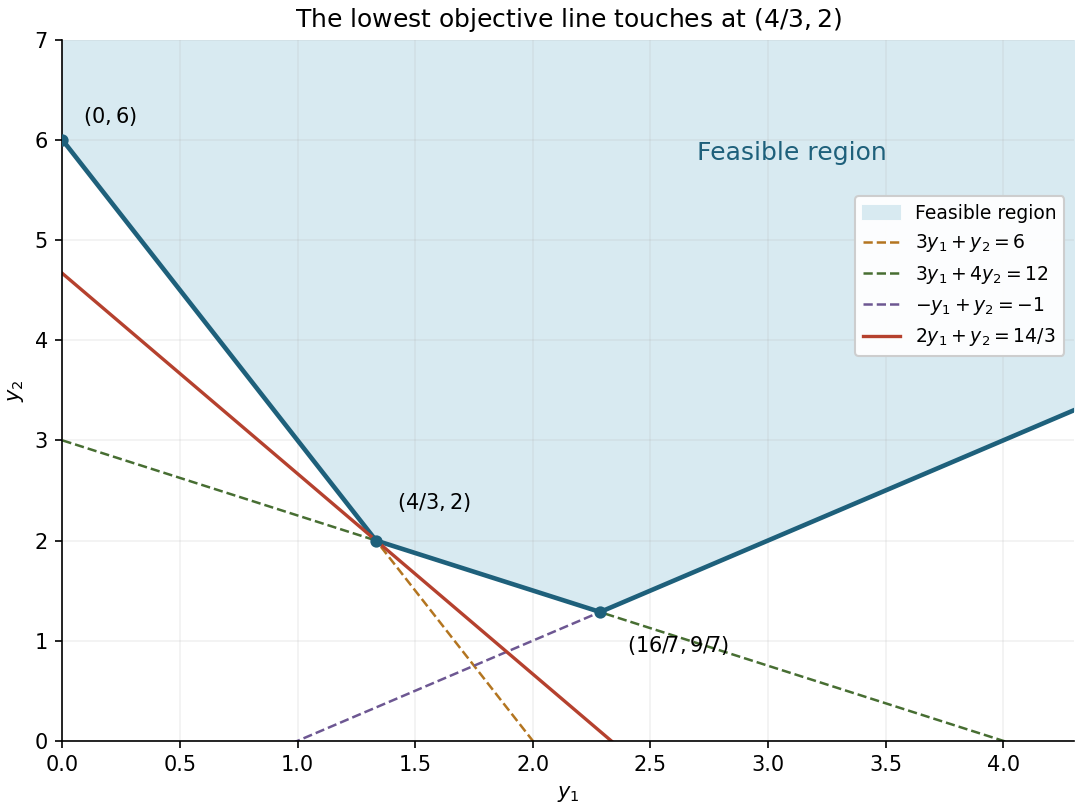
The boundary extreme points areAlong its three successive pieces, the objective function has respective slopes , and as increases. Thus it decreases to the middle extreme point and increases thereafter. For fixed , moving above the boundary only increases the objective function. HenceAs an algebraic check of the graphical answer, the active inequalities givewith equality at the stated extreme point.
Past exam of the mathematics course of the University of Oxford 2015 Prelims Mathematics IV 5 b ii Solution by Codex 0 2026-10-25
Codex 0 2026-10-25The inequality , together with , impliesAlso impliesThus both inequalities are strictly slack throughout the feasible region. They are redundant: the remaining inequalities imply them, even with strict inequality. By complementary slackness, any primal optimum must therefore have ; this is the principle that strictly slack dual constraints force zero primal variables.
Past exam of the mathematics course of the University of Oxford 2015 Prelims Mathematics IV 5 b i Solution by Codex 0 2026-10-25
Codex 0 2026-10-25There are two primal inequalities, so there are two nonnegative dual variables. The five primal variables yield five dual inequalities:Each coefficient column of the primal linear program becomes one row of this dual linear program.
Past exam of the mathematics course of the University of Oxford 2015 Prelims Mathematics IV 5 a iv Solution by Codex 0 2026-10-25
Codex 0 2026-10-25The complementary slackness conditions areTo see their role, decompose the duality gap asEvery summand is nonnegative for feasible solutions, so the gap is zero exactly when every displayed product vanishes. Zero gap implies optimality by weak duality. Conversely, strong duality states that primal and dual optima, when both are attained, have equal values, and hence satisfy these conditions.
Past exam of the mathematics course of the University of Oxford 2015 Prelims Mathematics IV 5 a iii Solution by Codex 0 2026-10-25
Codex 0 2026-10-25For every primal feasible solution , weak duality givesThus no primal feasible solution improves on . Similarly, for every dual feasible solution ,Therefore both candidates are optimal, with the same objective function value. Equality is a linear programming optimality certificate and does not require a separate existence argument.
Past exam of the mathematics course of the University of Oxford 2015 Prelims Mathematics IV 5 a ii Solution by Codex 0 2026-10-25
Codex 0 2026-10-25For feasible solutions , nonnegativity givesThe first inequality uses and ; the second uses and . This is weak duality.
Past exam of the mathematics course of the University of Oxford 2015 Prelims Mathematics IV 5 a i Solution by Codex 0 2026-10-25
Codex 0 2026-10-25If has rows and columns, attach a nonnegative dual variable to each of the upper-bound constraints. The dual linear program isHere is the transpose of , and all vector inequalities hold componentwise. Nonnegative dual variables preserve the direction of the original inequalities when taking weighted sums.
Past exam of the mathematics course of the University of Oxford 2015 Prelims Mathematics IV 3 b ii Solution by Codex 0 2026-10-25
Codex 0 2026-10-25If , putThe linearized equation becomes , soArbitrarily small initial perturbations can have and grow exponentially. Hence the strict unstable equilibrium condition isFor the particular wire, this occurs precisely at , ; the alternating radii satisfy the stable equilibrium condition.
Past exam of the mathematics course of the University of Oxford 2015 Prelims Mathematics IV 3 b i Solution by Codex 0 2026-10-25
Codex 0 2026-10-25If , defineThe linearized equation is , with bounded simple harmonic motionThus the strict stable equilibrium condition isThis is also a sufficient condition for local nonlinear Lyapunov stability. Indeed the equation for the bead on a uniformly rotating wire has the conserved quantityIts derivative is times the governing equation moved to one side, so it vanishes. At , the last two terms have zero first derivative and positive second derivative . Their strict local minimum traps sufficiently small perturbations. The motion is bounded rather than asymptotically returning to rest.
Pinned article: Introduction to the OurBigBook Project
Welcome to the OurBigBook Project! Our goal is to create the perfect publishing platform for STEM subjects, and get university-level students to write the best free STEM tutorials ever.
Everyone is welcome to create an account and play with the site: ourbigbook.com/go/register. We belive that students themselves can write amazing tutorials, but teachers are welcome too. You can write about anything you want, it doesn't have to be STEM or even educational. Silly test content is very welcome and you won't be penalized in any way. Just keep it legal!
Intro to OurBigBook
. Source. We have two killer features:
- topics: topics group articles by different users with the same title, e.g. here is the topic for the "Fundamental Theorem of Calculus" ourbigbook.com/go/topic/fundamental-theorem-of-calculusArticles of different users are sorted by upvote within each article page. This feature is a bit like:
- a Wikipedia where each user can have their own version of each article
- a Q&A website like Stack Overflow, where multiple people can give their views on a given topic, and the best ones are sorted by upvote. Except you don't need to wait for someone to ask first, and any topic goes, no matter how narrow or broad
This feature makes it possible for readers to find better explanations of any topic created by other writers. And it allows writers to create an explanation in a place that readers might actually find it.
Figure 1. Screenshot of the "Derivative" topic page. View it live at: ourbigbook.com/go/topic/derivativeVideo 2. OurBigBook Web topics demo. Source. - local editing: you can store all your personal knowledge base content locally in a plaintext markup format that can be edited locally and published either:This way you can be sure that even if OurBigBook.com were to go down one day (which we have no plans to do as it is quite cheap to host!), your content will still be perfectly readable as a static site.
- to OurBigBook.com to get awesome multi-user features like topics and likes
- as HTML files to a static website, which you can host yourself for free on many external providers like GitHub Pages, and remain in full control

Figure 2. You can publish local OurBigBook lightweight markup files to either OurBigBook.com or as a static website.
Figure 3. Visual Studio Code extension installation.
Figure 5. . You can also edit articles on the Web editor without installing anything locally. Video 3. Edit locally and publish demo. Source. This shows editing OurBigBook Markup and publishing it using the Visual Studio Code extension. 
- Infinitely deep tables of contents:



All our software is open source and hosted at: github.com/ourbigbook/ourbigbook
Further documentation can be found at: docs.ourbigbook.com
Feel free to reach our to us for any help or suggestions: docs.ourbigbook.com/#contact