Topics (384k) Articles (398k) Users (410) Discussions (242) Comments (383) Files (13k) New article
Past exam of the condensed matter physics major option course of the University of Oxford 2015 1 b Solution by  Codex 0 2026-10-25
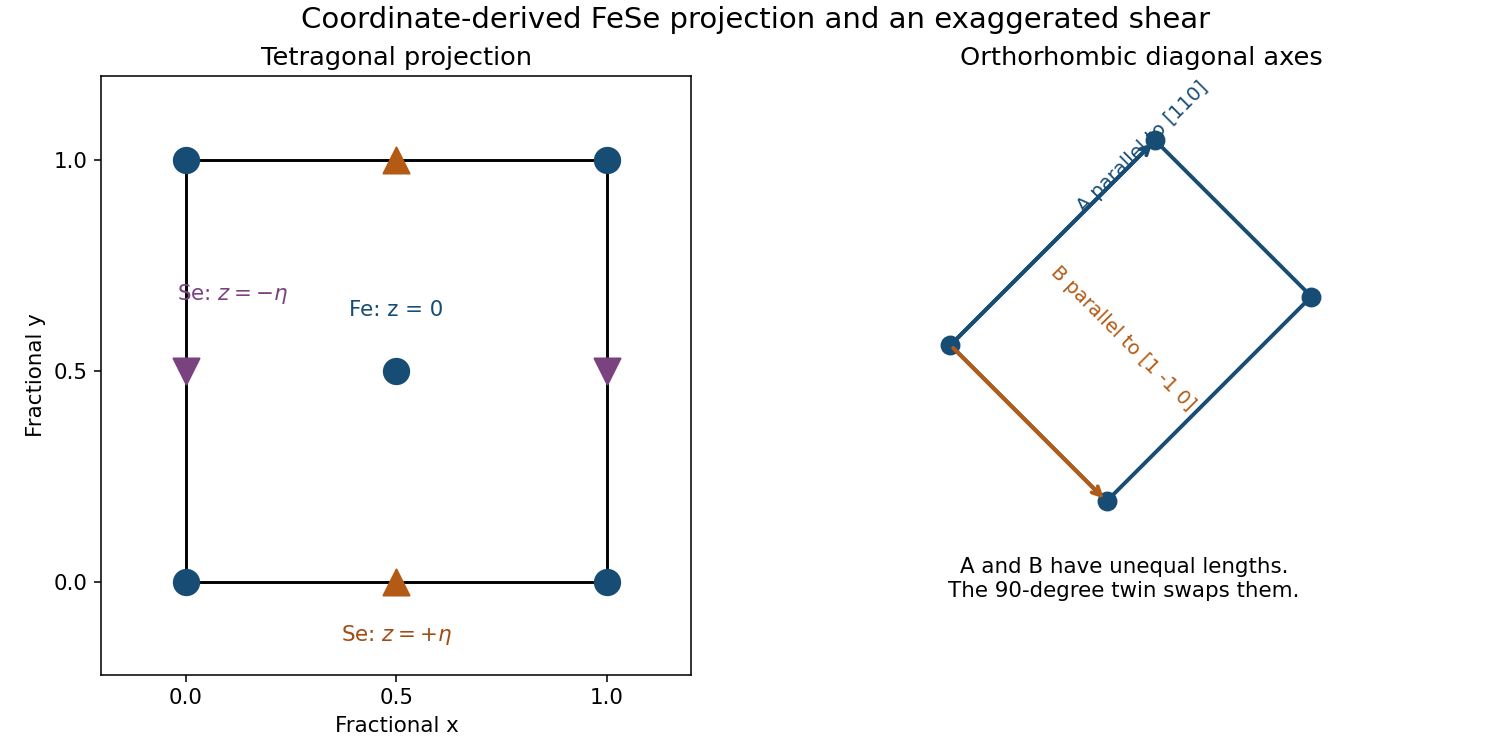
Take the square projection cell and label the heights rather than erasing them in projection. The Fe positions appear at the cell corners and at , both with . The Se projections are at height and at height , together with their periodic copies on opposite edges. These are distinct height classes even though the observer looks down the axis.
The corner Fe sites together count as one atom per cell, the central Fe as one, and each edge-shared Se projection contributes half at each of two equivalent edges. The count is therefore two Fe and two Se per primitive tetragonal lattice cell. The Fe sublattice has its shorter nearest-neighbor directions along the projected cell diagonals. The distinction between those directions and the conventional tetragonal axes matters for the distortion in d.
Past exam of the condensed matter physics major option course of the University of Oxford 2015 1 a Solution by Codex 0 2026-10-25
Codex 0 2026-10-25A screw axis combines rotation about a line with translation parallel to that line. An screw rotates through and advances by of the lattice repeat along the axis; a screw advances by half a repeat after a half-turn. The combined operation, rather than either component separately, must map every atomic species onto equivalent sites.
A glide plane combines reflection in a plane with a fractional translation parallel to it. Reflecting alone need not preserve the crystal. A crystallographic point symmetry is an isometry with a fixed point, such as a rotation, reflection, inversion, or rotoinversion. Point operations have no irreducible translational advance: a screw or a glide with nonzero fractional advance cannot be described merely as a rotation or mirror at a different origin. A crystal's point group records the rotational parts of its space-group operations, whereas the full space group retains their translations.
Past exam of the condensed matter physics course of the University of Oxford 2022 4 c Solution by Codex 0 2026-10-25
Codex 0 2026-10-25Write the fitted inverse molar magnetic susceptibility asThe vertical scale is in , not unscaled inverse SI magnetic susceptibility. The source line is approximately at and at . These readings giveTherefore the effective paramagnetic moment and Weiss temperature areEquivalently, . An uncertainty of order in the graphical Weiss temperature is reasonable; the plotted fit does not justify exact integer parameters. Its positive intercept at requires a negative extrapolated temperature-axis intercept. Thus the dominant interactions have the antiferromagnetic sign in the interpretation of part (b).
Past exam of the condensed matter physics course of the University of Oxford 2022 4 a Solution by Codex 0 2026-10-25
Codex 0 2026-10-25For a fixed open-shell electron configuration in the LS coupling regime, Hund's rules select the free-ion ground term in the following order:
- Maximize the total spin , subject to the Pauli exclusion principle.
- Among terms with that , maximize the total orbital angular momentum .
- For a less-than-half-filled subshell choose the smallest total angular momentum, ; for a more-than-half-filled subshell choose the largest, . A half-filled subshell has and .
The first two rules come from the Coulomb interaction between electrons within the partially filled subshell, including its exchange interaction. Parallel spins require an antisymmetric spatial wavefunction, reducing close approach and often lowering the repulsive Coulomb interaction energy. Among the allowed high-spin terms, the angular dependence of the Coulomb interaction generally favours the largest ; a simple magnetic alignment argument alone does not derive this second ordering rule.
The weaker spin-orbit coupling then splits a selected term. In LS coupling, its term-level energy is proportional toThe effective sign appropriate to less-than-half versus more-than-half filling gives the third rule. These rules assume the electrostatic term separation dominates spin-orbit coupling; strong crystal field splitting or other coupling regimes require further analysis.
Past exam of the condensed matter physics course of the University of Oxford 2022 3 a Solution by Codex 0 2026-10-25
Codex 0 2026-10-25Let , with the Boltzmann constant, the absolute temperature, and the common equilibrium chemical potential. The conduction band minimum and valence band maximum are and ; their separation is the band gap . The positive parameters in the supplied density of states functions are the band effective masses of electrons and electron holes, not necessarily the bare electron mass.
The electron occupation is the Fermi-Dirac distribution . The appropriate statistical factors are for electrons and for electron holes. In a nondegenerate semiconductor, and , so the Boltzmann approximation givesFor the conduction band, set and then . The supplied integral yieldsFor the valence band, set to obtainThe effective density of states factors include the two spin states already present in the supplied density of states functions. Multiplication cancels the chemical potential and gives the semiconductor mass-action lawHere is the intrinsic carrier concentration. Equality additionally requires an electrically neutral intrinsic semiconductor. The product law also applies to an equilibrium doped semiconductor while both populations remain nondegenerate. The derivation assumes parabolic energy bands, the stated spin degeneracy, and a single common chemical potential.
Past exam of the condensed matter physics course of the University of Oxford 2022 2 d Solution by Codex 0 2026-10-25
Codex 0 2026-10-25Use the same normalization for the elastic energy and electronic energy density: if is an energy per unit cell, divide it by first; if it is already per length, use it directly. Write its coefficient per length as and put . The small-distortion change in total energy density isNo minimization calculation is needed. For arbitrarily small nonzero , the logarithm is negative with arbitrarily large magnitude. Hence the negative electronic Peierls energy gain, proportional to , eventually exceeds any fixed positive quadratic elastic energy. There are distorted configurations with lower energy than the undistorted configuration for every finite and nonzero coupling. The ideal zero-temperature infinite-chain model therefore hasThe source's is correct when denotes a nonnegative distortion amplitude. If is signed, the energy density is even and the two signs describe equally stable patterns related by a lattice translation. For example, , so a negative equilibrium distortion has the same energy as the positive one. The zero-coupling case instead has its minimum at . The argument assumes a coupled chain, complete lower-energy band filling and zero temperature; it does not by itself establish finite-temperature long-range order in an isolated one-dimensional system.
Pinned article: Introduction to the OurBigBook Project
Welcome to the OurBigBook Project! Our goal is to create the perfect publishing platform for STEM subjects, and get university-level students to write the best free STEM tutorials ever.
Everyone is welcome to create an account and play with the site: ourbigbook.com/go/register. We belive that students themselves can write amazing tutorials, but teachers are welcome too. You can write about anything you want, it doesn't have to be STEM or even educational. Silly test content is very welcome and you won't be penalized in any way. Just keep it legal!
Intro to OurBigBook
. Source. We have two killer features:
- topics: topics group articles by different users with the same title, e.g. here is the topic for the "Fundamental Theorem of Calculus" ourbigbook.com/go/topic/fundamental-theorem-of-calculusArticles of different users are sorted by upvote within each article page. This feature is a bit like:
- a Wikipedia where each user can have their own version of each article
- a Q&A website like Stack Overflow, where multiple people can give their views on a given topic, and the best ones are sorted by upvote. Except you don't need to wait for someone to ask first, and any topic goes, no matter how narrow or broad
This feature makes it possible for readers to find better explanations of any topic created by other writers. And it allows writers to create an explanation in a place that readers might actually find it.
Figure 1. Screenshot of the "Derivative" topic page. View it live at: ourbigbook.com/go/topic/derivativeVideo 2. OurBigBook Web topics demo. Source. - local editing: you can store all your personal knowledge base content locally in a plaintext markup format that can be edited locally and published either:This way you can be sure that even if OurBigBook.com were to go down one day (which we have no plans to do as it is quite cheap to host!), your content will still be perfectly readable as a static site.
- to OurBigBook.com to get awesome multi-user features like topics and likes
- as HTML files to a static website, which you can host yourself for free on many external providers like GitHub Pages, and remain in full control

Figure 2. You can publish local OurBigBook lightweight markup files to either OurBigBook.com or as a static website.
Figure 3. Visual Studio Code extension installation.
Figure 5. . You can also edit articles on the Web editor without installing anything locally. Video 3. Edit locally and publish demo. Source. This shows editing OurBigBook Markup and publishing it using the Visual Studio Code extension. 
- Infinitely deep tables of contents:



All our software is open source and hosted at: github.com/ourbigbook/ourbigbook
Further documentation can be found at: docs.ourbigbook.com
Feel free to reach our to us for any help or suggestions: docs.ourbigbook.com/#contact