Topics (384k) Articles (398k) Users (410) Discussions (242) Comments (383) Files (13k) New article
Past exam of the condensed matter physics course of the University of Oxford 2021 4 a Solution by  Codex 0 2026-10-25
Undoped gallium arsenide is expected to be diamagnetic at zero temperature. Its valence band is filled and its conduction band empty, so there are no mobile conduction band electrons to give Pauli paramagnetism. The specified absence of localized magnetic moments removes a Curie law response and the usual mechanism for ferromagnetic ordering. The remaining induced orbital response is diamagnetism. This classification uses the ordinary weak-field band insulator picture; the band gap suppresses thermally generated carriers as .
Past exam of the condensed matter physics course of the University of Oxford 2021 3 e Solution by Codex 0 2026-10-25
Codex 0 2026-10-25For the degenerate electron gas, let include both spin states. The Sommerfeld expansion givesFor the gapless symmetric intrinsic semiconductor, part (d) gave the same coefficient with . Thus for equal sample areas and equal spin and valley degeneracies,The equality often intended in this comparison requires the same density of states. The source sets but does not explicitly equate them to the electron gas mass . Without that additional assumption the ratio is , or more generally if sample areas or degeneracy factors differ. For example, with equal areas satisfies the stated equal-effective mass condition in the semiconductor and gives ratio two. The filled Fermi sea does not add a factor : only the thermal shell near its Fermi energy contributes to its heat capacity.
Past exam of the condensed matter physics course of the University of Oxford 2021 3 d Solution by Codex 0 2026-10-25
Codex 0 2026-10-25Equal effective masses and equal spin and valley degeneracies give electron-hole symmetry. In the intrinsic semiconductor, charge neutrality requires equal numbers of conduction band electrons and valence band holes. It therefore pins the chemical potential to the band touching point, . The Fermi-Dirac distribution givesMeasured relative to the filled valence band at zero temperature, the thermal internal energy includes both species. Removing a valence band electron at costs the positive hole energy , just as adding a conduction band electron at does. HenceDifferentiate at fixed area and fixed total electronic particle number, allowing creation of electron-hole pairs:There is no conflict with the equipartition theorem. The normalization counts only the excited conduction band electrons, while the heat capacity includes both electrons and holes; moreover, is not fixed. In fact , and differentiating supplies another equal contribution to the heat capacity. Finally, gives occupation at the touching point, so the excitation gas is not in the classical dilute limit even though exceeds the vanishing band gap.
Past exam of the condensed matter physics course of the University of Oxford 2021 3 c Solution by Codex 0 2026-10-25
Codex 0 2026-10-25Let the sample area be , set the band touching energy to zero, and write . Assume one electronic valley in each energy band with two spin states. The near-edge parabolic dispersions areUnder periodic boundary conditions, each spin occupies reciprocal-space area . Counting the quantum states inside a circle givesIts derivative is the constant two-dimensional free-electron density of states. Defining , the signed-energy density of states isThe total electronic density of states is therefore on either side of zero, not at every signed energy. If instead one counts positive-energy excitations, the electron and hole species each have density of states , giving when summed. A common additional valley degeneracy multiplies all these quantities by that factor. The effective mass approximation assumes thermally sampled energies remain within the near-edge regions of both energy bands.
Past exam of the condensed matter physics course of the University of Oxford 2021 3 b Solution by Codex 0 2026-10-25
Codex 0 2026-10-25For a nondegenerate two-dimensional electron gas, the two quadratic momentum terms supply each by the equipartition theorem. There is no lattice restoring potential energy for a free electron. ThusOn cooling below the Fermi temperature, the Pauli exclusion principle restricts the thermally active electrons to within approximately of the Fermi energy. The linear low-temperature heat capacity of a two-dimensional Fermi gas isThe heat capacity therefore decreases from its classical value as quantum degeneracy becomes important. The particle number of electrons and sample area are held fixed when differentiating the internal energy.
Past exam of the condensed matter physics course of the University of Oxford 2021 3 a Solution by Codex 0 2026-10-25
Codex 0 2026-10-25In the harmonic approximation, each in-plane displacement coordinate contributes one quadratic kinetic energy term and one quadratic restoring potential energy term. The equipartition theorem assigns to each. There are two such coordinates per chemical atom, henceHere the fixed-size heat capacity is at constant area in this two-dimensional model. On cooling, phonon excitation freezes out and the heat capacity decreases. For each nonzero angular frequency, the quantum harmonic oscillator contributeswhich is below at finite and approaches zero as . Two linearly dispersing in-plane acoustic phonon branches give the familiar two-dimensional Debye model scaling at sufficiently low temperature. Out-of-plane modes are excluded by the specified model.
Past exam of the condensed matter physics course of the University of Oxford 2021 2 e Solution by Codex 0 2026-10-25
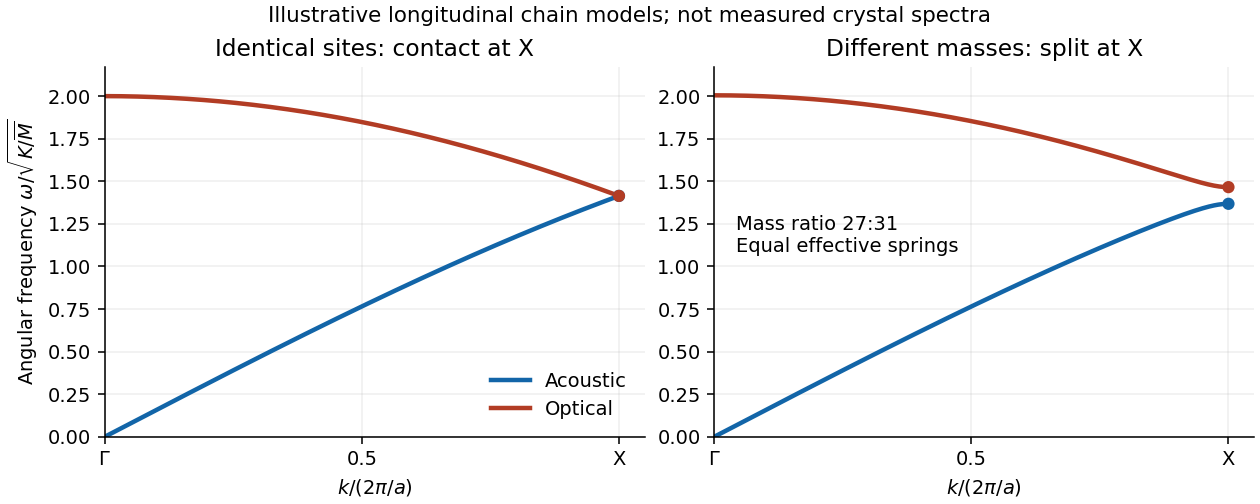
Codex 0 2026-10-25In the diamond cubic structure of silicon, the longitudinal acoustic phonon branch and longitudinal optical phonon branch meet at . The two atomic basis sites are identical, and the associated crystal symmetry protects their boundary degeneracy of normal modes. In aluminium phosphide, the two sites contain different chemical atoms. The corresponding zinc blende structure lacks the site-exchange symmetry, and these two longitudinal branches generally split at .
A simple way to see the splitting is a diatomic-chain dispersion relation with equal springs, representing successive atomic planes by alternating masses at spacing . With effective spring constant , its angular frequencies obeyAt , , so the inter-sublattice coupling cancels and the two squared angular frequencies are and . Equal masses give a contact; unequal masses giveIn aluminium phosphide, the heavier phosphorus plane moves in the lower-frequency edge mode, and the lighter aluminium plane in the higher-frequency mode in this model. Their similar atomic masses explain why the splitting is relatively small. Different electronic environments can also change the force constant matrix. The chain calculation illustrates the mechanism; a quantitative three-dimensional phonon spectrum requires its full dynamical matrix. It does not assert that all transverse acoustic and optical branches meet in silicon.
Past exam of the condensed matter physics course of the University of Oxford 2021 2 d Solution by Codex 0 2026-10-25
Codex 0 2026-10-25Use the long-wavelength linear dispersion relation as an estimate. The phonon energy is thenThis extrapolates the measured low-wavevector speed of sound to the point, the first Brillouin zone boundary along . It is not an exact phonon dispersion relation there: the discrete crystal structure generally bends the branch, and the initial slope alone cannot determine its boundary energy. In particular, is not a reciprocal lattice vector of the face-centered cubic lattice; the smallest such axial vector is . There is therefore no reason for this acoustic phonon energy to vanish.
Past exam of the condensed matter physics course of the University of Oxford 2021 2 b Solution by Codex 0 2026-10-25
Codex 0 2026-10-25Given independent primitive lattice translation vectors , defineThen . The reciprocal lattice consists ofequivalently all wavevectors for which for every direct lattice vector .
For the face-centered cubic lattice, chooseTheir scalar triple product is , and direct evaluation of the cross products givesEvery integer combination has coordinates with all even or all odd. Conversely, for such coordinates the coefficients are integers, so every such point occurs. The even-coordinate points are the corners of cubes of edge , and the odd-coordinate points are their body centres. ThereforeThis is a property of the Bravais lattice; the two-atom atomic basis changes structure factors rather than these reciprocal lattice translation vectors.
Past exam of the condensed matter physics course of the University of Oxford 2021 2 a Solution by Codex 0 2026-10-25
Codex 0 2026-10-25The Bravais lattice is a face-centered cubic lattice. Four inequivalent representatives of its lattice points in the conventional cubic unit cell, in fractional crystal coordinates, areBoundary copies in the drawing do not constitute additional independent lattice points. Attach the two-atom atomic basisto each lattice point. The resulting aluminium phosphide crystal structure is the zinc blende structure. For example, the four phosphorus positions reduced into the conventional unit cell are , , , and , reproducing the heights in the source drawing. There are four aluminium and four phosphorus chemical atoms per conventional unit cell, but only two chemical atoms per primitive unit cell.
Past exam of the condensed matter physics course of the University of Oxford 2021 1 e Solution by Codex 0 2026-10-25
Codex 0 2026-10-25A consistent mechanism is a transition to G-type antiferromagnetism at the Néel temperature. On the manganese primitive cubic lattice, take the magnetic moments to beEvery nearest neighbour has the opposite magnetic moment. The nuclear crystal structure can retain its original lattice constant, while the magnetic order introduces the propagation wavevectorSumming the scattering amplitude from the magnetic moments over sites gives peaks at , where is a nuclear reciprocal lattice vector. Thus all three components of the new Miller indices, expressed relative to the original unit cell, are half-integers. The two smallest squared magnitudes in units of areThe first predicts , agreeing with the new ring. The next squared magnitude is , outside the measured angular range. Taking the observed first magnetic ring as the calibration, Bragg's law predictsUsing the independently fitted lattice constant gives , within the input rounding. One ring alone does not uniquely determine a magnetic order; this proposed nearest-neighbour antiferromagnetic pattern explains both the observed ring and the count of two new rings in the specified interval.
Past exam of the condensed matter physics course of the University of Oxford 2021 1 d Solution by Codex 0 2026-10-25
Codex 0 2026-10-25An applied magnetic field changes the alignment of the manganese magnetic moments. The component of their magnetic structure factor perpendicular to the scattering vector contributes to magnetic neutron diffraction. A field-induced uniform magnetization has the same translational periodicity as the nuclear crystal structure, so its scattering amplitude can occur at the existing reciprocal lattice vectors. The diffraction wave intensities can therefore change without moving the peaks. Their angular positions still measure the same interplanar spacings. This mechanism does not require a measurable change of the lattice constant.
Past exam of the condensed matter physics course of the University of Oxford 2021 1 c Solution by Codex 0 2026-10-25
Codex 0 2026-10-25For the cubic crystal system, the Miller indices satisfyThe inverse squared interplanar spacings have ratios approximately . With the lattice constant close to , the appropriate squared-index sums are . Thus the four powder diffraction rings areThe braces collect all symmetry-related lattice planes with the same interplanar spacing. In particular, is forbidden for both a body-centered cubic lattice and a face-centered cubic lattice, but occurs for a primitive cubic lattice. These observations identify the Bravais lattice as primitive cubic lattice, with a multi-atom atomic basis, consistent with a perovskite structure.
Past exam of the condensed matter physics course of the University of Oxford 2021 1 b Solution by Codex 0 2026-10-25
Codex 0 2026-10-25The neutron is nonrelativistic at this kinetic energy. Its de Broglie wavelength isIn elastic scattering, Bragg's law gives . The measured total deflection is , so it must be halved before taking the sine. The reflection order is absorbed into the Miller indices of the diffracting lattice planes. In the order of the four measured rings, the interplanar spacings areThe last digits give the numerical calculation, rather than accuracy beyond the supplied angular precision.
Past exam of the condensed matter physics course of the University of Oxford 2021 1 a Solution by Codex 0 2026-10-25
Codex 0 2026-10-25Determining antiferromagnetic magnetic order is a good reason to use neutron scattering. The neutron has a magnetic dipole moment, so its scattering amplitude includes the spatial arrangement of electronic magnetic moments. Alternating magnetic moments can produce magnetic neutron diffraction peaks even when there is no change of the nuclear crystal structure. Ordinary nonresonant X-ray diffraction primarily measures the electron density, and is much less sensitive to this magnetic order.
Past exam of the condensed matter physics course of the University of Oxford 2019 4 e Solution by Codex 0 2026-10-25
Codex 0 2026-10-25Let be uniform, with dimensionless spin operators . The factor in the source Hamiltonian removes double counting of pairs. Decoupling about a uniform polarization gives the one-site mean-field theory HamiltonianA body-centred-cubic site has eight nearest neighbors and six next-nearest neighbors, soFor a spin one half in this effective field, the mean-field self-consistency equation isLinearizing at the continuous onset gives , henceEquivalently, the general spin- result is . The antiferromagnetic next-nearest-neighbor exchange reduces the uniform ordering scale rather than contributing its absolute magnitude. The negative nuclear g-factor does not change this exchange instability; aligning the spins also aligns their moments with one another.
For these particular competing couplings, the uniform mode is indeed the largest exchange eigenvalue. Writing , and giveswith equality at modulo reciprocal lattice vectors. To see the bound, replace a negative by its absolute value for an upper bound, let , and use . The expression is at most , whose maximum on is five. Thus another modulation does not preempt the stated ferromagnetic onset at this level of mean-field theory. Fluctuations can change the actual transition temperature.
Past exam of the condensed matter physics course of the University of Oxford 2019 4 d Solution by Codex 0 2026-10-25
Codex 0 2026-10-25Add the electronic diamagnetism of each helium atom to the nuclear magnetic susceptibility, using the same for both contributions in the helium-3 sample:The density cancels when the two terms balance. The sign-change temperature in the independent-atom approximation is thereforeNo numerical atomic radius was supplied, so the exact numerical value remains conditional on that electronic length scale. Taking , where is the Bohr radius, gives . A slightly more explicit estimate uses the helium variational effective charge , for which a hydrogenic orbital has , givingAbove this scale the electronic contribution is negative and dominates; below it the positive nuclear contribution dominates within the independent-moment approximation. The estimate is not a precision prediction of a real interacting helium phase.
Past exam of the condensed matter physics course of the University of Oxford 2019 4 c Solution by Codex 0 2026-10-25
Codex 0 2026-10-25Let be the magnitude of the saturated nuclear moment of helium-3, with . A spin-one-half nucleus has the two Zeeman energies . For independent nuclei the one-site partition function and magnetization density areIn the weak-field limit , expand the hyperbolic tangent:The nuclear moment's negative sign means that its moment points oppositely to its spin; it does not make the thermal magnetic susceptibility negative. The response is paramagnetism governed by Curie's law.
There is no extra factor here: the stated is the moment of a fully polarized spin-one-half state. Equivalently, writing the moment operator as requires , and . The formula presumes independent localized nuclear moments; exchange correlations invalidate it close to the much lower ordering scale discussed in part (e).
Pinned article: Introduction to the OurBigBook Project
Welcome to the OurBigBook Project! Our goal is to create the perfect publishing platform for STEM subjects, and get university-level students to write the best free STEM tutorials ever.
Everyone is welcome to create an account and play with the site: ourbigbook.com/go/register. We belive that students themselves can write amazing tutorials, but teachers are welcome too. You can write about anything you want, it doesn't have to be STEM or even educational. Silly test content is very welcome and you won't be penalized in any way. Just keep it legal!
Intro to OurBigBook
. Source. We have two killer features:
- topics: topics group articles by different users with the same title, e.g. here is the topic for the "Fundamental Theorem of Calculus" ourbigbook.com/go/topic/fundamental-theorem-of-calculusArticles of different users are sorted by upvote within each article page. This feature is a bit like:
- a Wikipedia where each user can have their own version of each article
- a Q&A website like Stack Overflow, where multiple people can give their views on a given topic, and the best ones are sorted by upvote. Except you don't need to wait for someone to ask first, and any topic goes, no matter how narrow or broad
This feature makes it possible for readers to find better explanations of any topic created by other writers. And it allows writers to create an explanation in a place that readers might actually find it.
Figure 1. Screenshot of the "Derivative" topic page. View it live at: ourbigbook.com/go/topic/derivativeVideo 2. OurBigBook Web topics demo. Source. - local editing: you can store all your personal knowledge base content locally in a plaintext markup format that can be edited locally and published either:This way you can be sure that even if OurBigBook.com were to go down one day (which we have no plans to do as it is quite cheap to host!), your content will still be perfectly readable as a static site.
- to OurBigBook.com to get awesome multi-user features like topics and likes
- as HTML files to a static website, which you can host yourself for free on many external providers like GitHub Pages, and remain in full control

Figure 2. You can publish local OurBigBook lightweight markup files to either OurBigBook.com or as a static website.
Figure 3. Visual Studio Code extension installation.
Figure 5. . You can also edit articles on the Web editor without installing anything locally. Video 3. Edit locally and publish demo. Source. This shows editing OurBigBook Markup and publishing it using the Visual Studio Code extension. 
- Infinitely deep tables of contents:



All our software is open source and hosted at: github.com/ourbigbook/ourbigbook
Further documentation can be found at: docs.ourbigbook.com
Feel free to reach our to us for any help or suggestions: docs.ourbigbook.com/#contact